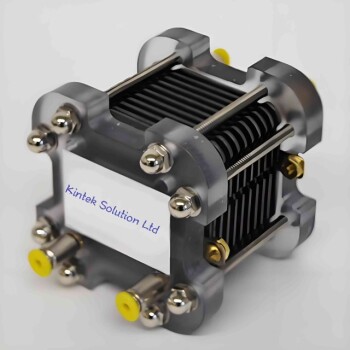
The critical function of specialized pressure molds and pressurized electrolytic cells is to act as a mechanical stabilizer that applies constant, continuous stack pressure to all-solid-state batteries (ASSBs). While liquid electrolytes can flow to fill gaps, solid-state components are rigid; these devices are required to counteract the significant volume fluctuations of active materials during charge and discharge cycles, preventing physical failure.
The central role of these devices is to maintain the physical integrity of the solid-solid interface. By applying continuous external force, they compensate for the expansion and contraction of electrode materials, preventing delamination and inhibiting the growth of lithium dendrites that would otherwise destroy the battery.
The Mechanics of Solid-State Instability
Counteracting Volume Fluctuations
Unlike conventional batteries, solid-state batteries "breathe" significantly during operation. Active materials, particularly lithium metal anodes and high-capacity cathodes (like sulfur or high-nickel NCM-811), undergo substantial volume expansion and contraction during lithium stripping and plating.
Without an external clamp, this movement is unchecked. The specialized mold provides a counter-force, compressing the stack to ensure the battery retains its structural shape despite these internal shifts.
Preventing Interface Separation
The interface between a solid electrode and a solid electrolyte is brittle and prone to separation. As the electrode material shrinks (e.g., during delithiation), it pulls away from the electrolyte.
This creates physical gaps, or voids. The pressurized cell ensures that even when materials contract, the contact remains tight, preserving the ion transport channels necessary for the battery to function.
Operational Benefits of Pressurized Cells
Inhibiting Lithium Dendrite Growth
One of the most dangerous failure modes in ASSBs is the formation of dendrites—needle-like lithium structures that pierce the electrolyte and cause short circuits.
High external pressure (often ranging from 1.5 MPa to over 10 MPa) physically suppresses this growth. By densifying the lithium metal layer, the mold forces a smoother deposition of lithium, extending the battery's safety and cycle life.
Reducing Interfacial Impedance
Any gap between layers results in massive resistance (impedance) to ion flow. If the layers are not pressed firmly together, the battery's internal resistance spikes, leading to capacity decay.
Pressure molds ensure maximum contact area between particles. This minimizes interfacial resistance, allowing the battery to charge and discharge efficiently without losing energy to heat or poor connectivity.
Manufacturing and Assembly Functions
Consolidating the Monolithic Structure
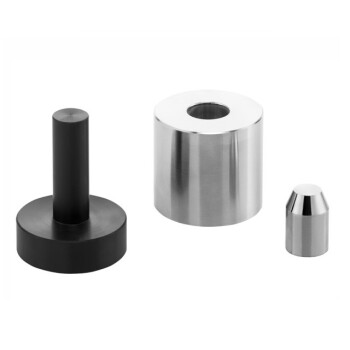
During the initial assembly, pressure is not just about maintenance; it is about construction. Molds are used to apply high pressure (sometimes 200–450 MPa) to compress powders into solid pellets.
This process consolidates the cathode, electrolyte, and anode into a unified, monolithic structure.
Ensuring Lamination Precision
Specialized dies transfer uniaxial pressure to laminate multi-layer structures. These tools must offer extreme dimensional stability to ensure pressure is distributed uniformly across the entire surface area.
Uneven pressure during this stage can lead to "hot spots" or gaps, which will become failure points once the battery enters operation.
Understanding the Trade-offs
The Challenge of Uniformity
While pressure is vital, non-uniform pressure can be detrimental. If the mold applies force unevenly, it can crack the electrolyte pellets or crush the active material particles, permanently damaging the cell.
Material Compatibility
The molds themselves must be chemically inert and electrically insulating. Materials like PEEK (Polyether ether ketone) are often used because they can withstand high mechanical loads without reacting with the lithium or interfering with Electrochemical Impedance Spectroscopy (EIS) readings.
Making the Right Choice for Your Goal
To select the correct pressure device, you must identify the specific stage of development you are addressing.
- If your primary focus is long-term cycle testing: Prioritize devices with "active" pressure control (spring-loaded or pneumatic) that can dynamically maintain a set pressure (e.g., 7–17 MPa) as the battery expands and contracts.
- If your primary focus is initial material synthesis: Focus on molds capable of withstanding ultra-high pressures (200+ MPa) to ensure dense powder compaction and proper pellet formation.
- If your primary focus is safety and failure analysis: Ensure the mold design allows for the suppression of dendrites but includes monitoring capabilities to detect internal short circuits immediately.
Ultimately, the pressurized cell is not just a container; it is an active mechanical component that substitutes for the lack of fluidity in solid-state chemistries.
Summary Table:
| Critical Function | Mechanical Mechanism | Operational Benefit |
|---|---|---|
| Interface Stabilization | Applies constant uniaxial pressure | Prevents delamination and voids between solid layers |
| Volume Compensation | Counteracts expansion/contraction | Maintains structural integrity during charge/discharge cycles |
| Dendrite Suppression | Densifies the lithium metal layer | Physically inhibits needle-like growth to prevent short circuits |
| Impedance Reduction | Maximizes particle-to-particle contact | Lowers interfacial resistance for efficient ion transport |
| Structural Consolidation | High-pressure powder compaction | Creates dense, monolithic pellets for initial cell assembly |
Optimize Your Battery Research with KINTEK Precision
Achieving the perfect solid-solid interface is critical for the success of all-solid-state batteries. KINTEK specializes in high-performance laboratory equipment designed to meet the rigorous demands of advanced energy research.
Our extensive portfolio includes:
- Advanced Battery Tools: Specialized pressurized electrolytic cells, pressure molds, and battery research consumables.
- Thermal Processing: High-temperature furnaces (muffle, tube, vacuum, and CVD systems).
- Material Preparation: Precision hydraulic presses (pellet, hot, isostatic), crushing, and milling systems.
- Lab Essentials: PTFE products, ceramics, crucibles, and high-pressure reactors.
Whether you are suppressing dendrites or consolidating monolithic structures, KINTEK provides the reliability and precision your lab deserves.
Contact KINTEK today to find the right solution for your application!
Related Products
- Customizable PEM Electrolysis Cells for Diverse Research Applications
- Customizable Swagelok Type Test Cells for Advanced Battery Research Electrochemical Analysis
- Electrolytic Electrochemical Cell for Coating Evaluation
- PTFE Electrolytic Cell Electrochemical Cell Corrosion-Resistant Sealed and Non-Sealed
- Quartz Electrolytic Electrochemical Cell for Electrochemical Experiments
People Also Ask
- What are the risks of improper voltage control in an electrolysis cell? Avoid Costly Damage and Inefficiency
- What are the opening configurations for the non-sealed and sealed versions of the electrolysis cell? Optimize Your Electrochemical Setup
- What is an electrolysis cell? A Guide to Driving Chemical Reactions with Electricity
- What parameters must be strictly controlled during the electrolysis process? Ensure Precision and Efficiency
- What are the precautions for heating or sterilizing an electrolysis cell? Avoid Damaging Sensitive Components