Knowledge What is the difference between 121 and 134 autoclave? Choose the Right Sterilization Cycle
Author avatar

Tech Team · Kintek Solution

Updated 6 days ago

What is the difference between 121 and 134 autoclave? Choose the Right Sterilization Cycle


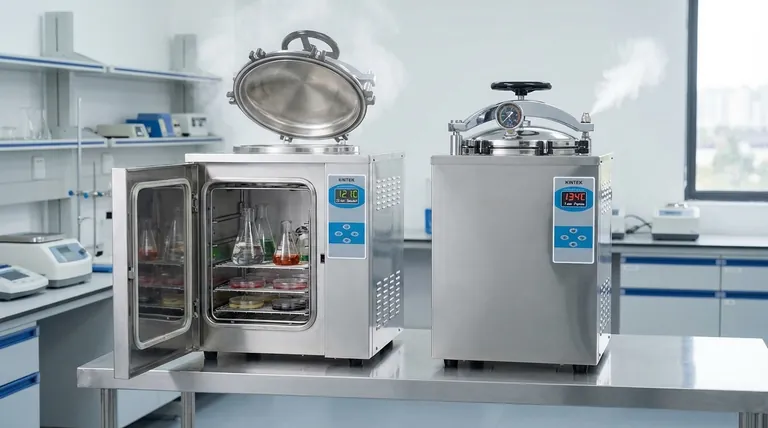
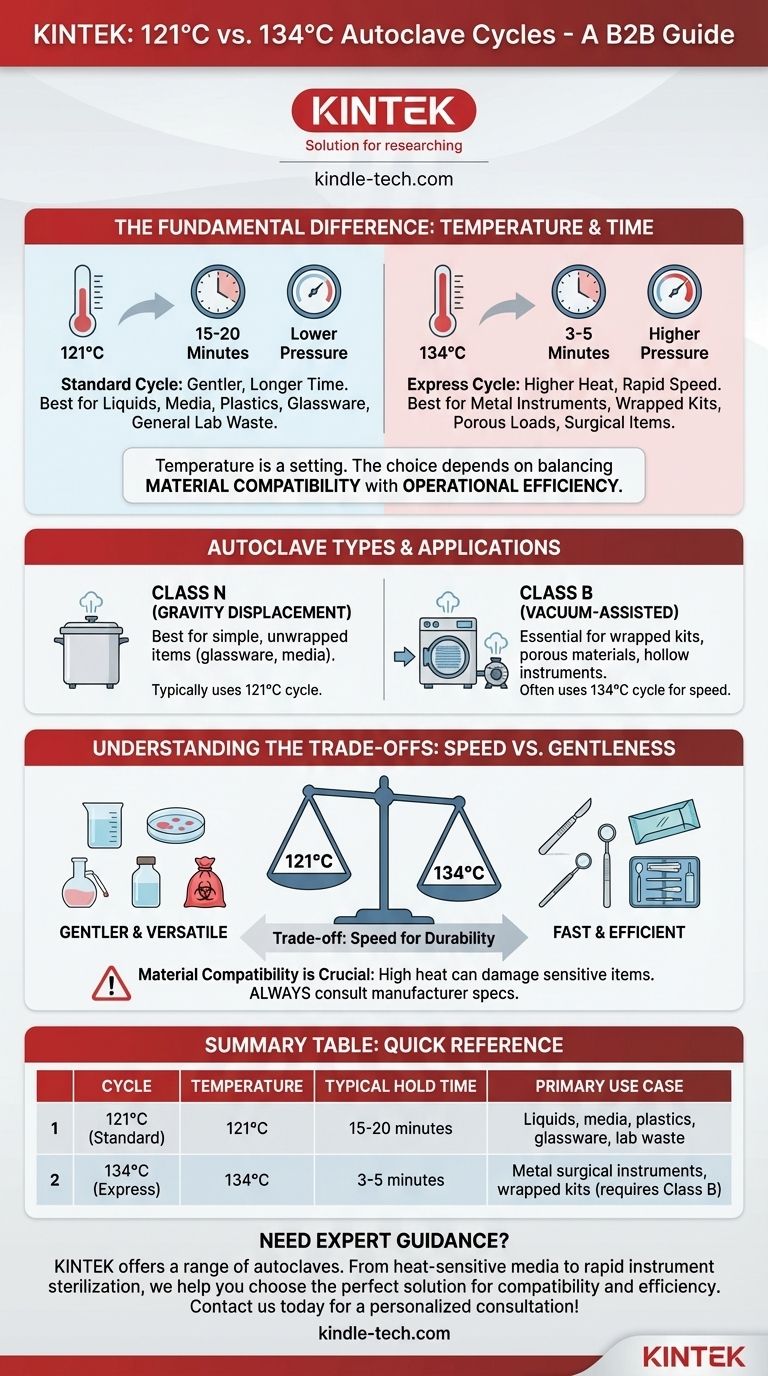
The fundamental difference is that "121" and "134" refer to the two standard sterilization temperatures used in autoclaves, measured in degrees Celsius. A 121°C cycle is the universal standard for general-purpose sterilization, requiring a longer time to be effective. In contrast, a 134°C cycle is a higher-temperature, higher-pressure process used to sterilize heat-resistant materials like metal instruments much more quickly.

The choice between a 121°C and 134°C cycle is not about the autoclave itself, but about the material you are sterilizing and the speed you require. The temperature is a setting, and the right choice depends entirely on balancing material compatibility with operational efficiency.
What is the difference between 121 and 134 autoclave? Choose the Right Sterilization Cycle

The Core Difference: Temperature, Time, and Pressure

The effectiveness of steam sterilization depends on a precise relationship between temperature, pressure, and time. Changing one variable requires adjusting the others to achieve the complete destruction of all microorganisms.

The 121°C Standard Cycle

This is the workhorse of sterilization, particularly in research and laboratory settings. It operates at a lower temperature and requires a longer holding time to ensure sterility.

It is the ideal choice for sterilizing liquids, media, plastics, glassware, and general lab waste. The typical holding time at 121°C is 15 to 20 minutes, once the target temperature is reached.

The 134°C Express Cycle

This cycle is primarily used in medical and dental fields where speed and throughput are critical. The significantly higher temperature drastically reduces the required sterilization time.

This is best for robust, heat-resistant items like metal surgical instruments. The typical holding time at 134°C is only 3 to 5 minutes, making it highly efficient for clinical use.

How Temperature Connects to Autoclave Type

While most modern autoclaves can run cycles at both temperatures, the type of autoclave often reflects its primary intended use and the cycles it is optimized for.

Simple Gravity Displacement Autoclaves (Class N)

These are the most basic autoclaves, often found in labs. They introduce steam at the top, which displaces the heavier, cooler air downwards and out through a vent.

Because they don't have a vacuum pump to actively remove air, they are best suited for simple, unwrapped items like glassware or media. The 121°C cycle is most common for these applications.

Vacuum-Assisted Autoclaves (Class B)

These more advanced machines use a vacuum pump to remove air from the chamber before steam is injected. This process, called pre-vacuum, is critical for ensuring steam penetrates complex loads.

Class B autoclaves are essential for sterilizing porous materials (like surgical gowns), hollow instruments, and wrapped kits. The rapid 134°C cycle is frequently used with these machines to quickly prepare instruments for use.

Understanding the Trade-offs

Choosing the wrong temperature can lead to ineffective sterilization or damaged equipment. The decision requires careful consideration of the items being processed.

Material Compatibility is Crucial

The high heat of a 134°C cycle can melt certain plastics, damage sensitive electronics, or degrade rubber seals that would be perfectly safe at 121°C.

Always consult the manufacturer's specifications for any instrument or material before autoclaving it at a higher temperature.

Speed vs. Gentleness

The primary trade-off is clear: speed for durability. The 134°C cycle offers immense speed, which is critical in a busy clinic or hospital.

The 121°C cycle is gentler and offers broader material compatibility, making it the safer, more versatile choice for a mixed-use research environment.

The Goal is Always Sterility

Both temperatures achieve complete sterilization when used with the correct holding time and for the appropriate materials. One is not "better" than the other; they are simply tools for different jobs.

Making the Right Choice for Your Goal

To select the correct cycle, start by identifying your primary objective.

  • If your primary focus is sterilizing laboratory media, liquids, or glassware: Use the standard 121°C cycle to ensure compatibility and effectiveness.
  • If your primary focus is rapidly sterilizing unwrapped, solid metal instruments: Use the 134°C cycle to maximize speed and throughput.
  • If your primary focus is sterilizing wrapped instrument kits or porous loads: Use a 134°C cycle within a Class B (pre-vacuum) autoclave to ensure complete steam penetration.
  • If your primary focus is sterilizing heat-sensitive plastics or complex devices: Default to the gentler 121°C cycle after verifying the item's heat tolerance with the manufacturer.

Ultimately, selecting the correct sterilization temperature is a critical decision based on your material's tolerance and your operational needs.

Summary Table:

Cycle Temperature Typical Hold Time Primary Use Case
121°C (Standard) 121°C 15-20 minutes Liquids, media, plastics, glassware, lab waste
134°C (Express) 134°C 3-5 minutes Metal surgical instruments, wrapped kits (requires Class B autoclave)

Need expert guidance on selecting the right autoclave for your specific sterilization needs? KINTEK specializes in laboratory equipment and consumables, offering a range of autoclaves from basic gravity displacement to advanced pre-vacuum models. Whether you're processing heat-sensitive lab media or require rapid sterilization for clinical instruments, our team can help you choose the perfect solution for material compatibility and operational efficiency. Contact us today for a personalized consultation!

Visual Guide
What is the difference between 121 and 134 autoclave? Choose the Right Sterilization Cycle Visual Guide

Related Products

People Also Ask

Related Products

Laboratory Sterilizer Lab Autoclave Vertical Pressure Steam Sterilizer for Liquid Crystal Display Automatic Type

Laboratory Sterilizer Lab Autoclave Vertical Pressure Steam Sterilizer for Liquid Crystal Display Automatic Type

Liquid crystal display automatic vertical sterilizer is a safe, reliable and automatic control sterilization equipment, which is composed of heating system, microcomputer control system and overheating and overvoltage protection system.

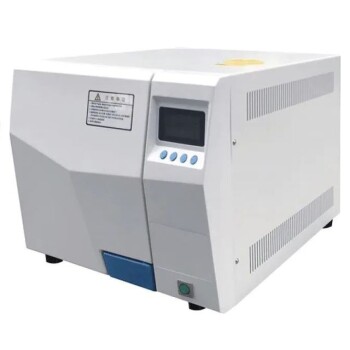
Desktop Fast Laboratory Autoclave Sterilizer 35L 50L 90L for Lab Use

Desktop Fast Laboratory Autoclave Sterilizer 35L 50L 90L for Lab Use

The desktop fast steam sterilizer is a compact and reliable device used for rapid sterilization of medical, pharmaceutical, and research items. It efficiently sterilizes surgical instruments, glassware, medicines, and resistant materials, making it suitable for various applications.

Desktop Fast Laboratory Autoclave Sterilizer 20L 24L for Lab Use

Desktop Fast Laboratory Autoclave Sterilizer 20L 24L for Lab Use

The desktop fast steam sterilizer is a compact and reliable device used for rapid sterilization of medical, pharmaceutical, and research items.

Laboratory Sterilizer Lab Autoclave Pulse Vacuum Lifting Sterilizer

Laboratory Sterilizer Lab Autoclave Pulse Vacuum Lifting Sterilizer

The pulse vacuum lifting sterilizer is a state-of-the-art equipment for efficient and precise sterilization. It uses pulsating vacuum technology, customizable cycles, and a user-friendly design for easy operation and safety.

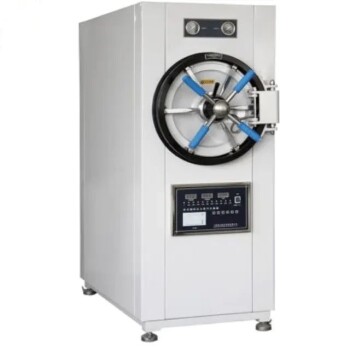
Laboratory High Pressure Horizontal Autoclave Steam Sterilizer for Lab Use

Laboratory High Pressure Horizontal Autoclave Steam Sterilizer for Lab Use

The horizontal autoclave steam sterilizer adopts the gravity displacement method to remove the cold air in the inner chamber, so that the inner steam and cold air content is less, and the sterilization is more reliable.

Laboratory Sterilizer Lab Autoclave Pulsating Vacuum Desktop Steam Sterilizer

Laboratory Sterilizer Lab Autoclave Pulsating Vacuum Desktop Steam Sterilizer

The pulsating vacuum desktop steam sterilizer is a compact and reliable device used for rapid sterilization of medical, pharmaceutical, and research items.

Laboratory Horizontal Autoclave Steam Sterilizer Lab Microcomputer Sterilizer

Laboratory Horizontal Autoclave Steam Sterilizer Lab Microcomputer Sterilizer

The horizontal autoclave steam sterilizer adopts the method of gravity displacement to remove the cold air in the inner chamber, so that the content of steam cold air in the inner chamber is less, and the sterilization is more reliable.

Laboratory Test Sieves and Sieving Machines

Laboratory Test Sieves and Sieving Machines

Precision lab test sieves & sieving machines for accurate particle analysis. Stainless steel, ISO-compliant, 20μm-125mm range. Request specs now!

Benchtop Laboratory Freeze Dryer for Lab Use

Benchtop Laboratory Freeze Dryer for Lab Use

Premium benchtop laboratory freeze dryer for lyophilization, preserving samples with ≤ -60°C cooling. Ideal for pharmaceuticals & research.

Benchtop Laboratory Vacuum Freeze Dryer

Benchtop Laboratory Vacuum Freeze Dryer

Benchtop laboratory freeze dryer for efficient lyophilization of biological, pharmaceutical, and food samples. Features intuitive touchscreen, high-performance refrigeration, and durable design. Preserve sample integrity—consult now!

Custom PTFE Teflon Parts Manufacturer for PTFE Mesh F4 Sieve

Custom PTFE Teflon Parts Manufacturer for PTFE Mesh F4 Sieve

PTFE mesh sieve is a specialized test sieve designed for particle analysis in various industries, featuring a non-metallic mesh woven from PTFE filament. This synthetic mesh is ideal for applications where metal contamination is a concern . PTFE sieves are crucial for maintaining the integrity of samples in sensitive environments, ensuring accurate and reliable results in particle size distribution analysis.

HFCVD Machine System Equipment for Drawing Die Nano-Diamond Coating

HFCVD Machine System Equipment for Drawing Die Nano-Diamond Coating

The nano-diamond composite coating drawing die uses cemented carbide (WC-Co) as the substrate, and uses the chemical vapor phase method ( CVD method for short ) to coat the conventional diamond and nano-diamond composite coating on the surface of the inner hole of the mold.

Custom PTFE Teflon Parts Manufacturer for PTFE Buchner Funnel and Triangular Funnel

Custom PTFE Teflon Parts Manufacturer for PTFE Buchner Funnel and Triangular Funnel

The PTFE funnel is a piece of laboratory equipment used primarily for filtration processes, particularly in the separation of solid and liquid phases in a mixture. This setup allows for efficient and rapid filtration, making it indispensable in various chemical and biological applications.

Anti-Cracking Press Mold for Lab Use

Anti-Cracking Press Mold for Lab Use

The anti-cracking press mold is a specialized equipment designed for molding various shapes and sizes of film using high pressure and electric heating.

915MHz MPCVD Diamond Machine Microwave Plasma Chemical Vapor Deposition System Reactor

915MHz MPCVD Diamond Machine Microwave Plasma Chemical Vapor Deposition System Reactor

915MHz MPCVD Diamond Machine and its multi-crystal effective growth, the maximum area can reach 8 inches, the maximum effective growth area of single crystal can reach 5 inches. This equipment is mainly used for the production of large-size polycrystalline diamond films, the growth of long single crystal diamonds, the low-temperature growth of high-quality graphene, and other materials that require energy provided by microwave plasma for growth.

Laboratory Hybrid Tissue Grinding Mill

Laboratory Hybrid Tissue Grinding Mill

KT-MT20 is a versatile laboratory device used for rapid grinding or mixing of small samples, whether dry, wet, or frozen. It comes with two 50ml ball mill jars and various cell wall breaking adapters for biological applications such as DNA/RNA and protein extraction.

Variable Speed Peristaltic Pump

Variable Speed Peristaltic Pump

KT-VSP Series Smart Variable Speed Peristaltic Pumps offer precise flow control for labs, medical, and industrial applications. Reliable, contamination-free liquid transfer.

Laboratory Vibratory Sieve Shaker Machine Slap Vibrating Sieve

Laboratory Vibratory Sieve Shaker Machine Slap Vibrating Sieve

KT-T200TAP is a slapping and oscillating sieving instrument for laboratory desktop use, with 300 rpm horizontal circular motion and 300 vertical slapping motions to simulate manual sieving to help sample particles pass through better.

Small Vacuum Heat Treat and Tungsten Wire Sintering Furnace

Small Vacuum Heat Treat and Tungsten Wire Sintering Furnace

The small vacuum tungsten wire sintering furnace is a compact experimental vacuum furnace specially designed for universities and scientific research institutes. The furnace features a CNC welded shell and vacuum piping to ensure leak-free operation. Quick-connect electrical connections facilitate relocation and debugging, and the standard electrical control cabinet is safe and convenient to operate.

Electric Rotary Kiln Continuous Working Small Rotary Furnace Heating Pyrolysis Plant

Electric Rotary Kiln Continuous Working Small Rotary Furnace Heating Pyrolysis Plant

Efficiently calcine and dry bulk powder and lump fluid materials with an electric heating rotary furnace. Ideal for processing lithium ion battery materials and more.


Leave Your Message