
In modern practice, there is often no difference. Most laboratory-grade chamber furnaces sold today are electric muffle furnaces. The term chamber furnace describes its physical shape—a box-like chamber—while muffle furnace describes its operating principle: isolating the sample from the heat source and its byproducts. Because modern electric furnaces have no combustion byproducts, their insulated chamber inherently provides this "muffle" effect, making the terms interchangeable.
The critical distinction is not shape versus shape, but one of heating principle. A "muffle" is a barrier that protects a sample from contamination by the heat source. A "chamber" is simply a box-shaped interior. In today's market, most lab-scale chamber furnaces are electric, meaning they function as muffle furnaces by default.
Deconstructing the Terminology
What Defines a Chamber Furnace?
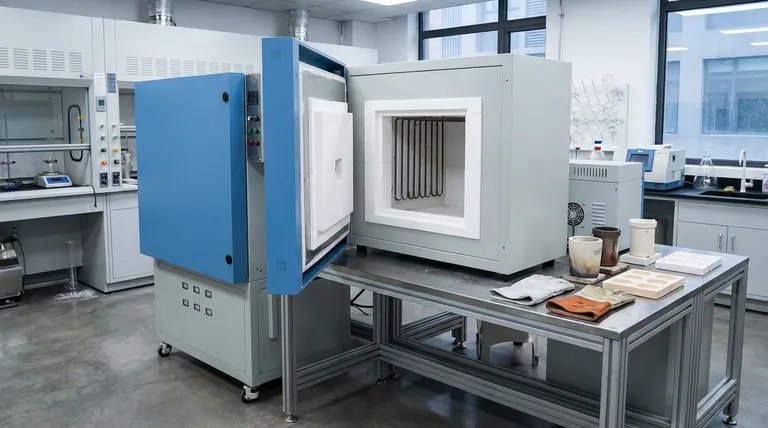
A chamber furnace is defined by its physical structure. It features a rectangular or box-shaped chamber where you place the material to be heated.
This design contrasts with other furnace types, like a tube furnace, which uses a narrow cylindrical tube. The box-like chamber makes it easy to place larger or multiple samples.
What Defines a Muffle Furnace?
A muffle furnace is defined by its method of heating. The core principle is indirect heating.
Historically, in fuel-fired furnaces, a "muffle" was a physical inner box (retort) made of ceramic or high-alloy steel. This box shielded the sample from direct contact with the flames and combustion gases, preventing chemical contamination.
The sample is heated by thermal radiation and convection from the hot walls of the muffle, not by the fire itself.
The Modern Overlap: Electric Furnaces
The confusion between these terms arises from the dominance of electric furnaces in laboratory and precision settings.
In an electric furnace, the heating elements are typically embedded in the chamber walls. Since there is no fuel being burned, there are no combustion byproducts to contaminate the sample.
The entire insulated chamber provides the clean, isolated heating environment that a traditional muffle was designed to create. Therefore, a modern electric chamber furnace performs the exact function of a muffle furnace.
How Heating Method Dictates the Design
Fuel-Fired Furnaces: The Classic Muffle
For furnaces that burn natural gas, oil, or propane, the distinction is critical. If the process is sensitive to contamination, the furnace must have a true muffle design.
This is a "box-within-a-box" structure where the outer chamber contains the flame and the inner chamber (the muffle) contains the sample.
Electric Furnaces: The De Facto Muffle
For an electric furnace, the heating elements radiate heat inward. The chamber itself is the barrier between the sample and the outside world.
Because this design inherently prevents process contamination from the heat source, it functions as a muffle furnace. Manufacturers use the terms "chamber furnace" and "muffle furnace" almost synonymously for these products.
Understanding the Trade-offs
Purity vs. Efficiency
The primary purpose of a muffle is to ensure process purity. For applications like elemental analysis (ashing), sintering advanced ceramics, or heat-treating sensitive alloys, exposure to combustion gases could ruin the result.
This purity comes at a slight cost to thermal efficiency, as the heat must be transferred indirectly to the sample through the muffle wall.
Sample Form Factor
Chamber furnaces (the common form of a muffle furnace) are ideal for processing multiple samples, bulk materials, or objects with an awkward shape.
Their primary limitation compared to a tube furnace is that they are generally not designed for processes requiring a controlled gas atmosphere or vacuum, though specialized models exist.
Temperature Uniformity
In any chamber furnace, achieving perfect temperature uniformity across the entire chamber can be a challenge. Larger chambers require carefully placed heating elements and robust insulation to ensure the sample is heated evenly.
Making the Right Choice for Your Application
Ultimately, the choice depends on your specific process requirements, not the name used by the manufacturer.
- If your primary focus is high-purity lab work (e.g., ashing, material analysis, or research): You need a furnace that provides a clean heating environment. An "electric muffle furnace" or "electric chamber furnace" will meet this need perfectly.
- If your primary focus is general heat treatment of non-sensitive parts: The distinction is less critical. An electric chamber furnace is a robust and reliable choice.
- If you are considering a fuel-fired system for a sensitive application: You must confirm it has a true muffle design to protect your workpiece from combustion byproducts.
Focus on the required heating environment for your process, and you will select the correct tool for the job.
Summary Table:
| Feature | Chamber Furnace | Muffle Furnace | Modern Electric Furnace |
|---|---|---|---|
| Definition | Box-shaped heating chamber | Indirect heating principle | Combines both features |
| Primary Function | Heating samples in a box space | Protecting samples from contamination | Clean, isolated heating environment |
| Heating Method | Varies (electric, fuel-fired) | Historically fuel-fired with barrier | Electric elements in walls |
| Sample Protection | Depends on heat source | Designed for purity | Inherently contamination-free |
| Modern Application | General heat treatment | High-purity lab work | Suitable for both purposes |
Upgrade Your Lab's Heating Capabilities with KINTEK
Choosing the right furnace is critical for your research and production quality. Whether you need a standard chamber furnace for general heat treatment or a high-purity muffle furnace for sensitive applications, KINTEK has the solution.
Why Choose KINTEK?
- Precision Engineering: Our electric chamber furnaces provide the contamination-free environment of traditional muffle furnaces with modern efficiency
- Application Expertise: We help laboratories select the perfect heating equipment for ashing, material analysis, ceramics sintering, and alloy treatment
- Quality Assurance: Built to deliver consistent temperature control and uniform heating for reproducible results
- Technical Support: Our specialists ensure your furnace meets your specific process requirements
Ready to optimize your lab's heating processes? Contact our experts today for a personalized consultation and discover how KINTEK's laboratory equipment can enhance your research outcomes.
Visual Guide

Related Products
- 1200℃ Muffle Furnace Oven for Laboratory
- 1800℃ Muffle Oven Furnace for Laboratory
- 1400℃ Muffle Oven Furnace for Laboratory
- 1700℃ Muffle Oven Furnace for Laboratory
- High Temperature Muffle Oven Furnace for Laboratory Debinding and Pre Sintering
People Also Ask
- What role does a laboratory high-temperature muffle furnace play in iron-based composite phase structure development?
- What role does a laboratory high-temperature muffle furnace play in studying the thermal stability of solidification matrices?
- How is a laboratory high-temperature muffle furnace utilized in sol-gel synthesis for perovskite catalysts?
- Why is a high-temperature muffle furnace required for xLi2ZrO3–(1−x)Li4SiO4? Ensure Ceramic Structural Integrity
- Why is a laboratory high-temperature muffle furnace required for the post-annealing treatment of copper oxide?



















