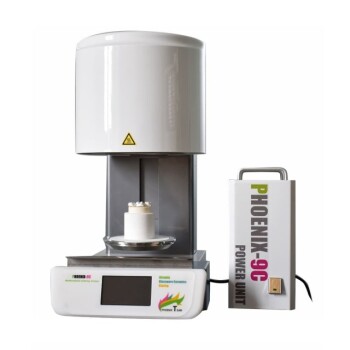
Knowledge muffle furnace Dry Ashing vs Wet Ashing: Which Method is Best for Your Sample Analysis?
Author avatar

Tech Team · Kintek Solution

Updated 3 months ago

Dry Ashing vs Wet Ashing: Which Method is Best for Your Sample Analysis?


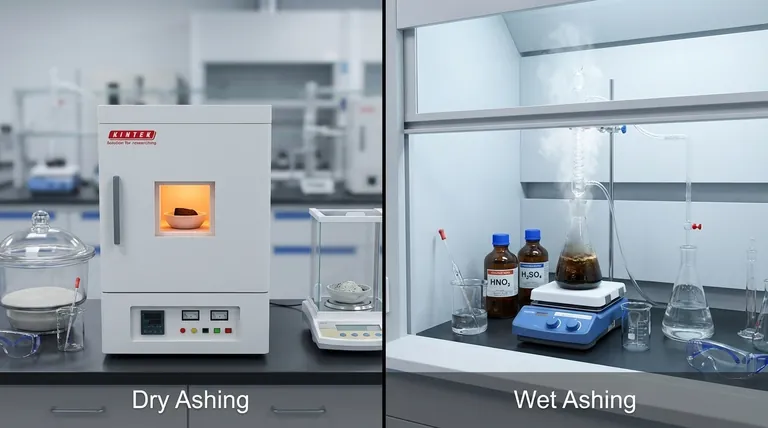
Dry ashing and wet ashing (or wet digestion) are two distinct analytical techniques used to prepare samples for further analysis, particularly in determining the inorganic composition of organic materials. Dry ashing involves heating a dry sample at high temperatures (around 500-600°C) in a muffle furnace to oxidize organic matter and leave behind inorganic residues like oxides, sulfates, and phosphates. Wet ashing, on the other hand, uses strong acids and oxidizing agents in an aqueous solution to decompose organic matter at lower temperatures, leaving mineral oxides in the solution. While dry ashing is simpler and requires less equipment, it can be less accurate due to the potential loss of volatile compounds. Wet ashing offers greater precision and control over the decomposition process but is more complex and time-consuming. The choice between the two methods depends on the sample type, the elements being analyzed, and the required accuracy.
Dry Ashing vs Wet Ashing: Which Method is Best for Your Sample Analysis?

Key Points Explained:

  1. Definition and Process:

    • Dry Ashing: This method involves heating a dry sample in a muffle furnace at high temperatures (typically 500-600°C) to combust organic matter and leave behind inorganic residues such as oxides, sulfates, and phosphates.
    • Wet Ashing (Wet Digestion): This technique involves heating a sample in an aqueous solution with strong acids (e.g., nitric acid, sulfuric acid) and oxidizing agents to decompose organic matter at lower temperatures, leaving mineral oxides in the solution.
  2. Sample State:

    • Dry Ashing: The sample is in a dry state, making it suitable for solid materials like food, soil, or ash.
    • Wet Ashing: The sample is in an aqueous state, which is ideal for liquid samples or samples that need to be dissolved in acid.
  3. Temperature and Equipment:

    • Dry Ashing: Requires a muffle furnace and operates at high temperatures (500-600°C). The process is relatively simple but may lead to the loss of volatile compounds.
    • Wet Ashing: Operates at lower temperatures and does not require a muffle furnace. The temperature and time depend on the type and strength of the acids and oxidizing agents used, offering greater control over the decomposition process.
  4. Accuracy and Precision:

    • Dry Ashing: Less accurate due to the potential loss of volatile materials during the high-temperature process.
    • Wet Ashing: More precise as it minimizes the loss of volatile compounds and allows for better control over the decomposition of organic matter.
  5. Applications:

    • Dry Ashing: Commonly used for samples where high-temperature oxidation is acceptable, such as in food analysis, soil testing, and ash content determination.
    • Wet Ashing: Preferred for samples requiring precise decomposition of organic matter, such as in environmental analysis, biological samples, and trace metal analysis.
  6. Advantages and Disadvantages:

    • Dry Ashing:
      • Advantages: Simple, requires less equipment, and is cost-effective for large-scale analysis.
      • Disadvantages: Potential loss of volatile compounds, less accurate for certain elements.
    • Wet Ashing:
      • Advantages: Greater precision, better control over decomposition, and suitable for a wider range of samples.
      • Disadvantages: More complex, time-consuming, and requires handling of hazardous chemicals.
  7. Standards and Guidelines:

    • Both methods may be governed by international standards such as ISO, EN, or ASTM, ensuring consistency and reliability in analytical results. For example, dry ashing is often used in Loss on Ignition (LOI) tests, where samples are weighed before and after ashing to determine mass reduction.
  8. Volatility and Residue:

    • Dry Ashing: May result in the loss of volatile elements (e.g., mercury, arsenic) due to high temperatures, leaving behind non-volatile residues like metal oxides.
    • Wet Ashing: Minimizes the loss of volatile elements, as the process occurs at lower temperatures, and the residues remain in the solution for further analysis.

In summary, the choice between dry ashing and wet ashing depends on the nature of the sample, the elements being analyzed, and the required accuracy. Dry ashing is simpler and more cost-effective but may compromise accuracy for volatile elements. Wet ashing, while more complex, offers greater precision and control, making it suitable for a wider range of applications.

Summary Table:

Aspect Dry Ashing Wet Ashing
Process High-temperature oxidation in a muffle furnace (500-600°C) Decomposition using strong acids and oxidizing agents at lower temperatures
Sample State Dry (solid materials like food, soil, ash) Aqueous (liquid samples or samples dissolved in acid)
Temperature High (500-600°C) Lower (depends on acids and oxidizing agents)
Accuracy Less accurate due to potential loss of volatile compounds More precise, minimizes loss of volatile compounds
Applications Food analysis, soil testing, ash content determination Environmental analysis, biological samples, trace metal analysis
Advantages Simple, cost-effective, requires less equipment Greater precision, better control, suitable for a wider range of samples
Disadvantages Loss of volatile compounds, less accurate for certain elements Complex, time-consuming, requires handling hazardous chemicals

Need help choosing the right ashing method for your analysis? Contact our experts today for personalized guidance!

Visual Guide

Dry Ashing vs Wet Ashing: Which Method is Best for Your Sample Analysis? Visual Guide

Related Products

People Also Ask

Related Products

High Temperature Muffle Oven Furnace for Laboratory Debinding and Pre Sintering

High Temperature Muffle Oven Furnace for Laboratory Debinding and Pre Sintering

KT-MD High temperature debinding and pre-sintering furnace for ceramic materials with various molding processes. Ideal for electronic components such as MLCC and NFC.

Graphite Vacuum Furnace High Thermal Conductivity Film Graphitization Furnace

Graphite Vacuum Furnace High Thermal Conductivity Film Graphitization Furnace

The high thermal conductivity film graphitization furnace has uniform temperature, low energy consumption and can operate continuously.

Ultra-High Temperature Graphite Vacuum Graphitization Furnace

Ultra-High Temperature Graphite Vacuum Graphitization Furnace

The ultra-high temperature graphitization furnace utilizes medium frequency induction heating in a vacuum or inert gas environment. The induction coil generates an alternating magnetic field, inducing eddy currents in the graphite crucible, which heats up and radiates heat to the workpiece, bringing it to the desired temperature. This furnace is primarily used for graphitization and sintering of carbon materials, carbon fiber materials, and other composite materials.

Vertical High Temperature Graphite Vacuum Graphitization Furnace

Vertical High Temperature Graphite Vacuum Graphitization Furnace

Vertical high temperature graphitization furnace for carbonization and graphitization of carbon materials up to 3100℃.Suitable for shaped graphitization of carbon fiber filaments and other materials sintered in a carbon environment.Applications in metallurgy, electronics, and aerospace for producing high-quality graphite products like electrodes and crucibles.

Large Vertical Graphite Vacuum Graphitization Furnace

Large Vertical Graphite Vacuum Graphitization Furnace

A large vertical high-temperature graphitization furnace is a type of industrial furnace used for the graphitization of carbon materials, such as carbon fiber and carbon black. It is a high-temperature furnace that can reach temperatures of up to 3100°C.

Laboratory Muffle Oven Furnace Bottom Lifting Muffle Furnace

Laboratory Muffle Oven Furnace Bottom Lifting Muffle Furnace

Efficiently produce batches with excellent temperature uniformity using our Bottom Lifting Furnace. Features two electric lifting stages and advanced temperature control up to 1600℃.

2200 ℃ Graphite Vacuum Heat Treat Furnace

2200 ℃ Graphite Vacuum Heat Treat Furnace

Discover the power of the KT-VG Graphite Vacuum Furnace - with a maximum working temperature of 2200℃, it's perfect for vacuum sintering of various materials. Learn more now.

Non Consumable Vacuum Arc Induction Melting Furnace

Non Consumable Vacuum Arc Induction Melting Furnace

Explore the benefits of Non-Consumable Vacuum Arc Furnace with high melting point electrodes. Small, easy to operate & eco-friendly. Ideal for laboratory research on refractory metals & carbides.

Horizontal High Temperature Graphite Vacuum Graphitization Furnace

Horizontal High Temperature Graphite Vacuum Graphitization Furnace

Horizontal Graphitization Furnace: This type of furnace is designed with the heating elements placed horizontally, allowing for uniform heating of the sample. It's well-suited for graphitizing large or bulky samples that require precise temperature control and uniformity.

Graphite Vacuum Continuous Graphitization Furnace

Graphite Vacuum Continuous Graphitization Furnace

High-temperature graphitization furnace is a professional equipment for graphitization treatment of carbon materials. It is a key equipment for the production of high-quality graphite products. It has high temperature, high efficiency and uniform heating. It is suitable for various high-temperature treatments and graphitization treatments. It is widely used in metallurgy, electronics, aerospace, etc. industry.

Dental Porcelain Zirconia Sintering Ceramic Furnace Chairside with Transformer

Dental Porcelain Zirconia Sintering Ceramic Furnace Chairside with Transformer

Experience top-notch sintering with Chairside Sintering Furnace with Transformer. Easy to operate, noise-free pallet, and automatic temperature calibration. Order now!

Vacuum Heat Treat and Pressure Sintering Furnace for High Temperature Applications

Vacuum Heat Treat and Pressure Sintering Furnace for High Temperature Applications

Vacuum pressure sintering furnaces are designed for high temperature hot pressing applications in metal and ceramic sintering. Its advanced features ensure precise temperature control, reliable pressure maintenance, and a robust design for seamless operation.

Rotary Tube Furnace Split Multi Heating Zone Rotating Tube Furnace

Rotary Tube Furnace Split Multi Heating Zone Rotating Tube Furnace

Multi zone rotary furnace for high-precision temperature control with 2-8 independent heating zones. Ideal for lithium ion battery electrode materials and high-temperature reactions. Can work under vacuum and controlled atmosphere.

1700℃ Controlled Atmosphere Furnace Nitrogen Inert Atmosphere Furnace

1700℃ Controlled Atmosphere Furnace Nitrogen Inert Atmosphere Furnace

KT-17A Controlled atmosphere furnace: 1700℃ heating, vacuum sealing technology, PID temperature control, and versatile TFT smart touch screen controller for laboratory and industrial use.

1200℃ Controlled Atmosphere Furnace Nitrogen Inert Atmosphere Furnace

1200℃ Controlled Atmosphere Furnace Nitrogen Inert Atmosphere Furnace

Discover our KT-12A Pro Controlled atmosphere furnace - high precision, heavy duty vacuum chamber, versatile smart touch screen controller, and excellent temperature uniformity up to 1200C. Ideal for both laboratory and industrial application.

Vacuum Heat Treat Furnace with Ceramic Fiber Liner

Vacuum Heat Treat Furnace with Ceramic Fiber Liner

Vacuum furnace with polycrystalline ceramic fiber insulation liner for excellent heat insulation and uniform temperature field. Choose from 1200℃ or 1700℃ max. working temperature with high vacuum performance and precise temperature control.

Spark Plasma Sintering Furnace SPS Furnace

Spark Plasma Sintering Furnace SPS Furnace

Discover the benefits of Spark Plasma Sintering Furnaces for rapid, low-temperature material preparation. Uniform heating, low cost & eco-friendly.

Graphite Vacuum Furnace Bottom Discharge Graphitization Furnace for Carbon Materials

Graphite Vacuum Furnace Bottom Discharge Graphitization Furnace for Carbon Materials

Bottom-out graphitization furnace for carbon materials, ultra-high temperature furnace up to 3100°C, suitable for graphitization and sintering of carbon rods and carbon blocks. Vertical design, bottom discharging, convenient feeding and discharging, high temperature uniformity, low energy consumption, good stability, hydraulic lifting system, convenient loading and unloading.

1800℃ Muffle Oven Furnace for Laboratory

1800℃ Muffle Oven Furnace for Laboratory

KT-18 muffle furnace with Japan Al2O3 polycrystalline fibe and Silicon Molybdenum heating element, up to 1900℃, PID temperature control and 7" smart touch screen. Compact design, low heat loss, and high energy efficiency. Safety interlock system and versatile functions.

Mesh belt controlled atmosphere furnace

Mesh belt controlled atmosphere furnace

Discover our KT-MB mesh belt sintering furnace - perfect for high-temperature sintering of electronic components & glass insulators. Available for open air or controlled atmosphere environments.


Leave Your Message