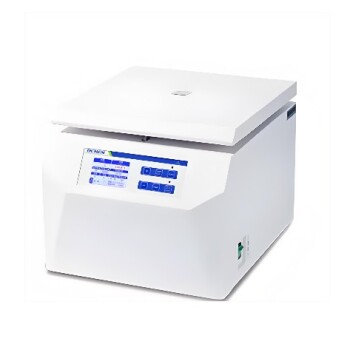
The primary function of a benchtop mild shaker is to facilitate the complete and uniform diffusion of chemical reagents into the complex porous structure of cellulose paper. By providing continuous mechanical oscillation, the shaker ensures that essential components—such as silver salts, reducing agents, and complexing agents—penetrate deep into the microfiber network rather than simply reacting on the surface layer.
Core Insight: In static environments, reaction kinetics are limited by how fast chemicals can drift into the paper. The shaker replaces this passive diffusion with active fluid dynamics, eliminating local concentration gradients and guaranteeing consistent nanoparticle growth throughout the entire volume of the substrate.
The Mechanics of Reagent Diffusion
Penetrating the Porous Matrix
Cellulose paper possesses a complex, fibrous architecture that naturally resists passive fluid penetration. A static bath often fails to wet the inner fibers completely.
Continuous mechanical oscillation provides the necessary kinetic energy to drive the solution into these microscopic pores. This ensures that the plating chemistry reaches the internal surface area of the paper, not just the exterior.
Maintaining Reagent Availability
During the plating process, the chemical reagents (silver salts and reducing agents) are consumed rapidly at the reaction sites.
Without agitation, the liquid immediately surrounding the fibers becomes depleted of these chemicals. The shaker constantly refreshes the solution at the fiber interface, ensuring a steady supply of fresh reactants is always available for deposition.
Ensuring Uniform Nanoparticle Growth
Eliminating Concentration Gradients
A major cause of poor quality plasmonic paper is the formation of local reactant concentration gradients.
When the solution remains stagnant, areas with higher reactant concentration develop thick metal deposits, while depleted areas remain bare. The dynamic environment created by the shaker homogenizes the solution, preventing these irregularities.
Achieving Volumetric Coverage
The goal of plasmonic paper fabrication is often to create a 3D conductive network, not just a 2D coating.
The shaker ensures uniform growth and coverage of metal nanoparticles both on the surface and inside the cellulose microfibers. This internal deposition is critical for the resulting optical and electrical properties of the material.
Understanding the Operational Trade-offs
The Importance of "Mild" Agitation
While agitation is necessary, the specification of a "mild" shaker is deliberate and critical.
Violent agitation can damage the fragile cellulose fibers, particularly when they are wet and swollen with chemical agents. Furthermore, excessive turbulence could disrupt the delicate nucleation process of the nanoparticles, leading to poor adhesion or irregular particle sizes. The agitation must be sufficient to move fluids but gentle enough to preserve the substrate's integrity.
Optimizing Your Fabrication Protocol
To maximize the quality of your plasmonic cellulose paper, consider your specific fabrication goals:
- If your primary focus is internal conductivity: Ensure the oscillation is continuous throughout the entire duration of the reaction to drive reagents into the deepest fibers.
- If your primary focus is surface uniformity: Prioritize the elimination of concentration gradients to prevent patchy nanoparticle growth.
Controlled, continuous agitation is the defining variable that transforms a surface reaction into a comprehensive volumetric deposition.
Summary Table:
| Feature | Function in Plating/Deposition | Impact on Material Quality |
|---|---|---|
| Mechanical Oscillation | Drives reagents into porous cellulose matrix | Ensures full volumetric coverage and internal deposition |
| Continuous Agitation | Eliminates local concentration gradients | Prevents patchy growth and ensures uniform nanoparticle size |
| Fluid Dynamics | Refreshes reactants at the fiber interface | Maintains steady reaction kinetics for consistent silver plating |
| Mild Intensity | Prevents substrate fiber damage | Preserves structural integrity of delicate cellulose paper |
Elevate Your Advanced Material Research with KINTEK
Precision is the foundation of high-performance plasmonic substrates. KINTEK specializes in high-quality laboratory equipment designed to meet the rigorous demands of chemical deposition and materials science. From our high-precision benchtop shakers and homogenizers that ensure perfect reagent diffusion, to advanced high-temperature furnaces, electrolytic cells, and battery research tools, we provide the tools you need for consistent, repeatable results.
Whether you are developing 3D conductive networks or scaling up nanoparticle fabrication, our experts are ready to provide the technical support and laboratory consumables—including PTFE products, ceramics, and crucibles—to optimize your workflow.
Ready to enhance your lab's capabilities? Contact KINTEK today to explore our full range of solutions and request a custom quote for your research needs!
References
- Changlin Dong, Di Zhang. Flexible plasmonic cellulose papers for broadband absorption and efficient solar steam generation. DOI: 10.1007/s40843-022-2238-6
This article is also based on technical information from Kintek Solution Knowledge Base .
Related Products
- Benchtop High Speed Small Lab Centrifuge for Serum Separation and Low Temperature Dehydration
- Laboratory Micro Tissue Grinding Mill Grinder
- Laboratory Single Horizontal Jar Mill
- Laboratory Micro Horizontal Jar Mill for Precision Sample Preparation in Research and Analysis
- Laboratory Multifunctional Small Speed-Adjustable Horizontal Mechanical Shaker for Lab
People Also Ask
- How is a benchtop laboratory centrifuge used in the desorption and regeneration of composite adsorbent beads?
- What is the primary function of a laboratory centrifuge? Master PAAMP-b-PVK Block Copolymer Purification
- What role does a Laboratory Centrifuge play in the production of succinic acid? Critical Solid-Liquid Separation Guide
- What are the advantages and disadvantages of a centrifuge? Weighing Speed Against Cost and Risk
- How does a centrifuge work and for what purpose? Unlock the Power of Rapid Sample Separation