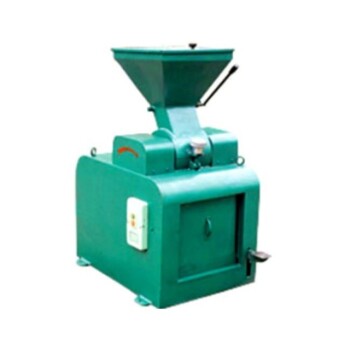
In the processing of Big Bluestem biomass, the hammer mill functions as a critical mechanical reduction unit designed to fracture raw material into particles ranging from 2 to 10 mm. Using high-speed impact, it transforms bulky raw material into a consistent feedstock suitable for advanced biochemical conversion.
The hammer mill does not just shrink material; it maximizes the specific surface area of the biomass. This physical transformation is the prerequisite for effective chemical soaking and mechanical extrusion, ultimately determining the success of enzymatic saccharification recovery.
The Mechanics of Reduction
High-Speed Impact
The core mechanism of the hammer mill involves rapidly rotating hammers within a chamber. These hammers collide with the raw Big Bluestem material at high speeds immediately upon feeding.
Repeated Collision
The reduction process is not instantaneous for every particle. Material is struck repeatedly, fracturing the biomass through the force of these high-velocity impacts.
Sizing Control via Screens
The process concludes only when the particles reach the desired dimensions. The material remains in the chamber until it is small enough to pass through a specific screen, ensuring a consistent output size between 2 and 10 mm.
Enhancing Downstream Efficiency
Increasing Specific Surface Area
The primary goal of this mechanical reduction is to significantly increase the specific surface area of the biomass. By exposing more of the material's internal structure, the hammer mill prepares the biomass for chemical reactivity.
Improving Chemical Penetration
A larger surface area directly improves the efficiency of subsequent alkaline soaking. With more surface exposed, the chemical agents can penetrate the biomass structure more deeply and uniformly.
Facilitating Mechanical Shearing
The pre-sized particles are better suited for single-screw extrusion. The specific particle size (2-10 mm) enhances the mechanical shearing effects during this extrusion phase, further breaking down the biomass structure.
Critical Process Considerations
The Necessity of Target Sizing
The range of 2 to 10 mm is not arbitrary; it is a calculated requirement for process efficiency. Deviation from this range can compromise the effectiveness of the entire pretreatment train.
Impact on Recovery Rates
The mechanical reduction provided by the hammer mill is a deciding factor in the final yield. By optimizing surface area and sizing, the process directly increases the recovery rate of enzymatic saccharification.
Optimizing Biomass Pretreatment
To ensure the highest efficiency in processing Big Bluestem, consider how the hammer mill aligns with your specific processing goals:
- If your primary focus is Chemical Efficiency: Ensure the hammer mill output is consistently sized to maximize surface area for rapid alkaline penetration.
- If your primary focus is Mechanical Processing: Maintain the 2-10 mm range to optimize the shearing effects during the subsequent extrusion stage.
- If your primary focus is Final Yield: Recognize that effective milling is the foundational step for maximizing enzymatic saccharification recovery rates.
Proper mechanical sizing is the key that unlocks the chemical potential of the biomass.
Summary Table:
| Feature | Function in Biomass Processing | Impact on Efficiency |
|---|---|---|
| Mechanism | High-speed rotating hammers | Rapidly fractures raw material into particles |
| Output Sizing | Integrated screens (2 to 10 mm) | Ensures consistent feedstock for extrusion |
| Surface Area | Maximized specific surface area | Enhances chemical soaking and penetration |
| Yield Outcome | Foundational reduction step | Increases recovery of enzymatic saccharification |
Optimize Your Biomass Research with KINTEK
Achieve precision in your primary processing with KINTEK’s high-performance crushing and milling systems. We understand that the success of enzymatic saccharification depends on perfect mechanical reduction. Beyond milling, KINTEK offers a comprehensive range of laboratory equipment tailored for biomass and material research, including:
- High-Temperature Processing: Muffle, tube, and vacuum furnaces for thermal conversion.
- Reaction Systems: High-temperature high-pressure reactors and autoclaves.
- Sample Preparation: Hydraulic presses, pellet systems, and specialized sieving equipment.
- Lab Essentials: ULT freezers, cooling solutions, and high-quality ceramic or PTFE consumables.
Don't let inconsistent particle sizing hinder your lab's efficiency. Contact KINTEK today to find the ideal equipment for your Big Bluestem biomass workflow and maximize your research yield!
References
- Chinnadurai Karunanithy, Kasiviswanathan Muthukumarappan. Optimization of alkali, big bluestem particle size, and extruder parameters for maxium enzymatic sugar recovery using response surface methodology. DOI: 10.15376/biores.6.1.762-790
This article is also based on technical information from Kintek Solution Knowledge Base .
Related Products
- Laboratory Sealed Hammer Crusher for Efficient Sample Preparation
- Electric Rotary Kiln Small Rotary Furnace Biomass Pyrolysis Plant
People Also Ask
- What role do laboratory crushers and standard sieves play in Datura stramonium pretreatment? Optimize Your HTL Yield
- What is the primary function of a laboratory crusher? Optimize Biomass & Coal Co-Gasification Efficiency
- What lab equipment would be use to crush or grind a substance? A Guide to Choosing the Right Tool
- What is the purpose of sample preparation? Ensure Accurate & Reliable Analytical Results
- What kind of material is a hammer mill used for? Process Brittle, Dry, and Crystalline Materials Efficiently