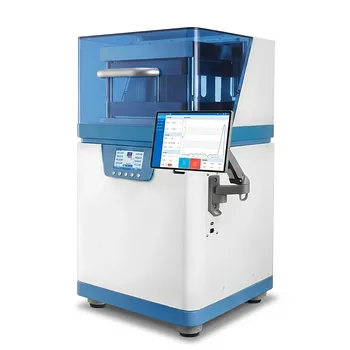
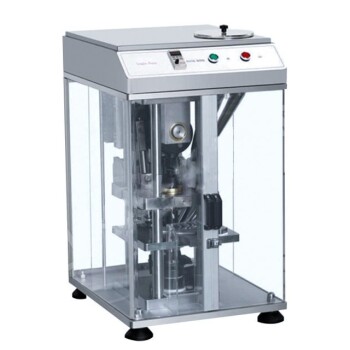
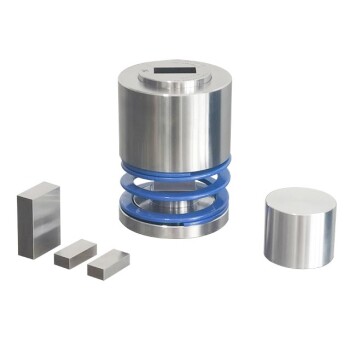
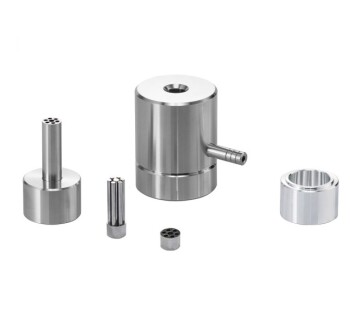
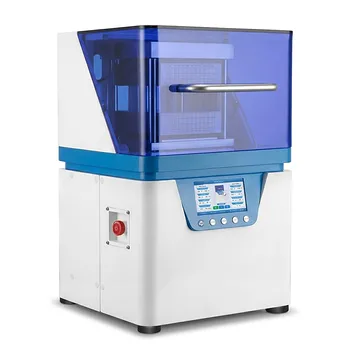
In the production of aluminum/alumina composites, the high-pressure powder forming machine acts as the bridge between loose powder and a solid material. It applies precise uniaxial pressure—often ranging from 350 MPa to 486 MPa—to compress mixed powders into a dense "green compact." This process forces metal particles to undergo plastic deformation and mechanical interlocking, creating the physical foundation required for successful bonding during subsequent heat treatment.
The high-pressure forming machine is critical for achieving high packing density and eliminating internal voids. By establishing intimate microscopic contact between particles, it enables the atomic diffusion and "cold welding" necessary to transform a powder mixture into a structurally sound composite.
The Mechanics of Microscopic Densification
Inducing Plastic Deformation and Interlocking
High pressure forces the ductile aluminum matrix particles to deform around the rigid alumina (Al2O3) reinforcement. This plastic deformation causes the particles to physically interlock, a process often referred to as cold welding. This mechanical bond gives the resulting "green body" enough initial strength to be handled without crumbling.
Eliminating Internal Porosity
The primary physical goal of the forming machine is to eliminate pores between the powder particles. By applying high-precision loads, the machine forces particles to rearrange and fill empty spaces, significantly increasing the packing density. Reducing this internal porosity is a prerequisite for achieving the high mechanical strength required in the final composite.
Preparing the Foundation for Sintering
Establishing Atomic Diffusion Pathways
Effective sintering—the process of bonding particles using heat—requires particles to be in direct physical contact at the atomic level. The forming machine creates a tight contact base, which is essential for atomic diffusion and the formation of "particle necks." Without this high-pressure compaction, the distance between particles would be too great for strong chemical bonds to form during heating.
Maintaining Structural Integrity
The pressure applied by the machine ensures the green compact has a uniform density distribution. This uniformity prevents the material from warping, cracking, or collapsing during the high-temperature sintering stage. A well-pressed compact ensures that the final product maintains its intended geometry and structural reliability.
Understanding the Trade-offs and Limitations
The Risk of Density Gradients
While high pressure is necessary, applying it uniaxially can lead to density gradients where the top of the compact is denser than the bottom. This occurs due to friction between the powder and the mold walls. Uneven density can lead to internal stresses and microscopic cracks during the cooling phase of production.
Pressure Limits and Tool Wear
Increasing pressure beyond a certain point (e.g., above 500 MPa) offers diminishing returns in density while significantly increasing die wear. Excessive pressure can also cause "springback," where the compact expands slightly upon release from the mold, potentially causing delamination or surface defects.
How to Optimize Forming for Your Project
Recommendations Based on Production Goals
- If your primary focus is maximizing mechanical strength: Use higher pressures (near 480 MPa) to maximize the contact area for atomic diffusion during sintering.
- If your primary focus is geometric precision: Focus on high-precision hydraulic control and longer "hold times" to ensure uniform density and minimize springback.
- If your primary focus is preventing brittle fracture: Ensure powders are sieved to under 10 micrometers before pressing to prevent large particles from creating stress points during compaction.
By precisely controlling the compaction phase, manufacturers can ensure that aluminum/alumina composites transition from simple powder mixtures into high-performance engineering materials.
Summary Table:
| Key Stage | Primary Mechanism | Impact on Final Composite |
|---|---|---|
| Compaction | Plastic deformation & mechanical interlocking | Creates a stable "green body" foundation |
| Densification | Elimination of internal pores and voids | Maximizes mechanical strength and density |
| Pre-sintering | Establishing atomic diffusion pathways | Ensures strong chemical bonding during heating |
| Quality Control | Uniform density distribution | Prevents warping, cracking, and geometry shifts |
Elevate Your Material Synthesis with KINTEK Precision
Achieving the perfect green compact requires more than just pressure—it requires precision. KINTEK specializes in advanced laboratory equipment designed to bridge the gap between powder and high-performance composites.
Whether you are developing aluminum/alumina composites or advanced ceramics, our comprehensive range of hydraulic presses (pellet, hot, isostatic) provides the exact load control needed to eliminate porosity and prevent delamination. To support your entire workflow, we also offer:
- Crushing & Milling Systems: For ideal powder particle size distribution.
- High-Temperature Furnaces: Muffle, vacuum, and atmosphere furnaces for superior sintering.
- Consumables: High-purity ceramics, crucibles, and PTFE products.
Ready to optimize your production density and mechanical strength? Contact our technical experts today to find the right high-pressure solution for your lab!
References
- Anup Choudhury, Sankar Narayan Das. The effect of compaction pressure, sintering time, and temperature on the characterization of an aluminum/alumina composite with rising alumina proportions. DOI: 10.5267/j.ccl.2022.12.008
This article is also based on technical information from Kintek Solution Knowledge Base .
Related Products
- Automatic Laboratory Hot Press 400x400 mm with Programmable High Temperature and Hydraulic Force Control
- Round Bidirectional Press Mold for Lab
- Automatic High Temperature Heated Hydraulic Press Machine with Heated Plates for Lab
- Manual High Temperature Heated Hydraulic Press Machine with Heated Plates for Lab
- Single Punch Electric Tablet Press Machine Laboratory Powder Tablet Punching TDP Tablet Press
People Also Ask
- What is the primary function of a laboratory hot press in MEA assembly? Optimize Fuel Cell Bonding & Performance
- What specific conditions does a laboratory hot press provide for the assembly of fuel cell MEA? Expert Bond Tips.
- How do a laboratory hydraulic hot press and standardized steel molds ensure the quality of WPC test specimens?
- What are the core advantages of using a laboratory hot press to produce Bi2Se3? Achieve 93% Density & High Conductivity
- How does a laboratory heating hydraulic press contribute to the preparation of recycled graphite green bodies? - Optimize Density.