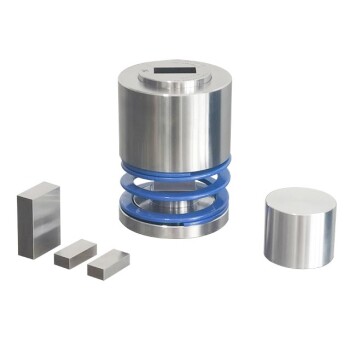
The primary function of a high-pressure stainless steel reactor with a PTFE liner in this context is to create a hermetically sealed, chemically inert environment capable of sustaining temperatures and pressures significantly above the atmospheric limits of the solvent. Specifically for the synthesis of octahedral Manganese Sulfide (MnS), this setup facilitates the thermal decomposition of thiourea within an ethylenediamine solution to release reactive sulfur ions. This controlled high-pressure atmosphere governs the nucleation and growth kinetics at approximately 433 K, ensuring the MnS crystallizes into a specific octahedral structure rather than a random aggregate.
The reactor system operates on a "contain and protect" principle: the stainless steel shell provides the structural strength to safely contain the internal pressure generated by heating solvents, while the PTFE liner acts as a barrier to ensure chemical purity and protect the vessel from corrosion.
Engineering the Reaction Environment
To achieve the synthesis of octahedral MnS, simple heating is insufficient. You require a solvothermal environment that alters the physical properties of the solvent and the reactivity of the precursors.
Generating Super-Atmospheric Pressure
The stainless steel reactor is designed to withstand substantial internal pressure. By sealing the vessel and heating it to 433 K, the ethylenediamine solvent creates vapor pressure within the confined space.
This pressure forces the solvent to remain in a liquid or subcritical state well beyond its normal boiling point. This increases the solubility of the reactants and improves the diffusion rate of ions, which is critical for uniform crystal growth.
Facilitating Precursor Decomposition
The specific chemistry of this reaction relies on the breakdown of thiourea. The high-temperature, high-pressure environment provided by the reactor supplies the necessary energy to decompose thiourea.
This decomposition releases sulfur ions ($S^{2-}$) into the solution. Because this release is driven by the reactor's thermal environment, the rate of sulfur generation is steady and controlled, preventing rapid precipitation that would ruin the crystal shape.
Ensuring Chemical Integrity
While the stainless steel provides the muscle, the Polytetrafluoroethylene (PTFE) liner provides the finesse. In material science, the purity of the reaction vessel is as critical as the purity of the starting chemicals.
The Role of Chemical Inertness
Solvothermal syntheses often involve precursors or solvents that can be corrosive or reactive toward metals. The PTFE liner serves as an inert boundary layer.
It isolates the reaction mixture from the steel walls. This prevents the ethylenediamine or the sulfur source from reacting with the iron, chromium, or nickel in the stainless steel, which could degrade the reactor body over time.
Preventing Metallic Contamination
If the reaction solution were to touch the bare steel, metal ions could leach into the mixture. In the synthesis of MnS, foreign metal ions would act as impurities (dopants).
These impurities could alter the optical or electronic properties of the final product or disrupt the crystal lattice. The PTFE liner ensures that the only metal ions participating in the nucleation process are the intended manganese ions.
Controlling Crystal Morphology
The ultimate goal of this specific setup is not just to make MnS, but to make octahedral MnS. The reactor configuration is the tool used to tune the thermodynamics of crystallization.
Regulating Nucleation Kinetics
The sealed nature of the reactor allows for a precise equilibrium between the manganese source and the released sulfur ions.
By maintaining a constant temperature (e.g., 433 K) and pressure, the system regulates the speed at which the MnS nuclei form and grow. This controlled growth rate is required to promote the formation of defined crystal planes, resulting in the distinct octahedral geometry.
Understanding the Trade-offs
While the stainless steel/PTFE combination is the industry standard for solvothermal synthesis, it is not without limitations. Understanding these constraints is vital for safe and effective experimental design.
Temperature Limitations of PTFE
The "weakest link" in this system is the liner. While stainless steel can withstand extremely high temperatures, PTFE begins to soften and deform above 250°C–260°C.
Operating near or above these temperatures risks melting the liner, which can lead to leaks, contamination, and potentially dangerous depressurization events. The synthesis of octahedral MnS at 433 K (160°C) is well within the safe zone, but pushing the temperature higher for other reactions requires caution.
The "Black Box" Nature
A high-pressure steel reactor is opaque. Unlike glass reflux setups, you cannot visually monitor the reaction progress, color changes, or precipitation as it happens.
This means the process relies heavily on reproducibility and post-synthesis characterization. You must trust that your temperature and time parameters will yield the expected result, as real-time adjustment is impossible once the vessel is sealed.
Making the Right Choice for Your Goal
The use of this specific reactor setup is a strategic choice based on your desired outcome.
- If your primary focus is Crystal Morphology: Ensure your temperature controls are precise (e.g., exactly 433 K), as the pressure generated at this specific temperature dictates the octahedral shape.
- If your primary focus is Material Purity: Inspect the PTFE liner for scratches or deformation before every use to ensure zero contact between the solvent and the steel casing.
- If your primary focus is Safety: Calculate the expected pressure of ethylenediamine at your target temperature to ensure it does not exceed the reactor's maximum pressure rating.
By decoupling the structural containment (steel) from the chemical interface (PTFE), this reactor configuration allows you to harness high-energy thermodynamics without compromising material purity.
Summary Table:
| Component | Primary Function | Material Advantage |
|---|---|---|
| Stainless Steel Shell | Structural containment & pressure resistance | Withstands super-atmospheric internal pressures at 433 K |
| PTFE Liner | Chemical isolation & purity preservation | Inert barrier prevents corrosion and metallic leaching |
| Sealed Environment | Solubility enhancement & kinetic control | Forces solvents into subcritical states for uniform crystal growth |
| Thermal Regulation | Precursor decomposition (Thiourea) | Enables steady release of sulfur ions for specific octahedral morphology |
Elevate Your Material Synthesis Precision
Unlock superior control over crystal morphology and material purity with KINTEK’s premium laboratory solutions. Whether you are performing solvothermal synthesis or complex chemical reactions, our high-performance high-temperature high-pressure reactors and autoclaves provide the safety and reliability your research demands.
Why choose KINTEK for your laboratory?
- Uncompromising Purity: High-quality PTFE products, ceramics, and crucibles to eliminate contamination.
- Advanced Thermal Control: Precision muffle and tube furnaces designed for exacting research standards.
- Comprehensive Support: From hydrostatic presses to cooling solutions, we equip your entire workflow.
Don’t compromise on your results. Contact KINTEK today to find the perfect reactor configuration for your lab and experience the difference that professional-grade equipment makes in your scientific discoveries.
References
- Jing Guo, Xiaogang Zheng. Efficient Adsorption-Photocatalytic Removal of Tetracycline Hydrochloride over Octahedral MnS. DOI: 10.3390/ijms23169343
This article is also based on technical information from Kintek Solution Knowledge Base .
Related Products
- Stainless High Pressure Autoclave Reactor Laboratory Pressure Reactor
- Mini SS High Pressure Autoclave Reactor for Laboratory Use
- Customizable High Pressure Reactors for Advanced Scientific and Industrial Applications
- Customizable Laboratory High Temperature High Pressure Reactors for Diverse Scientific Applications
- High Pressure Laboratory Autoclave Reactor for Hydrothermal Synthesis
People Also Ask
- Why is a laboratory high-pressure reactor used in the hydrothermal synthesis of hydroxyapatite catalysts?
- Why is a laboratory high-pressure reactor necessary for synthesizing fly ash-based zeolite? Achieve Pure Crystallization
- What role does a laboratory high-pressure reactor play in the leaching process of spent cathode materials? Optimize Recovery
- What conditions do laboratory high-pressure reactors provide for HTC? Optimize Your Biochar Production Processes
- How are high-pressure reactors used to prepare metaphosphate electrocatalysts? Master In-Situ Precursor Growth