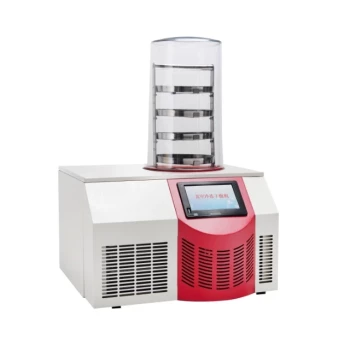
The primary function of a laboratory forced-air drying oven is to establish a controlled thermal environment, specifically at 105 °C, to isolate the dry matter of Prosopis juliflora pods. By maintaining continuous air circulation, the device drives off free moisture while preventing the chemical degradation of the sample, allowing for the precise calculation of its dry basis mass.
Core Takeaway The forced-air oven is critical for distinguishing between simple water weight and the actual biomass. Its forced circulation mechanism ensures that weight loss is strictly due to moisture evaporation, preventing the oxidation of organic components that would occur with localized overheating.
The Mechanics of Accurate Moisture Determination
Thermal Environment and Evaporation
To determine moisture content accurately, the sample must be heated to a point where water evaporates fully, but the organic material does not degrade.
The oven is set to a constant temperature of 105 °C. This specific threshold is sufficient to vaporize free moisture trapped within the Prosopis juliflora pod powder without reaching the combustion temperatures associated with ash determination (typically 575 °C).
The Role of Forced Air Circulation
The "forced-air" component is the defining feature of this equipment. A fan continuously circulates heated air throughout the chamber.
This mechanism ensures a uniform temperature distribution. Without this circulation, heat would stratify, creating pockets of intense heat and cold spots that would compromise the data.
Preserving Sample Integrity
Preventing Localized Overheating
Static ovens (those without fans) often suffer from hot spots. If a portion of the Prosopis juliflora powder gets too hot, it may begin to oxidize or burn.
Forced air circulation mitigates this risk. It prevents localized overheating, ensuring that the organic components remain chemically stable during the drying process.
Ensuring Accurate Dry Basis Mass
The ultimate goal of this process is to determine the "dry basis mass." This is the weight of the material with all free water removed.
Because the forced-air system prevents oxidation, you can be confident that the reduction in weight is caused solely by water loss, not by the destruction of organic matter. This baseline is essential for any further analysis, such as subsequent lignin or ash content tests.
Critical Considerations and Potential Pitfalls
The Risk of Oxidation
While the oven is designed to prevent oxidation, it relies on the correct operation of the forced-air system.
If the air circulation fails or is obstructed by overloading the oven, the temperature uniformity breaks down. This leads to oxidation of organic components, which artificially inflates the perceived moisture content reading because the sample loses mass from burning, not just drying.
Temperature Specificity
It is vital to adhere strictly to the 105 °C standard for moisture.
Setting the temperature higher moves the process closer to combustion or pyrolysis (closer to the 575 °C used in muffle furnaces for ash), while setting it lower may result in incomplete evaporation. Both scenarios yield inaccurate dry basis mass calculations.
Making the Right Choice for Your Goal
To ensure your analysis of Prosopis juliflora is valid, apply the following guidelines:
- If your primary focus is determining accurate moisture content: Ensure the oven is set strictly to 105 °C and verify that the fan is operating to guarantee uniform heat distribution.
- If your primary focus is preserving organic composition: Do not overcrowd the oven shelves, as this blocks airflow and creates the hot spots that lead to sample oxidation.
Ultimately, the forced-air oven acts as a precision tool to strip away water weight without altering the fundamental chemistry of the biomass.
Summary Table:
| Feature | Function in Moisture Analysis | Impact on Sample Integrity |
|---|---|---|
| 105 °C Temperature | Vaporizes free moisture without combustion | Prevents organic degradation/ash formation |
| Forced Air Fan | Ensures uniform thermal distribution | Eliminates hot spots that cause localized oxidation |
| Continuous Circulation | Drives off water vapor efficiently | Guarantees weight loss is strictly from evaporation |
| Controlled Environment | Establishes the "Dry Basis Mass" | Provides an accurate baseline for lignin/ash tests |
Elevate Your Biomass Research with KINTEK Precision
Accuracy in moisture determination is the foundation of high-quality material analysis. KINTEK specializes in advanced laboratory equipment designed to protect your sample integrity. Whether you are analyzing Prosopis juliflora or other organic biomass, our high-performance forced-air drying ovens and high-temperature furnaces deliver the thermal stability you need.
Our extensive portfolio supports every stage of your workflow, including:
- Drying & Heating: Precise forced-air ovens and muffle furnaces.
- Sample Prep: Crushing, milling, and hydraulic pellet presses.
- Advanced Research: Vacuum furnaces, CVD systems, and high-pressure reactors.
Don't let localized overheating compromise your data. Contact KINTEK today to find the perfect heating solution for your laboratory and ensure your dry basis mass calculations are beyond reproach.
References
- G. Gayathri, Kiran Babu Uppuluri. The comprehensive characterization of Prosopis juliflora pods as a potential bioenergy feedstock. DOI: 10.1038/s41598-022-22482-9
This article is also based on technical information from Kintek Solution Knowledge Base .
Related Products
- 56L Vertical Laboratory Vacuum Drying Oven
- 23L Laboratory Vacuum Drying Oven
- Laboratory Scientific Electric Heating Blast Drying Oven
- High Temperature Muffle Oven Furnace for Laboratory Debinding and Pre Sintering
- 1400℃ Muffle Oven Furnace for Laboratory
People Also Ask
- Why is a laboratory vacuum drying oven recommended for rice straw residues? Protect Your Biomass Integrity
- What role does a laboratory vacuum drying oven play in the preparation of modified multi-walled carbon nanotubes?
- What is the importance of using a laboratory vacuum drying oven? Preserving Slow-Release Microcapsule Integrity
- Why is a Laboratory Vacuum Drying Oven recommended for PBAT microspheres? Protect Sensitive Polymer Integrity
- What role does a laboratory vacuum drying oven play in processing nanoparticle powder samples? Protect Sample Integrity