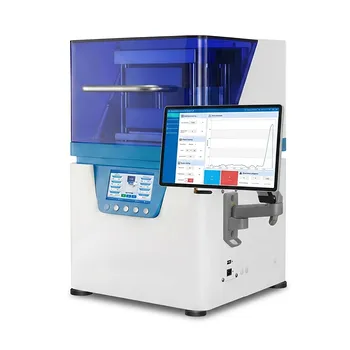
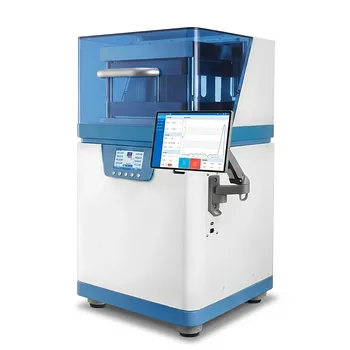
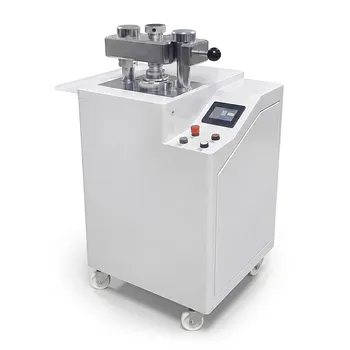
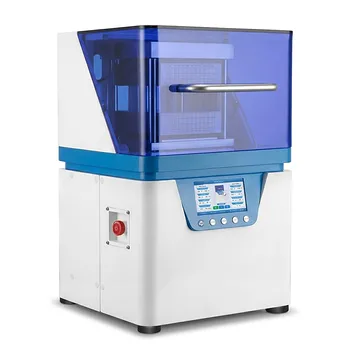
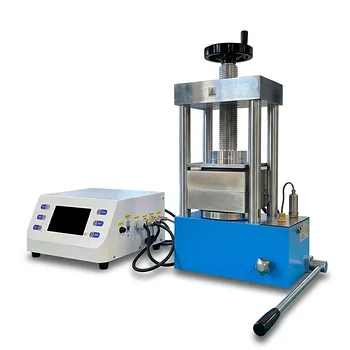
The laboratory hydraulic press serves as the primary tool for sample standardization in Lead Oxide (PbO) reduction experiments. It is used to compress high-purity PbO powder into uniform pellets with precise diameters and thicknesses. By applying a specific pressure—typically around 10 tons of force—the press ensures the internal density and geometric consistency required for accurate kinetic measurements.
The core function of the hydraulic press is to transform loose reactant powders into standardized "green pellets." This process establishes a stable physical foundation that ensures reproducible reaction kinetics and maximizes interfacial contact between materials.
Standardizing Sample Geometry and Density
Achieving Geometric Consistency
In kinetic studies, the surface area and volume of the sample must be identical across all trials. The hydraulic press allows researchers to produce pellets with exact dimensions, ensuring that subsequent isothermal reduction processes are comparable.
Controlling Internal Density
Loose powder contains unpredictable air gaps that can lead to uneven heating or gas flow. Applying high pressure eliminates these density gradients, creating a uniform "green body" that reacts predictably during thermal treatment.
Providing a Stable Physical Foundation
The resulting pellets are structurally sound enough to be handled and placed into a furnace without crumbling. This stability is essential for thermogravimetric analysis, where the sample must maintain its shape throughout the reduction process.
Enhancing Chemical Reaction Kinetics
Maximizing Particle-to-Particle Contact
For reduction to occur efficiently, the PbO particles must be in intimate contact with reducing agents or other additives. The press forces these particles together, creating ideal physical conditions for solid-solid and solid-liquid reactions.
Reducing Interfacial Resistance
High-pressure compaction reduces the resistance between different material layers within the sample. This ensures that heat and chemical reactions are distributed uniformly throughout the pellet rather than being concentrated on the surface.
Facilitating Uniform Gas Diffusion
By controlling the compaction pressure, researchers can influence the porosity of the pellet. This allows for a controlled environment where hydrogen or other reducing gases can infiltrate the sample interior at a consistent rate.
Understanding the Trade-offs and Pitfalls
Over-Compaction and Diffusion Barriers
While high pressure increases contact, excessive force can lead to over-compaction. This may close off necessary pore networks, trapping reaction gases inside the pellet and artificially slowing down the observed reduction rate.
Pressure-Induced Micro-Cracking
Applying force too rapidly or using excessive pressure can cause internal micro-cracks or "capping" in the pellet. These structural defects can cause the sample to disintegrate during high-temperature reduction, leading to catastrophic failure of the experiment.
Density Inhomogeneity
If the powder is not distributed evenly in the mold before pressing, the resulting pellet may have non-uniform density. This leads to uneven reaction fronts, where one side of the pellet reduces faster than the other, skewing the kinetic data.
How to Apply This to Your Project
To achieve the best results in your reduction experiments, consider the specific requirements of your material and setup:
- If your primary focus is Kinetic Accuracy: Ensure you apply a consistent pressure (e.g., 10-15 MPa) for a fixed duration to guarantee that every sample has identical density and surface area.
- If your primary focus is Solid-State Reactions: Use higher compaction forces to maximize the contact area between PbO and solid reducing agents like carbon powder.
- If your primary focus is Gas-Solid Interaction: Carefully calibrate your pressing force to maintain a specific volume of porosity, allowing reducing gases to reach the center of the pellet.
Standardizing your sample preparation with a hydraulic press is the most effective way to eliminate physical variables and isolate the true chemical behavior of your materials.
Summary Table:
| Key Function | Experimental Benefit | Impact on Results |
|---|---|---|
| Sample Standardization | Uniform geometric dimensions | Ensures reproducible reaction kinetics |
| Density Control | Elimination of internal air gaps | Provides stable heating & gas flow |
| Interfacial Contact | Maximized particle-to-particle contact | Accelerates solid-state reaction rates |
| Structural Stability | Durable "green pellet" formation | Prevents sample crumbling during thermal analysis |
| Porosity Calibration | Controlled gas diffusion paths | Allows uniform infiltration of reducing gases |
Achieve Unmatched Experimental Precision with KINTEK
High-quality Lead Oxide reduction begins with perfect sample preparation. KINTEK specializes in high-performance laboratory hydraulic presses, offering a versatile range including pellet, hot, and isostatic models designed for maximum density control and geometric consistency.
Beyond our industry-leading presses, KINTEK provides a comprehensive laboratory ecosystem to support your research, including:
- High-Temperature Furnaces: Muffle, tube, and vacuum systems for precise reduction environments.
- Material Preparation: Crushing, milling, and sieving equipment for uniform powder precursors.
- Specialized Consumables: High-purity ceramics, crucibles, and PTFE products to ensure zero contamination.
Ready to eliminate physical variables and isolate true chemical behavior in your experiments? Contact KINTEK today to find the perfect solution for your lab!
References
- A. Rukini, Amy Van den Bulck. Lead Recovery From PbO Using Hydrogen as a Reducing Agent. DOI: 10.1007/s11663-023-02745-0
This article is also based on technical information from Kintek Solution Knowledge Base .
Related Products
- Hydraulic Diaphragm Lab Filter Press for Laboratory Filtration
- Automatic Laboratory Hydraulic Pellet Press Machine for Lab Use
- Laboratory Hydraulic Press Lab Pellet Press Machine for Glove Box
- Laboratory Hydraulic Press Lab Pellet Press for Button Battery
- Laboratory Manual Hydraulic Pellet Press for Lab Use
People Also Ask
- What are the advantages and disadvantages of presses? A Guide to Lab Filter Presses for R&D
- How is a laboratory hydraulic press used in the preparation of modified biochar samples for FTIR analysis? Expert Guide
- What are the safety precautions for filter press? Essential Steps to Prevent High-Pressure Hazards
- What is the capacity of a filter press? A Guide to Volumetric & Throughput Metrics
- What is an example of a hydraulic press? Discover the Power of Laboratory Sample Preparation