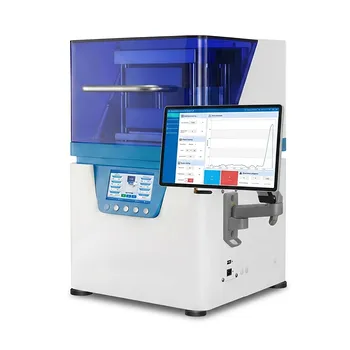
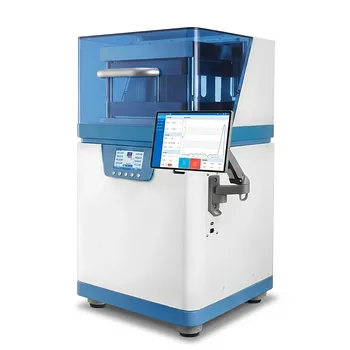
The final stage of Ni@TiO2/PVDF composite film fabrication relies on a laboratory hydraulic press to execute a precision hot-pressing process. Specifically, the press applies a temperature of 190 °C and a pressure of 10 MPa to compress dried composite powders into a consolidated film. This critical step transforms loose materials into a uniform sheet with a thickness of approximately 0.2 mm, ensuring the sample is ready for rigorous dielectric characterization.
The laboratory hydraulic press serves as a consolidation tool that uses simultaneous heat and pressure to facilitate polymer melt flow, eliminating internal voids and ensuring the sample integrity required for high-voltage dielectric testing.
Facilitating Material Transformation and Structural Integrity
Inducing Polymer Melt Flow
The application of 190 °C allows the PVDF matrix to transition into a molten state. This heat, combined with 10 MPa of pressure, forces the polymer to flow and fully encapsulate the Ni@TiO2 particles, ensuring a continuous phase.
Eliminating Internal Structural Defects
A primary function of the press is the elimination of internal voids and air gaps that naturally occur in powder mixtures. By removing these pores, the composite achieves a higher bulk density, which is essential for consistent electrical and mechanical behavior.
Ensuring Integrity Under High-Voltage
The consolidation process ensures the material can withstand high-voltage electric fields without premature breakdown. Without the dense packing provided by the press, internal air pockets would act as failure points, leading to sample rupture during testing.
Achieving Precision for Electrical Characterization
Standardizing Sample Dimensions
The press ensures the final film reaches a precise and uniform thickness of 0.2 mm. This dimensional consistency is mandatory for calculating dielectric constants and comparing performance across different experimental batches.
Enhancing Interfacial Contact
By applying high mechanical pressure, the press improves the contact tightness between the Ni@TiO2 fillers and the PVDF matrix. This reduces interfacial resistance and ensures that the electrical properties measured are representative of the material's true chemistry.
Regularity for Subsequent Analysis
The press produces a "green compact" or film with sufficient mechanical strength for handling and placement in testing fixtures. This regularity prevents the sample from deforming or crumbling during the transition from the laboratory bench to the characterization equipment.
Understanding the Trade-offs
Thermal Degradation Risks
Exposing the PVDF matrix to 190 °C requires careful timing to avoid thermal degradation. If the material is held at this temperature for too long within the press, the polymer chains may break down, negatively impacting the film's dielectric properties.
Pressure Calibration Challenges
While 10 MPa is necessary for density, excessive pressure can lead to particle crushing or unwanted filler rearrangement. If the Ni@TiO2 particles are forced into direct contact through the polymer layers, it may create unintended conductive pathways that short-circuit the composite.
How to Apply This to Your Project
- If your primary focus is dielectric testing accuracy: Use the press to achieve strict thickness control and surface flatness to minimize measurement errors in the capacitor setup.
- If your primary focus is high-voltage stability: Prioritize the maximum elimination of internal voids to prevent internal arcing and premature dielectric breakdown.
- If your primary focus is material density: Ensure the temperature is precisely calibrated to the polymer's melting point to allow the matrix to fully fill all interfacial gaps between the fillers.
The laboratory hydraulic press is the definitive tool for transforming raw composite powders into high-performance, test-ready films through the synergy of controlled heat and mechanical pressure.
Summary Table:
| Parameter | Process Requirement | Impact on Composite Film |
|---|---|---|
| Temperature | 190 °C | Melts PVDF matrix to encapsulate Ni@TiO2 particles |
| Pressure | 10 MPa | Eliminates internal voids and ensures high bulk density |
| Thickness | ~0.2 mm | Standardizes dimensions for dielectric constant calculation |
| Material State | Hot-Pressing | Transforms loose powder into a durable green compact |
Elevate Your Materials Research with KINTEK Precision
Achieving the perfect 0.2 mm composite film requires more than just pressure—it requires absolute control. KINTEK specializes in high-performance laboratory equipment designed for rigorous scientific applications. Our extensive range of hydraulic presses, including manual, electric, hot, and isostatic models, provides the uniform heating and precise pressure calibration necessary for void-free sample preparation.
Beyond pressing, KINTEK offers a complete ecosystem for material science:
- High-Temperature Furnaces: Muffle, vacuum, and CVD systems for advanced synthesis.
- Sample Preparation: Crushing, milling, and sieving equipment for uniform powder mixtures.
- Specialized Reactors: High-temperature high-pressure reactors and autoclaves.
- Lab Essentials: From PTFE products and ceramics to cooling solutions and homogenizers.
Don't let internal structural defects compromise your dielectric testing. Ensure your samples withstand high-voltage fields with KINTEK’s industry-leading durability and precision.
Contact our experts today to find the ideal pressing solution for your lab!
References
- Juanjuan Zhou, Xiangrong Liu. Significantly Suppressed Dielectric Loss and Enhanced Breakdown Strength in Core@Shell Structured Ni@TiO2/PVDF Composites. DOI: 10.3390/nano13010211
This article is also based on technical information from Kintek Solution Knowledge Base .
Related Products
- Laboratory Hydraulic Press Lab Pellet Press Machine for Glove Box
- Laboratory Hydraulic Press Split Electric Lab Pellet Press
- Fully Automatic Heated Hydraulic Lab Press for Materials Sintering and Sample Preparation
- Laboratory Hydraulic Press Lab Pellet Press for Button Battery
- Automatic Laboratory Hydraulic Press for XRF & KBR Pellet Press
People Also Ask
- What is the function of a laboratory hydraulic press in W-Cu composites? Control Porosity and Material Ratio
- What is the role of a laboratory hydraulic press in the initial stages of Li6PS5Cl preparation? Key to Green Pellets
- What role does a laboratory hydraulic press play in triboelectric testing? Achieve Precision Alloy Sample Prep
- How can a laboratory hydraulic press be applied to chitosan for wastewater treatment? Optimize Pores & Strength
- How do a precision laboratory hydraulic press and specialized molds contribute to the fabrication of spherical ceramic samples? Achieving High-Density Material Precision