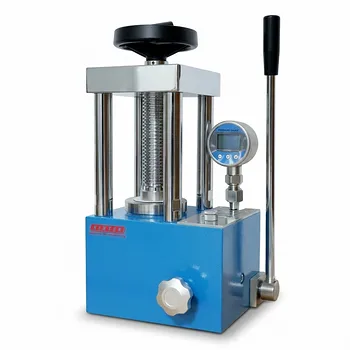
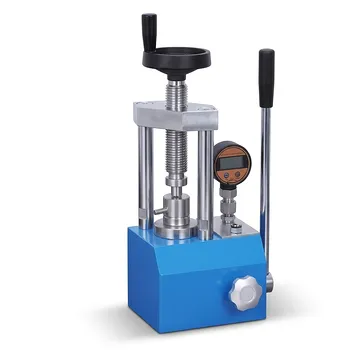
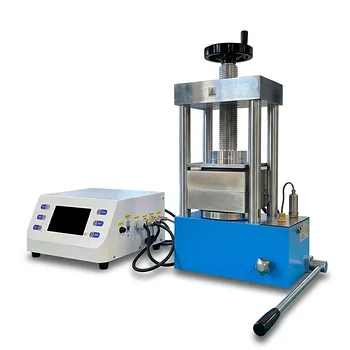
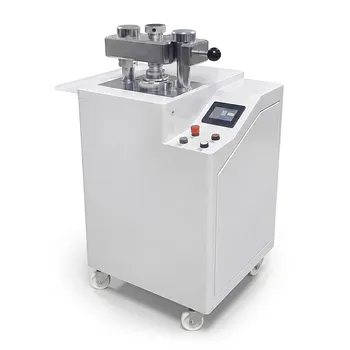
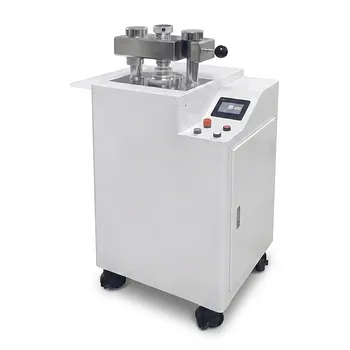
The laboratory manual hydraulic press serves as the critical bridge between loose powder and a structured solid. Its primary function in processing YBCO (Yttrium Barium Copper Oxide) and titanium dioxide mixtures is to apply controlled axial pressure to transform raw materials into a "green body" pellet. This process ensures the particles are in sufficiently close contact to allow for chemical diffusion and structural fusion during the subsequent sintering stage.
Core Takeaway: The manual hydraulic press converts loose powders into high-density cylindrical pellets by eliminating air and maximizing particle contact. This "green" compaction is essential for achieving the structural integrity and chemical reactivity required for high-temperature material synthesis.
The Mechanics of Powder Consolidation
Axial Pressure and Shape Formation
The hydraulic press utilizes a precision mold to apply uniaxial force to the YBCO or titanium dioxide powder. This force compresses the loose material into a specific geometry, typically a cylindrical pellet (often 10mm to 13mm in diameter), which provides a stable form for handling and further testing.
Creating Green Strength
By forcing particles together, the press creates what is known as green strength. This is the mechanical integrity of the unsintered pellet that allows it to maintain its shape without crumbling. Without this initial strength, the sample would be unable to withstand the transition to a high-temperature furnace.
Elimination of Air Pores
High-pressure compaction, often reaching levels between 50 bar and 800 MPa depending on the material requirements, expels trapped air from between the powder grains. Removing these voids is critical for preventing cracking or excessive shrinkage when the material is later heated.
Enhancing Material Properties for Sintering
Increasing Particle Contact Area
The primary chemical benefit of the pressing process is the significant increase in the contact area between individual particles. For YBCO and TiO2, which rely on solid-state reactions, this tight contact is the "physical foundation" that allows atoms to migrate and fuse during sintering.
Optimizing Green Density
Achieving a high green density—the density of the material before firing—is a prerequisite for a successful final product. A dense green body ensures that the final ceramic has the desired mechanical load-bearing capacity and uniform physical properties.
Promoting Uniform Grain Fusion
The precise control of pressure ensures that the density is as consistent as possible throughout the sample. This consistency helps reduce non-uniform deformation or warping when the pellets are subjected to temperatures often exceeding 800°C or 1000°C.
Understanding the Trade-offs and Limitations
Pressure Gradient Challenges
One inherent limitation of uniaxial pressing is the risk of density gradients. Friction between the powder and the mold walls can lead to the top of the pellet being denser than the center, potentially causing internal stresses during sintering.
Manual Variability
Because these presses are operated manually, achieving exact repeatability across multiple samples requires rigorous attention to detail. Small deviations in the force applied or the duration of the "hold" time can result in subtle variations in pellet density.
Tooling Wear and Contamination
The high pressures required for materials like titanium dioxide can cause wear on precision steel molds over time. If the molds are not properly maintained or lubricated, they may introduce trace contaminants into the YBCO mixture, potentially altering its superconducting or chemical properties.
How to Apply This to Your Project
Making the Right Choice for Your Goal
To achieve the best results with YBCO and titanium dioxide mixtures, your pressing strategy should align with your final research or production objectives.
- If your primary focus is Superconductivity (YBCO): Ensure maximum green density to facilitate the formation of continuous pathways for electron flow during the sintering phase.
- If your primary focus is Optical or Catalytic Analysis (TiO2): Use the press to create uniform, translucent pellets that minimize light scattering by eliminating large internal voids.
- If your primary focus is Structural Integrity: Gradually increase the pressure to the target level (e.g., 220 bars) and hold it for a consistent duration to ensure the air is fully evacuated.
Proper manual compaction is the defining first step in transforming raw chemical powders into high-performance functional ceramics.
Summary Table:
| Feature | Function in Shaping YBCO & TiO2 | Impact on Final Material |
|---|---|---|
| Uniaxial Pressure | Compresses loose powder into specific geometries | Creates a stable, handleable cylindrical pellet |
| Void Elimination | Expels trapped air pores at 50 bar - 800 MPa | Prevents cracking and excessive shrinkage during firing |
| Green Strength | Provides mechanical integrity to unsintered bodies | Allows samples to withstand furnace transitions |
| Particle Contact | Maximizes contact area between powder grains | Facilitates atom migration and solid-state reactions |
| Density Control | Ensures uniform green density throughout | Reduces non-uniform deformation and warping |
Elevate Your Material Synthesis with KINTEK Precision
Transform your raw powders into high-performance functional ceramics with KINTEK’s industry-leading laboratory solutions. Whether you are researching YBCO superconductors or titanium dioxide catalysts, our precision-engineered manual and automatic hydraulic presses (including pellet, hot, and isostatic models) ensure the perfect green density every time.
Beyond compaction, KINTEK provides a comprehensive ecosystem for your lab, including:
- High-Temperature Furnaces: Muffle, tube, and vacuum furnaces for flawless sintering.
- Sample Preparation: Precision crushing, milling, and sieving systems.
- Specialized Reactors: High-pressure autoclaves and CVD/PECVD systems.
- Lab Consumables: High-purity ceramics, crucibles, and PTFE products.
Ready to achieve superior structural integrity and chemical reactivity in your samples? Contact our technical experts today to find the ideal equipment tailored to your research goals.
References
- Fatma Barood, M. Muralidhar. Orthorhombic YBa2Cu3O7−δ Superconductor with TiO2 Nanoparticle Addition: Crystal Structure, Electric Resistivity, and AC Susceptibility. DOI: 10.3390/coatings13061093
This article is also based on technical information from Kintek Solution Knowledge Base .
Related Products
- Manual Heated Hydraulic Press Machine with Heated Plates for Laboratory Hot Press
- Laboratory Manual Hydraulic Pellet Press for Lab Use
- Manual High Temperature Heated Hydraulic Press Machine with Heated Plates for Lab
- Laboratory Manual Hydraulic Pellet Press for Lab Use
- Heated Hydraulic Press Machine with Integrated Manual Heated Plates for Lab Use
People Also Ask
- Why use laboratory manual hydraulic presses for semiconductor pellets? Optimize Annealing & Crystalline Quality
- What is manual hydraulic press? A Guide to Simple, High-Force Compression
- How is a laboratory manual hydraulic press used in solid-state battery testing? Optimize Electrode Performance
- How does a laboratory hydraulic hot press ensure the quality of PHBV/natural fiber composites? Expert Guide
- Why is a laboratory hydraulic hot press essential for high-density, additive-free Silicon Carbide? Unlock Pure SiC.