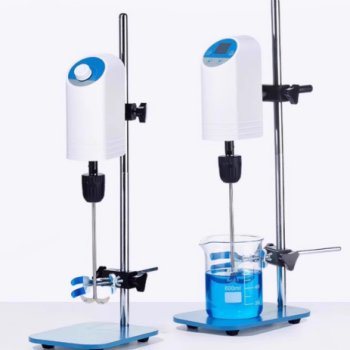
The primary function of a stirred tank reactor in the Fenton-TiO2 advanced oxidation process is to create a thoroughly homogenized reaction environment. By employing continuous mechanical stirring, the reactor forces intimate contact between synthetic dyes, Fenton reagents (hydrogen peroxide and ferrous sulfate), and TiO2 catalysts.
The stirred tank reactor acts as the kinetic engine of the process, using mechanical agitation to eliminate concentration dead zones. This ensures that the hydroxyl radicals generated by the system successfully collide with dye molecules for effective chemical breakdown.
The Mechanics of Homogeneity
Achieving Uniform Contact
The process involves three distinct phases: the liquid dye solution, liquid reagents, and solid TiO2 catalysts. The stirred tank reactor ensures these diverse materials do not separate or settle.
Eliminating Concentration Gradients
Without active mixing, reagents can pool in specific areas, creating inconsistent reaction rates. Continuous mechanical stirring eliminates these local concentration gradients.
Stabilizing the Reaction Environment
A controlled environment is essential for the sensitive Fenton chemistry. The reactor maintains uniformity across the entire volume, preventing localized interactions that could waste reagents.
Optimizing Reaction Kinetics
Enhancing Mass Transfer efficiency
Chemical degradation is limited by how fast reactants can move through the liquid to reach the catalyst surface. The reactor’s agitation significantly enhances this mass transfer efficiency.
Facilitating Molecular Collisions
Degradation occurs only when hydroxyl radicals physically encounter dye molecules. The stirring mechanism maximizes the frequency of these necessary collision reactions.
Driving Chemical Degradation
The combination of enhanced mass transfer and collision frequency directly correlates to performance. This mechanical support is critical for the effective chemical degradation of the dye.
Operational Considerations
The Necessity of Continuous Agitation
The system's efficiency is entirely dependent on the continuity of the stirring. If mechanical agitation stops, mass transfer drops immediately, and the reaction creates ineffective pockets of unmixed chemicals.
Managing Catalyst Suspension
The solid TiO2 catalyst requires constant energy to remain suspended in the mixture. The reactor design must account for keeping these particles distributed rather than letting them sink to the bottom.
Making the Right Choice for Your Process
To maximize the efficiency of your dye degradation project, focus on the relationship between mixing energy and reaction speed.
- If your primary focus is maximizing reaction speed: Ensure the stirring intensity is high enough to eliminate all mass transfer limitations between the fluid and the TiO2 particles.
- If your primary focus is reagent efficiency: Verify that the reactor design eliminates all dead zones where concentration gradients could cause reagents to be consumed without degrading the dye.
The stirred tank reactor transforms a static mixture into a dynamic system, ensuring that every molecule of reagent contributes to the degradation process.
Summary Table:
| Feature | Function in Fenton-TiO2 Process | Impact on Dye Degradation |
|---|---|---|
| Mechanical Stirring | Eliminates concentration gradients and dead zones | Ensures uniform reaction rates throughout volume |
| Phase Homogenization | Keeps solid TiO2 catalysts suspended in liquid reagents | Prevents catalyst settling and maximizes active surface area |
| Enhanced Mass Transfer | Increases frequency of molecular collisions | Accelerates the breakdown of dyes by hydroxyl radicals |
| Kinetic Optimization | Maintains a stable, dynamic reaction environment | Prevents reagent waste and ensures efficient chemical breakdown |
Elevate Your Advanced Oxidation Processes with KINTEK
Maximize the efficiency of your dye degradation and chemical synthesis with KINTEK’s high-performance stirred tank reactors. Whether you are working with Fenton-TiO2 advanced oxidation or complex multi-phase reactions, our equipment is designed to eliminate mass transfer limitations and ensure perfect homogeneity.
Beyond reactors, KINTEK offers a comprehensive suite of laboratory solutions tailored for research and industry:
- Reaction & Synthesis: High-temperature high-pressure reactors, autoclaves, and specialized electrolytic cells.
- Material Processing: Advanced crushing, milling, and hydraulic presses for pellet and isostatic pressing.
- Thermal & Environmental Control: Precision muffle and vacuum furnaces, ULT freezers, and freeze dryers.
- Lab Essentials: High-quality ceramics, crucibles, and PTFE consumables.
Ready to optimize your lab's reaction kinetics? Contact our technical experts today to find the perfect equipment configuration for your specific research needs!
References
- Dedi Teguh, Muhammad Faizal. Color And COD Degradation of Procion Red Synthetic Dye by Using Fenton-TiO2 Method. DOI: 10.24845/ijfac.v3.i1.23
This article is also based on technical information from Kintek Solution Knowledge Base .
Related Products
- Custom PTFE Teflon Parts Manufacturer for Microwave Digestion Tank
- Laboratory Small Constant Temperature Heated Magnetic Stirrer Heater and Stirrer
- High Performance Laboratory Stirrers for Diverse Applications
- Customizable Laboratory High Temperature High Pressure Reactors for Diverse Scientific Applications
- Stainless High Pressure Autoclave Reactor Laboratory Pressure Reactor
People Also Ask
- Why are PTFE containers required for PCT leaching tests? Ensure Chemical Inertness and Analytical Precision
- Why use high-quality PTFE containers for CO2 reduction electrolytes? Eliminate silicon contamination and ensure data.
- Why is PTFE Mandatory for Hydrofluoric Acid (HF) Handling? Ensure Safety and Data Integrity in Corrosion Testing
- Why is a PTFE container required for acid leaching of silicon nanosheets? Ensure High Purity and Safety
- Why are polytetrafluoroethylene (PTFE) containers essential for assessing the corrosion resistance of glassified waste?