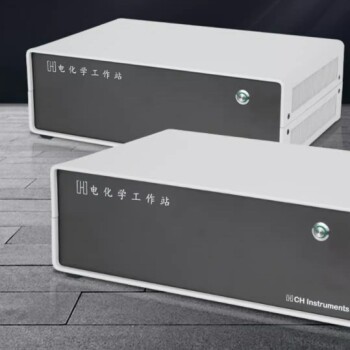
The primary function of a three-electrode electrochemical measurement system in platinum nanoparticle deposition is to achieve absolute precision in controlling the potential at the working electrode interface.
By decoupling the measurement of potential from the flow of current, this system maintains high stability of the deposition potential. This stability is the critical factor that allows researchers to manipulate the overpotential, thereby directly regulating the nucleation rate, particle size, and distribution density of the platinum nanoparticles.
Core Takeaway A three-electrode system separates the circuit into two loops: one for measuring potential (Reference) and one for carrying current (Counter). This isolation prevents voltage drops from distorting measurements, enabling the precise tuning of electrochemical driving forces required to grow uniform platinum nanoparticles with specific morphologies.
The Mechanics of Precision Control
Decoupling Current and Potential
In simpler two-electrode systems, the current required to drive the reaction flows through the same electrode used to measure voltage. This causes polarization, leading to inaccurate readings of the actual surface potential.
The three-electrode system solves this by introducing a Reference Electrode. The current flows between the Working Electrode and the Counter Electrode, while the potential is measured between the Working Electrode and the Reference Electrode.
Because negligible current flows through the Reference Electrode, its potential remains stable and drift-free.
Regulating the "Driving Force"
For platinum deposition, the overpotential—the difference between the applied potential and the thermodynamic equilibrium potential—is the primary lever for control.
By accurately controlling this overpotential, you dictate how the platinum grows. High stability allows you to precisely trigger nucleation (creating new seeds) or favor growth (enlarging existing particles).
This control is what determines the final physical properties of the deposition, specifically the particle size and distribution density.
The Role of Specific Components
The Reference Electrode (RE)
Often composed of Ag/AgCl (silver/silver chloride), this component serves as the unwavering benchmark for the system.
It provides a standardized potential reference point (often calibrated relative to the Reversible Hydrogen Electrode). This ensures that the voltage applied to the working electrode is accurate relative to a known standard, rather than fluctuating based on system resistance.
The Counter Electrode (CE)
Typically a platinum mesh or sheet, the counter electrode (also called the auxiliary electrode) acts as the conduit for the current loop.
It must possess high chemical inertness and excellent conductivity. Its primary job is to complete the circuit without participating in the reaction itself.
By using a highly conductive material with a large surface area (like a mesh), the system ensures uniform current distribution. This prevents the counter electrode from limiting the current or polarizing, which would otherwise introduce errors into the data collected from the working electrode.
The Working Electrode (WE)
This is the substrate where the actual platinum nanoparticle deposition occurs.
In this configuration, the electrochemical workstation monitors the interface of this electrode exclusively. Because the other two electrodes handle the reference and the current load respectively, the signals detected here originate solely from the deposition reaction, ensuring high data fidelity.
Common Pitfalls to Avoid
Counter Electrode Interference
While the Counter Electrode completes the circuit, it must not chemically interfere with the electrolyte.
If a non-inert material is used, it may undergo anodic dissolution. This releases ions into the solution that can contaminate the working electrode or alter the electrolyte composition. Using a chemically stable Platinum mesh prevents this interference, especially in strong electrolytes.
Current Load Limitations
If the Counter Electrode has a surface area smaller than the Working Electrode, it can become a bottleneck.
This leads to polarization at the Counter Electrode, which can limit the total current the system can supply. To avoid this, the Counter Electrode should always have a larger effective surface area than the Working Electrode to facilitate unrestricted charge exchange.
Making the Right Choice for Your Goal
To optimize your platinum deposition process, apply the principles of the three-electrode system as follows:
- If your primary focus is Particle Morphology: Focus on the precision of the Reference Electrode to maintain a stable overpotential, as this directly dictates nucleation rates and particle size.
- If your primary focus is Process Efficiency: Ensure your Counter Electrode (e.g., Pt mesh) has a surface area significantly larger than your substrate to prevent current throttling and polarization.
- If your primary focus is Data Purity: Verify the chemical inertness of your Counter Electrode to ensure that measured signals originate only from the interface reaction on the Working Electrode, not from system byproducts.
Ideally, the three-electrode setup transforms the chaotic variable of "voltage" into a precise tool for engineering nanostructures.
Summary Table:
| Component | Primary Function | Key Advantage in Pt Deposition |
|---|---|---|
| Working Electrode (WE) | Substrate for deposition | High data fidelity of interface reactions |
| Reference Electrode (RE) | Stable potential benchmark | Enables precise overpotential & nucleation control |
| Counter Electrode (CE) | Completes current loop | Prevents polarization and current throttling |
| System Result | Decoupled measurement | Uniform particle size and distribution density |
Elevate Your Electrochemical Research with KINTEK
Precision is the cornerstone of nanoparticle engineering. At KINTEK, we specialize in high-performance laboratory equipment designed to meet the rigorous demands of advanced material science.
Our extensive portfolio includes:
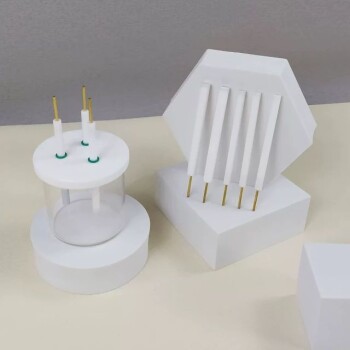
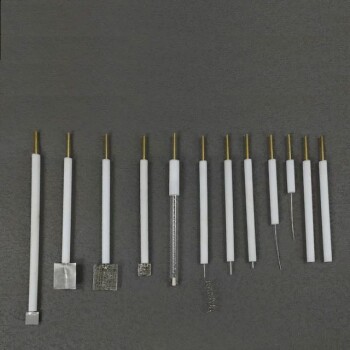
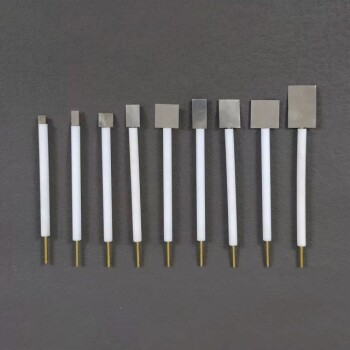
- Electrolytic cells and precision electrodes for stable three-electrode measurements.
- High-temperature furnaces and reactors for catalyst synthesis.
- Battery research tools and high-purity consumables like ceramics and crucibles.
Whether you are optimizing particle morphology or scaling process efficiency, KINTEK provides the reliable tools you need to ensure accurate, repeatable results.
Ready to upgrade your lab? Contact us today to explore our full range of solutions!
References
- Abdulsattar H. Ghanim, Syed Mubeen. Low-Loading of Pt Nanoparticles on 3D Carbon Foam Support for Highly Active and Stable Hydrogen Production. DOI: 10.3389/fchem.2018.00523
This article is also based on technical information from Kintek Solution Knowledge Base .
Related Products
- Rotating Platinum Disk Electrode for Electrochemical Applications
- HFCVD Machine System Equipment for Drawing Die Nano-Diamond Coating
- Chemical Vapor Deposition CVD Equipment System Chamber Slide PECVD Tube Furnace with Liquid Gasifier PECVD Machine
- RF PECVD System Radio Frequency Plasma-Enhanced Chemical Vapor Deposition RF PECVD
- Platinum Auxiliary Electrode for Laboratory Use
People Also Ask
- What is the working principle of a platinum disk electrode? A Guide to Precise Electrochemical Analysis
- What are the temperature limitations for a platinum disk electrode? The Critical Factor is the Insulating Body
- What can cause poisoning of a platinum disk electrode and how can it be prevented? Ensure Reliable Electrochemical Data
- How should a platinum disk electrode be polished? Master the Technique for Reliable Electrochemical Data
- How should a platinum disk electrode be used during an experiment? A Guide to Accurate Electrochemical Measurements