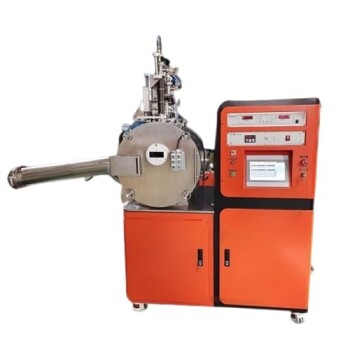
The primary function of a vacuum chamber during a Reduced Pressure Test (RPT) is to create a controlled low-pressure environment for liquid aluminum alloy just before it solidifies. This artificial drop in pressure forces dissolved gases to diffuse into microscopic impurities, effectively expanding them into visible defects that can be analyzed.
The vacuum chamber acts as an amplifier for hidden defects. By forcing dissolved gases to expand within microscopic oxide folds, it transforms invisible impurities into detectable cracks, providing a clear metric for the cleanliness of the metal melt.
The Mechanism of Defect Amplification
Creating a Low-Pressure Environment
The core operation of the RPT involves placing a sample of molten aluminum into the chamber and reducing the pressure.
This must occur while the alloy is still in a liquid state, prior to solidification. The vacuum alters the equilibrium of the melt, making it easier for gases to escape the solution.
Encouraging Gas Diffusion
In a standard atmosphere, dissolved gases might remain trapped harmlessly in the metal lattice.
Under the vacuum, these gases are encouraged to diffuse out of the liquid metal. Critically, they migrate toward existing discontinuities within the melt, specifically "bifilms."
Unfolding Bifilms
Bifilms are folded, microscopic oxide films that are often invisible in standard porosity tests.
The vacuum environment causes the diffusing gas to enter the folds of these bifilms. The pressure exerted by the gas forces the bifilm to expand and unfold, much like inflating a collapsed balloon.
From Microscopic to Visible
Creating Engineering Cracks
Without the vacuum, a bifilm might remain a harmless, microscopic flaw.
However, the expansion process triggered by the chamber transforms these microscopic features into macroscopic "engineering cracks." These are significantly larger voids that represent the true structural weakness of the material.
Enabling Accurate Evaluation
Once the metal solidifies with these expanded cracks, the sample can be properly assessed.
Operators can evaluate the severity of the contamination using radiographic testing (X-ray) or by cross-sectioning the sample for visual observation. This provides a tangible index of melt quality.
Understanding the Test Conditions
An Exaggerated State
It is important to recognize that the RPT creates conditions that are more severe than standard casting.
The vacuum deliberately exaggerates the size of defects. This is not necessarily how the metal would behave under normal atmospheric casting, but it is necessary to reveal the potential failure points hidden within the melt.
Dependency on Existing Oxides
The formation of these visible cracks relies on the presence of existing bifilms.
If the melt is perfectly clean (free of bifilms), the gas has nowhere to accumulate to form these specific cracks. Therefore, the test specifically targets the cleanliness of the melt regarding oxide inclusions.
Making the Right Choice for Your Goal
When utilizing RPT for aluminum alloys, your approach depends on what you are trying to verify.
- If your primary focus is Melt Cleanliness: Look for the presence of expanded cracks in the cross-section, as these confirm the presence of oxide bifilms.
- If your primary focus is Process Control: Use the severity of the expansion to gauge if your degassing or filtration steps are effectively removing impurities.
The vacuum chamber is not just removing air; it is a diagnostic tool that uses physics to make the invisible visible.
Summary Table:
| RPT Component/Step | Function & Impact |
|---|---|
| Vacuum Pressure | Creates a low-pressure environment to force gas out of the melt solution. |
| Gas Diffusion | Encourages dissolved gases to migrate toward microscopic discontinuities. |
| Bifilm Expansion | Unfolds microscopic oxide films into visible "engineering cracks." |
| Solidification | Preserves the expanded defects for subsequent visual or X-ray analysis. |
| Melt Quality Index | Provides a tangible metric for assessing cleanliness and degassing efficiency. |
Optimize Your Aluminum Melt Quality with KINTEK
Ensure the structural integrity of your castings by accurately detecting impurities before production. At KINTEK, we specialize in high-performance laboratory equipment designed for precision material testing. Beyond our advanced vacuum chambers for RPT, we offer a comprehensive suite of solutions including high-temperature furnaces, crushing and milling systems, and hydraulic presses for sample preparation.
Whether you are refining degassing protocols or conducting forensic material analysis, our expertise in high-temperature reactors and crucibles ensures your lab operates with industry-leading reliability.
Ready to elevate your process control? Contact our experts today to find the perfect equipment for your aluminum alloy research and quality assurance needs!
References
- John Campbell. Time-Dependent Failure Mechanisms of Metals; The Role of Precipitation Cleavage. DOI: 10.20944/preprints202508.2134.v1
This article is also based on technical information from Kintek Solution Knowledge Base .
Related Products
- 56L Vertical Laboratory Vacuum Drying Oven
- 23L Laboratory Vacuum Drying Oven
- Chemical Vapor Deposition CVD Equipment System Chamber Slide PECVD Tube Furnace with Liquid Gasifier PECVD Machine
- Vacuum Cold Trap Direct Cold Trap Chiller
- Vacuum Cold Trap Chiller Indirect Cold Trap Chiller
People Also Ask
- Why is a laboratory vacuum drying oven recommended for rice straw residues? Protect Your Biomass Integrity
- What role does a laboratory vacuum drying oven play in the preparation of modified multi-walled carbon nanotubes?
- What is the importance of using a laboratory vacuum drying oven? Preserving Slow-Release Microcapsule Integrity
- Why is a Laboratory Vacuum Drying Oven recommended for PBAT microspheres? Protect Sensitive Polymer Integrity
- What role does a laboratory vacuum drying oven play in processing nanoparticle powder samples? Protect Sample Integrity