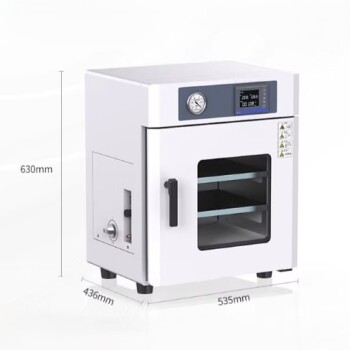
Vacuum drying is the definitive method for preserving catalyst longevity during the recovery process. By subjecting recovered catalysts to controlled heat—typically around 120°C—under negative pressure for extended periods, this process ensures the complete desorption of residual solvents and reactants without exposing the material to destructive thermal stress.
The vacuum environment facilitates the removal of trapped molecules from deep within catalyst pores at lower temperatures, effectively cleaning active sites while preventing the microstructural collapse often caused by high-temperature air drying.
Preserving Chemical Activity
Eliminating Pore Blockage
Recovered catalysts frequently retain solvent molecules and residual reactants deeply adsorbed within their porous structures.
If left untreated, these residues physically block active sites, rendering the catalyst ineffective for future reactions.
Vacuum drying applies negative pressure to forcibly extract these trapped substances, restoring the catalyst's accessible surface area.
Deep Solvent Removal
Standard drying methods often fail to remove solvents with high boiling points that are trapped in narrow pores.
The vacuum lowers the boiling point of these solvents, facilitating their evaporation at moderate temperatures.
This ensures a "deep clean" of the internal architecture that surface-level air drying cannot achieve.
Maintaining Structural Integrity
Preventing Microstructural Collapse
One of the primary risks in catalyst recovery is the physical degradation of the material's framework.
High-temperature air drying can cause the delicate pore structure to collapse, permanently reducing catalytic activity.
Vacuum drying operates at lower effective temperatures, avoiding this thermal damage and preserving the catalyst's microstructure.
Ensuring Multi-Cycle Stability
The combination of clean active sites and an intact physical structure allows for repeated use.
Properly vacuum-dried catalysts have been proven to maintain stable catalytic activity for at least five consecutive reaction cycles.
This stability is critical for economic efficiency, as it significantly extends the lifespan of expensive catalytic materials.
Understanding the Trade-offs
Process Duration vs. Speed
Vacuum drying is generally a time-intensive process, often requiring treatment times of up to 24 hours to ensure complete desorption.
This is significantly slower than rapid air drying, creating a potential bottleneck in high-throughput workflows.
Equipment Dependency
Unlike simple convective drying, this method relies on the integrity of vacuum pumps and seals.
Mechanical failures or leaks in the vacuum system can lead to incomplete drying, which may compromise the subsequent reaction cycle without the operator's knowledge.
Making the Right Choice for Your Process
To determine if vacuum drying is necessary for your specific application, consider your stability goals:
- If your primary focus is extending catalyst lifespan: Implement vacuum drying to prevent microstructural collapse and ensure stability for 5+ cycles.
- If your primary focus is restoring maximum activity: Use vacuum conditions to ensure the total removal of high-boiling point solvents that block active sites.
By decoupling solvent removal from high thermal stress, vacuum drying transforms fragile recovered materials into robust, reusable assets.
Summary Table:
| Feature | Vacuum Drying Benefit | Impact on Catalyst |
|---|---|---|
| Temperature Control | Effective evaporation at lower temps | Prevents microstructural collapse and thermal damage |
| Pore Cleaning | Forced extraction of trapped molecules | Unblocks active sites to restore chemical activity |
| Cycle Stability | Maintains integrity for 5+ cycles | Extends material lifespan and improves economic efficiency |
| Solvent Removal | Lowers boiling points of trapped solvents | Achieves deep cleaning of internal architectures |
Maximize Your Catalyst Life with KINTEK Precision Drying
Don't let residual solvents or thermal stress compromise your research. KINTEK specializes in high-performance laboratory equipment designed to protect your most sensitive materials. Our range of vacuum drying ovens, high-temperature furnaces, and rotary systems provides the precise environment needed to maintain catalyst stability across multiple cycles.
From crushing and milling systems for preparation to high-pressure reactors for testing, KINTEK offers the comprehensive tools required for advanced material science.
Ready to enhance your lab's efficiency and catalyst longevity? Contact us today to find the perfect drying solution for your workflow!
References
- Luxin Zhang, Meng Hu. Catalytic conversion of carbohydrates into 5-ethoxymethylfurfural using γ-AlOOH and CeO<sub>2</sub>@B<sub>2</sub>O<sub>3</sub> catalyst synergistic effect. DOI: 10.1039/d2ra01866g
This article is also based on technical information from Kintek Solution Knowledge Base .
Related Products
- 56L Vertical Laboratory Vacuum Drying Oven
- 23L Laboratory Vacuum Drying Oven
- Laboratory Scientific Electric Heating Blast Drying Oven
- Benchtop Laboratory Vacuum Freeze Dryer
- Dental Porcelain Zirconia Sintering Ceramic Vacuum Press Furnace
People Also Ask
- Why is a laboratory vacuum drying oven recommended for rice straw residues? Protect Your Biomass Integrity
- What role does a laboratory vacuum drying oven play in the preparation of modified multi-walled carbon nanotubes?
- What is the importance of using a laboratory vacuum drying oven? Preserving Slow-Release Microcapsule Integrity
- Why is a Laboratory Vacuum Drying Oven recommended for PBAT microspheres? Protect Sensitive Polymer Integrity
- What role does a laboratory vacuum drying oven play in processing nanoparticle powder samples? Protect Sample Integrity