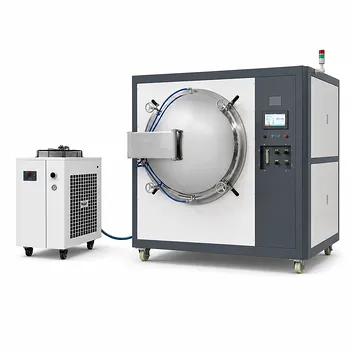
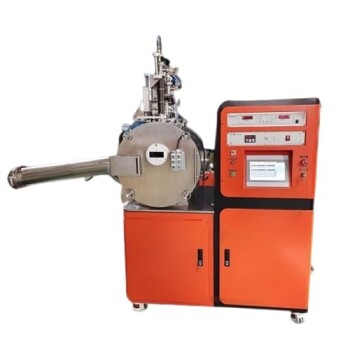
Vacuum Hot Pressing Sintering (VHPS) functions as a comprehensive densification system for CoCrFeNiMn high-entropy alloys by simultaneously applying high thermal energy and uniaxial mechanical pressure within a controlled vacuum environment. By integrating these forces, the system bypasses the limitations of conventional sintering to produce a near-fully dense bulk material at temperatures significantly below the alloy's melting point.
The core value of VHPS lies in its ability to overcome the high diffusion resistance of high-entropy alloy powders. It mechanically forces particle rearrangement and plastic deformation while strictly controlling the atmosphere to prevent the oxidation of reactive elements like Manganese and Chromium.
Driving Density Through Pressure and Heat
Overcoming Diffusion Resistance
The primary challenge in sintering CoCrFeNiMn alloys is the sluggish diffusion rate typical of high-entropy systems. VHPS addresses this by applying uniaxial pressure (e.g., 50 MPa) directly to the powder during heating. This pressure significantly reduces the diffusion resistance between particles, accelerating the consolidation process.
Promoting Plastic Deformation
Under simultaneous heat (e.g., 900°C) and pressure, the alloy powder undergoes significant plastic deformation. This mechanical force crushes the powder particles together, effectively closing voids and eliminating porosity that thermal energy alone might not remove.
Accelerating Atomic Diffusion via Dislocations
The application of continuous mechanical pressure introduces dislocations within the material's microstructure. These dislocations serve as fast-track diffusion channels, further speeding up the atomic movement required for densification.
Critical Function of the Vacuum Environment
Preventing High-Temperature Oxidation
CoCrFeNiMn alloys contain elements that are highly susceptible to oxidation, specifically Chromium (Cr), Manganese (Mn), and Iron (Fe). The VHPS system maintains a high vacuum (e.g., greater than 1x10^-2 Pa) to eliminate oxygen, ensuring the final material retains excellent mechanical properties and is free of oxide inclusions.
Degassing and Volatile Removal
Before the pores close completely, the negative pressure environment actively exhausts gases and volatiles trapped within the powder gaps. This "degassing" is foundational for achieving high bonding strength, as it prevents gas pockets from becoming permanently trapped inside the dense metal.
The Role of Graphite Molds
The system typically utilizes graphite molds, which provide uniform pressure transfer and thermal stability. Additionally, graphite generates a reducing atmosphere at high temperatures, offering a secondary layer of protection against oxidation for the metal powder.
Understanding the Trade-offs
Balancing Temperature and Grain Growth
Precise temperature control is required to manage the trade-off between densification and microstructural integrity. While higher temperatures promote faster diffusion and phase transformation (such as BCC to FCC), overheating can lead to abnormal grain growth, which degrades the mechanical strength of the alloy.
Pressure and Elemental Segregation
While pressure generally aids homogeneity, it must be optimized to prevent or correct phase separation. Research indicates that increasing hot-pressing pressure helps eliminate the separation of distinct phases (such as Cu-rich zones in similar alloys), thereby optimizing the overall phase structure.
Making the Right Choice for Your Goal
To maximize the effectiveness of VHPS for your specific high-entropy alloy project, consider these functional priorities:
- If your primary focus is Maximum Density: Prioritize high uniaxial pressure (up to 50 MPa) to mechanically force pore closure and induce plastic deformation.
- If your primary focus is Material Purity: Ensure the vacuum level is maintained strictly above 1x10^-2 Pa to prevent the oxidation of Manganese and Chromium.
- If your primary focus is Mechanical Strength: optimize the sintering temperature to achieve full density while avoiding the temperature threshold that triggers abnormal grain growth.
Ultimately, the VHPS system is not just a furnace, but a tool for microstructural engineering that balances mechanical force with thermal kinetics to achieve superior alloy integrity.
Summary Table:
| Functional Feature | Role in Densification | Key Benefit |
|---|---|---|
| Uniaxial Pressure | Forces particle rearrangement and plastic deformation | Eliminates porosity and closes voids |
| Vacuum Environment | Removes oxygen and exhaust volatiles | Prevents oxidation of Cr, Mn, and Fe |
| Thermal Energy | Activates atomic diffusion | Accelerates sintering at lower temperatures |
| Graphite Molds | Provides uniform pressure and reducing atmosphere | Ensures microstructural stability |
| Dislocation Creation | Provides fast-track diffusion channels | Overcomes sluggish diffusion resistance |
Elevate Your Material Research with KINTEK Precision Engineering
Unlock the full potential of your high-entropy alloys with KINTEK’s advanced Vacuum Hot Pressing Sintering (VHPS) systems. Our specialized laboratory equipment is designed to handle the rigorous demands of modern metallurgy, offering precise control over temperature and pressure to ensure your CoCrFeNiMn alloys achieve superior density and mechanical integrity.
Beyond VHPS, KINTEK offers a comprehensive range of high-temperature furnaces (muffle, vacuum, CVD, and induction melting), crushing and milling systems, and high-pressure reactors tailored for researchers and industrial innovators. Whether you need reliable hydraulic presses for pelletizing or specialized ceramic and graphite consumables, our solutions empower you to eliminate oxidation and master microstructural engineering.
Ready to optimize your sintering process? Contact our technical experts today to find the perfect equipment for your lab's specific needs.
Related Products
- Vacuum Heat Treat and Sintering Furnace with 9MPa Air Pressure
- Vacuum Heat Treat and Pressure Sintering Furnace for High Temperature Applications
- 600T Vacuum Induction Hot Press Furnace for Heat Treat and Sintering
- Vacuum Heat Treat Sintering Brazing Furnace
- Vacuum Heat Treat and Molybdenum Wire Sintering Furnace for Vacuum Sintering
People Also Ask
- What is the process of pressure sintering? Achieve Superior Density and Strength for High-Performance Parts
- What is the effect of pressure during sintering? Achieve Higher Density and Finer Microstructures Faster
- Why must green bodies produced via binder jetting undergo treatment in a vacuum sintering furnace?
- What is a vacuum sintering furnace? Unlock Purity and Performance in Advanced Materials
- How does the vacuum environment impact sintering of diamond-copper composites? Protect Against Thermal Damage