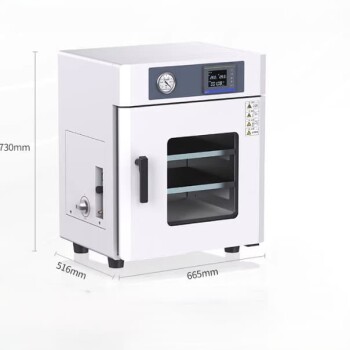
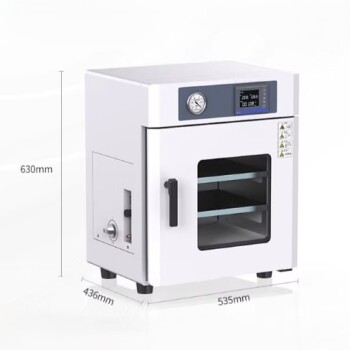
The primary function of the vacuum oven is to facilitate the controlled drying of electrode slurry coated on aluminum foil under reduced pressure. This environment accelerates the evaporation of the N-methyl-2-pyrrolidone (NMP) solvent while simultaneously preventing the oxidation of the active fluorinated graphene materials.
By operating in a reduced pressure environment, the vacuum oven achieves rapid solvent removal without high thermal stress or oxygen exposure. Its most critical role, however, is the complete elimination of residual moisture to prevent violent chemical reactions during final battery assembly.
The Mechanics of Solvent Removal
Accelerating NMP Evaporation
The slurry used for these electrodes typically relies on N-methyl-2-pyrrolidone (NMP) as a solvent.
Because NMP has a high boiling point, standard drying would require excessive heat or time. The vacuum oven reduces the ambient pressure, significantly lowering the boiling point of the NMP and accelerating its evaporation rate.
Preventing Material Oxidation
Drying at high temperatures in standard air can degrade sensitive active materials.
By creating a vacuum, the oven removes oxygen from the chamber. This ensures the fluorinated graphene and other components are dried effectively without suffering from oxidation, preserving their electrochemical properties.
Structural Integrity and Connectivity
Solidifying the Binder Matrix
The drying process is not just about removing liquid; it is about forming a solid structural architecture.
As the NMP evaporates, the PVDF binder must lock the solid components into place. The vacuum oven ensures this transition happens uniformly across the aluminum foil substrate.
Ensuring Electrochemical Contact
A high-performance battery requires a continuous conductive path.
Proper vacuum drying creates a tight electrochemical contact between the fluorinated graphene, the conductive carbon black, and the binder. This close contact is essential for the efficient flow of electrons during battery operation.
The Critical Safety Function
Total Moisture Elimination
Beyond removing the NMP solvent, the vacuum oven serves a vital safety role by removing residual moisture.
Trace amounts of water can get trapped in the porous electrode structure. The vacuum environment is effective at drawing out this deep-seated moisture that standard drying might miss.
Preventing Anode Reactions
The presence of water is a catastrophic failure mode for lithium primary batteries.
If moisture remains in the electrode sheet, it will react violently with the lithium metal anode during battery assembly. The vacuum oven is the final safeguard against these dangerous chemical reactions.
Understanding the Trade-offs
The Risk of Incomplete Drying
While the vacuum accelerates the process, cutting the drying time too short is a common pitfall.
If the process is rushed, residual NMP may remain deep within the electrode coating. This leads to a weak binder structure and poor adhesion to the aluminum foil, ultimately causing electrode delamination.
Moisture Re-adsorption
Even after successful vacuum drying, the electrodes are highly susceptible to moisture uptake.
Manufacturers must handle the dried sheets in dry rooms immediately after removal from the oven. Failure to maintain a low-humidity environment post-drying renders the vacuum process useless, re-introducing the risk of reaction with the lithium anode.
Making the Right Choice for Your Goal
To maximize the effectiveness of your electrode preparation, consider the following priorities:
- If your primary focus is Cell Performance: Ensure the vacuum cycle is long enough to fully evaporate NMP, guaranteeing tight contact between the graphene, carbon black, and PVDF binder.
- If your primary focus is Safety: Prioritize the depth of the vacuum to remove every trace of moisture, preventing violent interactions with the lithium metal anode.
The vacuum oven is not merely a drying tool; it is the gatekeeper of both the structural integrity and the operational safety of your battery cell.
Summary Table:
| Feature | Function in Electrode Preparation | Benefit |
|---|---|---|
| Reduced Pressure | Lowers NMP boiling point | Rapid solvent removal without high heat |
| Oxygen-Free Environment | Eliminates air from the chamber | Prevents oxidation of fluorinated graphene |
| Structural Solidification | Uniformly cures PVDF binder | Ensures adhesion and electrochemical contact |
| Moisture Extraction | Removes trace water content | Prevents violent reactions with lithium metal |
| Thermal Control | Regulated heating in vacuum | Avoids delamination and maintains material integrity |
Precision drying is the foundation of battery innovation. KINTEK specializes in laboratory equipment designed for the most demanding research, offering a comprehensive range of high-performance vacuum ovens specifically engineered for material science. Whether you are working with fluorinated graphene-based lithium primary batteries or advanced electrode architectures, our solutions ensure optimal solvent removal and total moisture elimination. Beyond drying, KINTEK provides a full suite of high-temperature furnaces, crushing and milling systems, and hydraulic presses to streamline your entire preparation workflow. Enhance your lab's efficiency and ensure the safety of your battery assembly—contact our technical experts today to find the perfect equipment for your research goals!
References
- Xu Bi, Jin Zhou. Fluorinated Graphene Prepared by Direct Fluorination of N, O-Doped Graphene Aerogel at Different Temperatures for Lithium Primary Batteries. DOI: 10.3390/ma11071072
This article is also based on technical information from Kintek Solution Knowledge Base .
Related Products
- 56L Vertical Laboratory Vacuum Drying Oven
- 23L Laboratory Vacuum Drying Oven
- Vacuum Heat Treat Sintering Brazing Furnace
- 2200 ℃ Graphite Vacuum Heat Treat Furnace
- Dental Porcelain Zirconia Sintering Ceramic Vacuum Press Furnace
People Also Ask
- Why is a laboratory vacuum drying oven recommended for rice straw residues? Protect Your Biomass Integrity
- What role does a laboratory vacuum drying oven play in the preparation of modified multi-walled carbon nanotubes?
- What is the importance of using a laboratory vacuum drying oven? Preserving Slow-Release Microcapsule Integrity
- Why is a Laboratory Vacuum Drying Oven recommended for PBAT microspheres? Protect Sensitive Polymer Integrity
- What role does a laboratory vacuum drying oven play in processing nanoparticle powder samples? Protect Sample Integrity