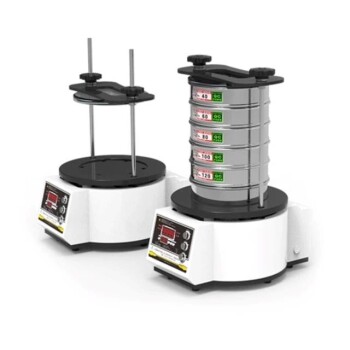
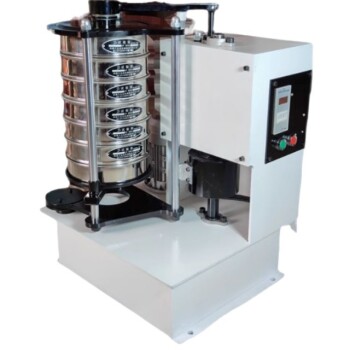
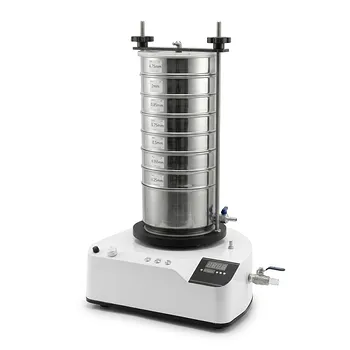
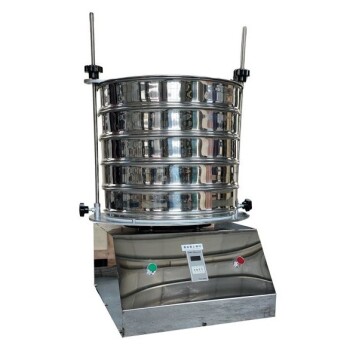
The primary function of a vibrating sieve in the preparation phase of biomass pyrolysis is to classify crushed materials into a consistent, uniform particle size. By filtering biomass through a specific standard, such as 100 mesh, the sieve ensures that only particles with optimal dimensions enter the reactor, acting as a critical quality control step before thermal processing begins.
Core Takeaway: In biomass pyrolysis, consistency is the precursor to efficiency. A vibrating sieve eliminates physical variability in raw materials, ensuring that every particle behaves predictably under heat to prevent process failures like incomplete degradation.
The Critical Role of Particle Uniformity
Ensuring Consistent Heat Transfer
The efficiency of a pyrolysis reactor depends heavily on thermal dynamics. If biomass particles vary significantly in size, they will absorb heat at different rates.
A vibrating sieve standardizes these inputs—for example, within a range of 0.25 to 0.40 mm—to guarantee that heat penetrates every piece of biomass uniformly. This creates a stable thermal environment where the entire feedstock reacts simultaneously.
Preventing Reaction Anomalies
When particle sizes are unregulated, the chemical reaction becomes unpredictable. Large particles may suffer from incomplete degradation, as heat fails to reach their core during the residence time.
Conversely, extremely small particles are prone to localized over-pyrolysis, where they degrade too quickly or burn. By strictly grading the material, the sieve prevents these extremes, ensuring the final bio-oil or biochar product is of consistent quality.
Improving Process Repeatability
For both industrial applications and experimental research, data reliability is paramount. Physical variables in the feedstock are a major source of error.
By using a vibrating sieve to remove these variables, operators ensure that moisture and heat interact with the biomass components identically in every run. This leads to higher experimental repeatability and more accurate performance data.
Understanding the Operational Considerations
The Necessity of Regrinding
Implementing a vibrating sieve reveals the inconsistencies in the crushing phase. Material that does not pass through the mesh cannot simply be discarded; it typically requires re-routing for further crushing.
This feedback loop ensures maximum resource utilization but adds a layer of complexity to the material handling system.
Balancing Flow Rate and Precision
There is an inherent tension between throughput speed and classification accuracy. A finer mesh (e.g., 100 mesh) ensures higher quality heat transfer but may slow down the preparation line.
Operators must select a mesh size that balances the chemical needs of the reactor with the production targets of the facility.
Making the Right Choice for Your Goal
To optimize your biomass preparation phase, align your sieving strategy with your specific objectives:
- If your primary focus is maximizing product quality: Prioritize a strict mesh size (e.g., 100 mesh) to eliminate localized over-pyrolysis and ensure complete degradation.
- If your primary focus is experimental research: Use precise grading to remove physical variables, ensuring that any changes in results are due to reaction parameters, not feedstock inconsistency.
Uniform particle preparation is the invisible foundation upon which successful pyrolysis reactions are built.
Summary Table:
| Feature | Impact on Pyrolysis | Importance |
|---|---|---|
| Particle Uniformity | Ensures consistent heat transfer and simultaneous reaction. | High |
| 100 Mesh Standard | Prevents incomplete degradation of large particles. | Critical |
| Variable Removal | Improves experimental repeatability and data accuracy. | High |
| Feedback Loop | Facilitates regrinding to maximize resource utilization. | Moderate |
Maximize Your Pyrolysis Efficiency with KINTEK
Achieve the ultimate precision in your material preparation. KINTEK specializes in high-performance laboratory equipment, providing the crushing, milling, and sieving systems essential for uniform feedstock. Whether you are conducting advanced biomass research or industrial processing, our range of vibrating sieves, high-temperature furnaces, and vacuum reactors ensures your experiments are repeatable and your yields are optimized.
Ready to eliminate variables and enhance your lab's performance? Contact KINTEK today to discover how our expert solutions can streamline your workflow.
References
- Tutuk Djoko Kusworo, Dani Puji Utomo. Bio-oil and Fuel Gas Production from Agricultural Waste via Pyrolysis: A Comparative Study of Oil Palm Empty Fruit Bunches (OPEFB) and Rice Husk. DOI: 10.3311/ppch.14553
This article is also based on technical information from Kintek Solution Knowledge Base .
Related Products
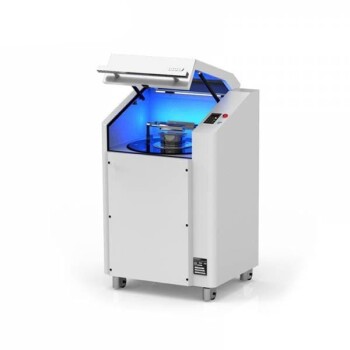
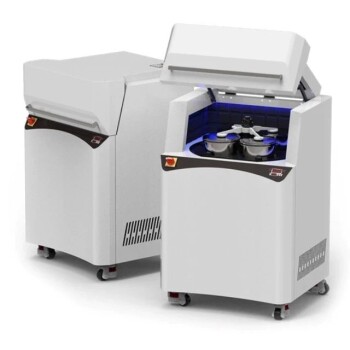
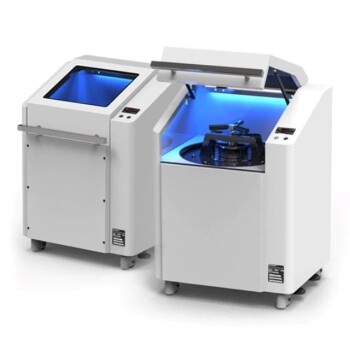
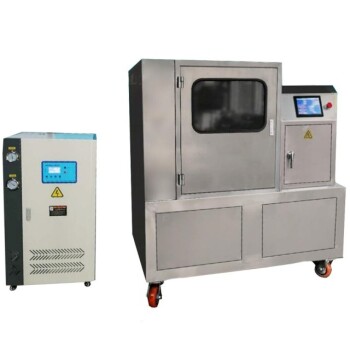
- Vibratory Sieve Shaker Machine Dry Three-Dimensional Vibrating Sieve
- Laboratory Vibratory Sieve Shaker Machine Slap Vibrating Sieve
- Laboratory Wet Three-Dimensional Vibratory Sieve Shaker Machine
- Laboratory Test Sieves and Vibratory Sieve Shaker Machine
- Laboratory Vibratory Sieve Shaker Machine for Dry and Wet Three-Dimensional Sieving
People Also Ask
- How is a vibratory sieve shaker used in the particle size analysis of mechanically alloyed powders? Expert Guide
- Why use a vibratory sieve shaker for PET powder? Achieve Precise Particle Size Control for Chemical Research
- What is the principle of vibratory sieve shaker? Achieve Accurate Particle Size Analysis
- What is the function of a vibratory sieve shaker? Achieve Precise Particle Size Analysis
- What is the use of vibratory sieve shaker? Achieve Precise Particle Size Analysis for Your Lab