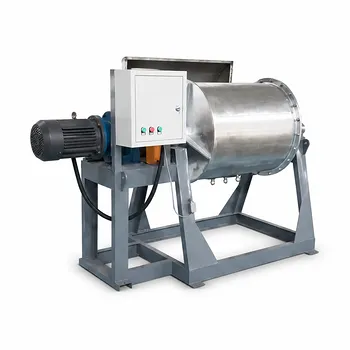
High-energy ball milling functions as the kinetic driver for solid-state alloying in the production of ODS steel. It utilizes intense impact and shear forces to repeatedly fracture and cold-weld raw metal and oxide powders. This forced mechanical mixing achieves an atomic-level distribution of components that is generally impossible to achieve through standard liquid melting processes.
Core Takeaway The equipment’s primary role is to mechanically force oxide particles (like yttria) into a metal matrix to create a uniform, ultrafine nanostructure. This mechanical alloying is the absolute prerequisite for achieving the superior high-temperature strength and radiation resistance that define ODS steels.
The Mechanics of Solid-State Alloying
Cyclical Cold-Welding and Fracturing
The fundamental mechanism relies on the repeated interaction between the powder and the grinding media. As the mill rotates, the high-energy impact of the balls causes the powder particles to flatten and cold-weld together.
Simultaneously, the work-hardened particles become brittle and fracture. This continuous cycle of welding and breaking ensures that the constituents are mixed thoroughly, eventually leading to a homogeneous composite particle.
Inducing Severe Plastic Deformation
The equipment delivers high kinetic energy to the powder, causing severe plastic deformation. This action breaks down agglomerated oxide particles into much finer sizes.
This deformation physically embeds the alloying elements into the pre-alloyed powder matrix. It forces the materials to mix at an atomic level, creating a true solid solution without ever reaching the melting point of the metal.
Engineering the Microstructure
Achieving Uniform Dispersion
The defining characteristic of ODS steel is the presence of uniformly distributed nano-oxides. The ball milling process ensures these oxides are not clumped together.
By generating intense shear forces, the equipment disperses oxide particles evenly throughout the metal matrix. This uniform dispersion is critical; without it, the final steel would lack the ultrafine grain structure required for its advanced properties.
Creating a Supersaturated Solution
The process does more than just mix; it alters the material's state. The high-energy collisions introduce high-density lattice distortions and defects into the matrix.
This creates a supersaturated solid solution. This unstable state is intentional, as it provides the necessary environment for nano-oxides to precipitate dispersedly during subsequent sintering or thermal processing.
Operational Criticalities
Kinetic Energy Transfer
To achieve the necessary alloying, the equipment must transfer significant kinetic energy. This is typically achieved using high-density grinding media, such as high-strength steel balls.
Optimizing the ball-to-powder ratio (often around 10:1) is essential. This ensures the collision frequency and energy impact are sufficient to drive the alloying process efficiently.
Atmosphere Control
The milling process drastically increases the specific surface area of the metal powders. This makes them highly reactive and susceptible to unintended oxidation.
Therefore, the equipment must operate with vacuum milling jars or in a controlled inert atmosphere. This isolation prevents active elements (like aluminum or titanium) from oxidizing prematurely, ensuring the chemical purity of the final alloy.
Understanding the Trade-offs
Risk of Impurity Contamination
While high-energy impact is necessary for alloying, it causes wear on the grinding media and the jar liner. This can introduce impurities, such as excess carbon or iron, into the powder mixture.
These impurities can negatively affect the final mechanical properties. The process requires a careful balance between sufficient energy for alloying and minimizing contamination from equipment wear.
Thermal Instability and Oxidation
The process inputs massive amounts of mechanical energy, which can generate localized heat. If the milling environment is not strictly controlled, the highly reactive powders can oxidize instantly.
Uncontrolled oxidation ruins the specific oxide dispersion required for ODS steel. Reliance on vacuum systems adds complexity and cost but is a non-negotiable requirement for high-quality powder production.
Making the Right Choice for Your Goal
When configuring your high-energy ball milling process for ODS steel, your priorities will dictate your operational parameters.
- If your primary focus is Maximum Strength: Prioritize higher impact energy and longer milling durations to maximize lattice defects and achieve the finest possible oxide dispersion.
- If your primary focus is Material Purity: Use wear-resistant jar liners and strictly controlled vacuum environments to minimize contamination from media wear and atmospheric oxygen.
- If your primary focus is Process Efficiency: Optimize the ball-to-powder ratio to maximize collision frequency, reducing the total time required to reach a homogenized state.
Success in ODS steel production depends entirely on using the ball mill not just as a mixer, but as a tool to force atomic-level structural changes in the solid state.
Summary Table:
| Function | Mechanism | Impact on ODS Steel |
|---|---|---|
| Mechanical Alloying | Repeated cold-welding & fracturing | Achieves atomic-level mixing of oxides & metal |
| Size Reduction | Severe plastic deformation | Breaks down oxides into ultrafine nano-particles |
| Microstructure Design | Lattice distortion induction | Creates supersaturated solutions for precipitation |
| Contamination Control | Vacuum/Inert atmosphere | Prevents unintended oxidation of reactive elements |
Elevate Your Advanced Material Research with KINTEK
Precision in ODS steel production begins with superior mechanical alloying. KINTEK specializes in high-performance laboratory equipment designed for the most demanding solid-state chemistry applications.
Our comprehensive range of crushing and milling systems, including high-energy ball mills, provides the kinetic energy and atmospheric control necessary for atomic-level dispersion. Whether you are developing radiation-resistant alloys or high-temperature materials, our expert solutions—from vacuum milling jars to planetary mills and high-temperature furnaces—ensure your research achieves maximum strength and purity.
Ready to optimize your alloying process? Contact our specialists today to find the perfect equipment configuration for your lab's success.
References
- Hideo Sakasegawa, Masami Ando. Corrosion-resistant coating technique for oxide-dispersion-strengthened ferritic/martensitic steel. DOI: 10.1080/00223131.2014.894950
This article is also based on technical information from Kintek Solution Knowledge Base .
Related Products
- High Energy Planetary Ball Mill Milling Machine for Laboratory
- High Energy Planetary Ball Mill for Laboratory Horizontal Tank Type Milling Machine
- High-Energy Omnidirectional Planetary Ball Mill Milling Machine for Laboratory
- High Energy Planetary Ball Mill Milling Machine for Laboratory
- High Energy Planetary Ball Mill Machine for Laboratory Horizontal Tank Type
People Also Ask
- What role do planetary ball mills and zirconia media play in LLZT preparation? Optimize Your Solid Electrolyte Research
- What is the primary function of a planetary ball mill? Mastering SiC/Al Composite Mixing for Homogeneity
- What is the primary purpose of using a planetary ball mill for LAGP? Achieve High-Purity Solid-State Electrolytes
- What role does a planetary ball mill play in the preparation of LGVO powders? Precision Refinement for Aerosol Deposition
- What is the function of a planetary ball mill in the preparation of high-entropy rare earth silicate multi-phase ceramics?