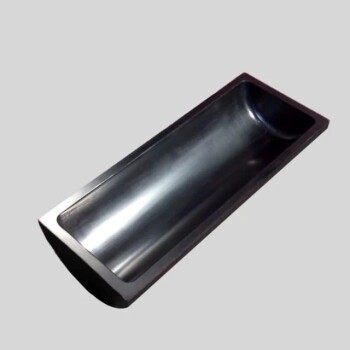
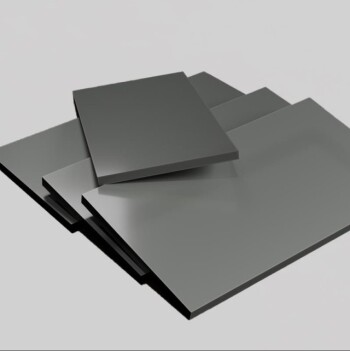
High-temperature graphite molds primarily serve as the critical interface between the manufacturing equipment and the composite material, functioning as both a shaping vessel and a transmission medium. In the production of metal laminated composites, these molds fix the geometry of the metal foil stack and transfer the immense pressure from the hydraulic system directly to the sample surface.
The core function of the graphite mold is to translate raw hydraulic force and thermal energy into uniform pressure and heat. This ensures the metal foil stack bonds consistently without local defects, warping, or variations in thickness.
The Mechanical Function: Shaping and Pressure
Fixing the Geometry
The primary role of the mold is to act as a positioning container. It secures the multi-layer metal foil stacks in a precise alignment.
By preventing lateral movement of the foils, the mold ensures the final product maintains the intended shape and dimensional precision. This containment is essential for defining the final geometry of the composite plate.
Uniform Force Transmission
The mold acts as the medium for force transmission. It takes the axial load applied by the hot press hydraulic system and distributes it onto the sample surface.
Because the mold is rigid, it converts point-source loads into uniform stress distribution across the entire laminate. This prevents local non-bonding defects that would occur if pressure were applied unevenly.
Withstanding Extreme Loads
To function correctly, the mold must possess exceptional high-temperature mechanical strength. It must withstand pressures of tens of megapascals (often 20–35 MPa) without deforming.
If the mold were to deform under this load, the composite would suffer from uneven thickness. The graphite maintains its structural integrity even at temperatures exceeding 1000°C, ensuring the matrix material flows properly to fill gaps.
The Thermal Function: Conductivity and Heating
Ensuring Thermal Homogeneity
Graphite is chosen for its excellent thermal conductivity. The mold ensures that heat is transferred efficiently and uniformly from the furnace environment to the powder or foil stack inside.
Uniform heat transfer is vital for the microstructural consistency of the material. It prevents thermal gradients that could lead to uneven sintering or residual stresses within the laminated composite.
Acting as a Heating Element
In many vacuum hot pressing setups, the graphite mold serves a dual purpose as an induction or resistive heating receptor.
It converts electromagnetic energy into heat, effectively becoming the heat source itself. This allows for rapid and efficient heating of the composite material from the outside in.
Understanding the Trade-offs
Environmental Sensitivity
While graphite is excellent in a vacuum, it is highly susceptible to oxidative loss in oxygen-rich environments. The vacuum atmosphere is strictly required not just for the composite quality, but to prevent the mold itself from degrading or burning away.
Mechanical Fragility
Graphite has high compressive strength but is brittle. While it can handle the crushing force of the press, it has low impact resistance. Molds must be handled with care during loading and unloading to avoid chipping or cracking, which would ruin the surface finish of subsequent composites.
Making the Right Choice for Your Goal
When selecting or designing graphite molds for metal laminated composites, align your approach with your specific production targets:
- If your primary focus is Dimensional Precision: Prioritize high-density graphite grades with superior machining tolerances to ensure exact alignment of the metal foil stack.
- If your primary focus is Defect Prevention (Non-bonding): focus on the mold's wall thickness and geometry to ensure it can distribute maximal axial pressure (up to 35 MPa) without slightest deformation.
- If your primary focus is Process Efficiency: Utilize graphite grades optimized for induction receptivity to shorten heating cycles while acting as the heating element.
By leveraging the high-temperature stability and conductivity of graphite, you transform a chaotic high-energy environment into a controlled process that yields structurally sound composites.
Summary Table:
| Function Category | Role of Graphite Mold | Key Benefit |
|---|---|---|
| Mechanical | Geometry Fixing & Shaping | Ensures dimensional precision and prevents foil shifting. |
| Pressure | Uniform Force Transmission | Distributes hydraulic load evenly to prevent bonding defects. |
| Thermal | High Thermal Conductivity | Provides thermal homogeneity and eliminates microstructural gradients. |
| Heating | Induction/Resistive Receptor | Converts energy to heat, acting as an efficient local heat source. |
| Structural | High-Temp Strength | Withstands 20–35 MPa at 1000°C+ without deformation. |
Elevate Your Material Research with KINTEK Precision Engineering
Achieving perfect bonding in metal laminated composites requires more than just high temperatures; it demands the right equipment and high-performance consumables. KINTEK specializes in advanced laboratory solutions, providing the high-quality vacuum hot pressing furnaces and precision-machined graphite molds your research depends on.
Beyond hot pressing, our portfolio includes:
- High-Temperature Furnaces: Muffle, tube, rotary, and CVD/PECVD systems.
- Sample Preparation: Crushing, milling, sieving, and hydraulic pellet presses.
- Specialized Reactors: High-temperature high-pressure reactors, autoclaves, and electrolytic cells.
- Consumables: High-purity ceramics, crucibles, and PTFE products.
Don't let equipment limitations hinder your innovation. Contact KINTEK today to optimize your production workflow and discover how our tailored solutions can improve your material consistency and lab efficiency.
Related Products
- Ultra-High Temperature Graphite Vacuum Graphitization Furnace
- High Purity Pure Graphite Crucible for Evaporation
- Vertical High Temperature Graphite Vacuum Graphitization Furnace
- Horizontal High Temperature Graphite Vacuum Graphitization Furnace
- 2200 ℃ Graphite Vacuum Heat Treat Furnace
People Also Ask
- What is the disadvantage of graphite furnace? Managing Reactivity and Contamination Risks
- Is a graphite melting point high or low? Discover Its Extreme Thermal Resilience
- What are the advantages and disadvantages of graphite furnace? Unlock Extreme Heat Performance
- What gas is used in graphite furnace? Maximize Accuracy with the Right Inert Gas
- What is the temperature range of a graphite furnace? Unlock up to 3000°C for advanced materials processing.