The primary function of mechanochemical grinding equipment is to act as a dual-purpose reactor: it achieves nano-level mixing of raw materials while simultaneously inducing "mechanical activation." By utilizing high-energy collisions and shear forces, the equipment lowers the activation energy required for subsequent solid-phase reactions, ensuring the successful synthesis of Li2ZrO3 and Li4SiO4 ceramics.
Core Takeaway Mechanochemical grinding is not merely a physical mixing process; it is an energy-transfer method. By introducing lattice distortions at the molecular level, it lowers the thermal energy required during sintering, directly enabling the formation of highly uniform, stable crystal structures.
The Mechanism of Action
To understand the value of this equipment, one must look beyond simple blending. The process relies on specific high-energy mechanical forces to alter the physical and chemical state of the reactants.
High-Energy Impact and Friction
The equipment, often a planetary ball mill, does not just stir components; it subjects them to intense violence.
By utilizing grinding media and specific operational speeds (e.g., 400 rpm), the machine generates high-energy collisions and shear forces. This mechanical stress is critical for breaking down stoichiometric initial powder components.
Nano-Level Homogeneity
Standard mixing results in pockets of isolated material. Mechanochemical grinding achieves a microscopic mixture.
This process forces components to mix at the nano-level, and in some cases, the molecular level. This proximity is essential for ensuring that the lithium, zirconium, and silicon atoms are perfectly positioned for reaction.
The Role of Mechanical Activation
The most distinct advantage of this equipment is "mechanical activation." This phenomenon changes how the material behaves under heat.
Lowering the Energy Barrier
In standard solid-state synthesis, significant heat is required to force atoms to react. Mechanochemical grinding pre-energizes the material.
By applying mechanical force, the process reduces the activation energy required for the solid-phase reaction. This means the material is primed to react before it ever enters the furnace.
Inducing Lattice Distortion
The intense impact and friction physically deform the crystalline structure of the raw powders.
This induces lattice distortion, creating defects and stress within the material. These distortions make the structure chemically unstable and highly reactive, which facilitates easier phase transformation during heat treatment.
Impact on Sintering and Final Structure
The work done by the grinding equipment directly dictates the quality of the final ceramic product during the 1000 °C sintering process.
Ensuring Structural Uniformity
Because the materials are mixed at the nano-level and pre-activated, the final ceramic avoids segregation.
The process ensures the formation of a uniform crystal structure. This uniformity is vital for the consistent performance of Li2ZrO3 and Li4SiO4 ceramics in practical applications.
Stabilizing Phase Formation
The ultimate goal is a stable, ordered material.
The mechanical activation promotes the formation of stable single-phase monoclinic crystal structures. Furthermore, it ensures that the structural order of the final product exceeds 90%.
Understanding the Process Constraints
While highly effective, mechanochemical grinding is an aggressive process that requires precise control.
The Energy Trade-off
This method substitutes thermal energy with mechanical energy. While it lowers the heat required for reaction, it demands high mechanical energy input initially.
Precision Dependence
The outcome is strictly dependent on operational parameters. Factors like rotation speed (e.g., 400 rpm) and milling media must be tuned precisely. Inadequate force will fail to induce the necessary lattice distortion, rendering the subsequent sintering step less effective.
Making the Right Choice for Your Project
The use of mechanochemical grinding is a strategic decision to ensure material quality before the sintering phase begins.
- If your primary focus is Compositional Uniformity: Rely on this equipment to achieve nano-level mixing, ensuring no distinct pockets of raw ingredients remain.
- If your primary focus is Sintering Efficiency: Use this process to mechanically activate powders, significantly lowering the thermal barrier required for solid-phase reactions.
- If your primary focus is Structural Integrity: Implement this to guarantee high structural order (>90%) and stable single-phase crystal formations in the final ceramic.
Mechanochemical grinding transforms raw powder from a passive mixture into a reactive precursor, setting the foundation for high-performance ceramics.
Summary Table:
| Feature | Mechanism | Benefit for Ceramics |
|---|---|---|
| Energy Transfer | High-energy collision & shear (e.g., 400 rpm) | Lowers reaction activation energy |
| Mixing Level | Nano-to-molecular level homogenization | Prevents material segregation |
| Material State | Lattice distortion & crystal defects | Enhances chemical reactivity |
| Final Quality | Uniform crystal structure formation | Ensures >90% structural order |
Elevate Your Advanced Ceramic Production with KINTEK
Precision in mechanochemical activation is the key to high-performance Li2ZrO3 and Li4SiO4 ceramics. KINTEK specializes in high-end laboratory equipment designed to meet the rigorous demands of material science. From high-energy crushing and milling systems for nano-level activation to precision high-temperature furnaces and hydraulic presses for final sintering and shaping, we provide the end-to-end solutions your research requires.
Our value to you:
- Unmatched Uniformity: Achieve superior stoichiometric mixing and lattice distortion.
- Comprehensive Range: Access everything from planetary mills to specialized ceramics and crucibles.
- Expert Support: Leverage our tools for battery research, cooling solutions, and high-pressure reactors.
Ready to optimize your solid-phase reactions? Contact KINTEK experts today to find the perfect equipment for your laboratory.
References
- Dmitriy I. Shlimas, Maxim V. Zdorovets. Study of the Surface-Layer Softening Effects in xLi2ZrO3–(1−x)Li4SiO4 Ceramics under Irradiation with He2+ Ions. DOI: 10.3390/ceramics7020036
This article is also based on technical information from Kintek Solution Knowledge Base .
Related Products
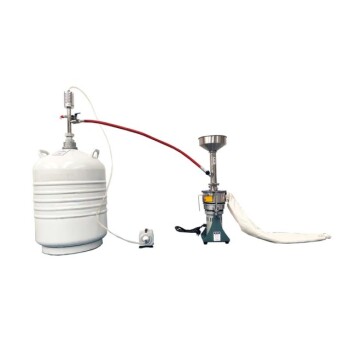
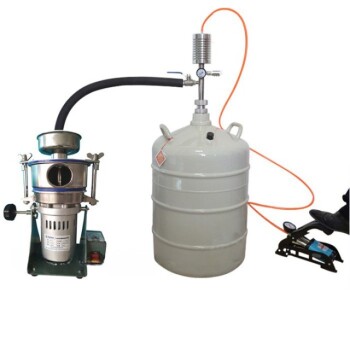
- Liquid Nitrogen Cryogenic Grinder Mill Cryomill Airflow Ultrafine Pulverizer
- Laboratory Ball Mill Jar Mill with Metal Alloy Grinding Jar and Balls
- Laboratory High Throughput Tissue Grinding Mill Grinder
- Small Cryogenic Grinder Cryomill Cryogrinder with Liquid Nitrogen for Laboratory Use
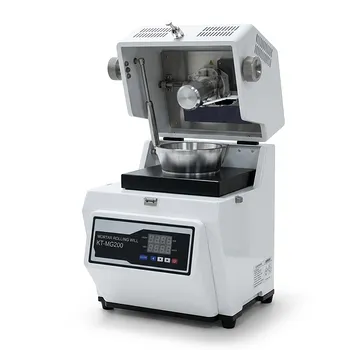
- Laboratory Grinding Mill Mortar Grinder for Sample Preparation
People Also Ask
- What is cryogenic grinding of crumb rubber? Achieve Fine, High-Quality Rubber Powder
- What are the advantages of using a cryogenic grinder? Achieve Nanoscale Precision for All-Solid-State Battery Cathodes
- What is the role of a cryogenic grinder in PET recycling? Transform Waste into High-Reactive Micron Powders
- Why is a cryogenic grinder required for cured alkyd resin HRMAS NMR? Ensure Structural Integrity & Sample Precision
- What is the temperature of cryogenic grinding? Achieve Superior Particle Size & Preserve Heat-Sensitive Materials