Temperature-controlled heating equipment is the critical driver for the chemical dissolution of the SBA-15 silica template. By maintaining a constant 85 °C environment for 16 hours, this equipment provides the steady thermal energy required for a sodium hydroxide (NaOH) solution to effectively etch away the silica framework. This precise control ensures the template is entirely removed, which is the only way to "unlock" the internal mesoporous channels of the resulting CMK-3 carbon.
The primary function of temperature-controlled heating is to maintain the kinetic stability required to dissolve the silica scaffold. Without this precise thermal regulation, the CMK-3 structure remains blocked, rendering the material ineffective for applications requiring high surface area.
The Role of Thermal Energy in Template Dissolution
Catalyzing the Chemical Reaction
The reaction between the strong base (NaOH) and the silica template is temperature-sensitive. Maintaining the solution at 85 °C provides the necessary activation energy to break the silicon-oxygen bonds within the SBA-15 framework efficiently.
Ensuring Uniform Diffusion
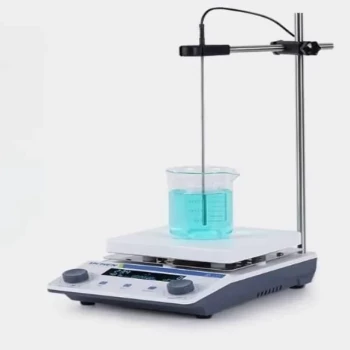
Equipment such as heating magnetic stirrers provides both heat and agitation to prevent localized temperature gradients. This ensures that the NaOH reaches every part of the silica-carbon composite, resulting in homogeneous template removal across the entire batch.
Impact on the CMK-3 Carbon Framework
Opening the Ordered Mesopores
CMK-3 derives its value from its ordered mesoporous structure, which is initially filled by the SBA-15 template. Precise heating ensures that the template is completely liquidated, leaving behind an open network of channels essential for gas storage, catalysis, or filtration.
Preserving Structural Integrity
A controlled 16-hour heating cycle allows for a gradual and thorough dissolution process. This steady approach prevents the physical stress on the carbon framework that might occur with more aggressive, uncontrolled heating methods, thereby preserving the pore architecture.
Common Pitfalls and Trade-offs
Temperature Inconsistency
If the temperature drops below the 85 °C threshold, the reaction rate slows dramatically. This often leads to residual silica remaining in the pores, which significantly reduces the final material's pore volume and surface area.
Risks of Overheating
Exceeding the recommended temperature can lead to rapid solvent evaporation, which shifts the NaOH concentration. This can lead to unpredictable etching patterns or, in extreme cases, damage to the delicate carbon nanostructures.
Strategic Recommendations for CMK-3 Synthesis
To achieve high-performance mesoporous carbon, the template removal phase must be treated with technical rigor.
- If your primary focus is maximum pore volume: Rigorously calibrate your heating equipment to ensure a steady 85 °C, as even minor deviations can leave "plugs" of silica that block the carbon channels.
- If your primary focus is batch-to-batch consistency: Use a digital heating magnetic stirrer rather than a manual water bath to ensure both thermal stability and uniform reactant distribution.
Precise thermal management during the etching phase is the defining factor in successfully transforming a rigid composite into a high-utility mesoporous carbon.
Summary Table:
| Parameter | Requirement | Role in CMK-3 Synthesis |
|---|---|---|
| Temperature | Constant 85 °C | Provides activation energy for NaOH to etch silica framework |
| Duration | 16 Hours | Ensures gradual, thorough dissolution of the SBA-15 scaffold |
| Equipment Type | Heating Magnetic Stirrer | Maintains thermal stability and ensures uniform NaOH diffusion |
| Key Outcome | Complete Template Removal | Unlocks ordered mesoporous channels for high surface area |
Precision Heating for Superior Material Synthesis
Achieving the perfect mesoporous structure in CMK-3 requires more than just a recipe—it requires uncompromising thermal precision. At KINTEK, we specialize in providing researchers with the high-performance laboratory equipment needed to unlock material potential.
Our extensive portfolio includes:
- High-Temperature Furnaces: Muffle, tube, and vacuum furnaces for precise carbonization.
- Reaction Systems: High-temperature high-pressure reactors and autoclaves for hydrothermal synthesis.
- Processing Tools: Crushing, milling, and hydraulic presses for sample preparation.
- Essential Lab Gear: Heating magnetic stirrers, cooling solutions, and high-purity ceramics/crucibles.
Don't let temperature fluctuations compromise your pore architecture. Contact KINTEK today to find the ideal heating and stirring solutions for your next breakthrough in carbon research!
References
- Federica Torrigino, Katharina Herkendell. Sustainably Sourced Mesoporous Carbon Molecular Sieves as Immobilization Matrices for Enzymatic Biofuel Cell Applications. DOI: 10.3390/catal13111415
This article is also based on technical information from Kintek Solution Knowledge Base .
Related Products
- Laboratory Small Constant Temperature Heated Magnetic Stirrer Heater and Stirrer
- 100L Heating Chilling Circulator Cooling Water Bath Circulator for High and Low Temperature Constant Temperature Reaction
- 10L Heating Chilling Circulator Cooling Water Bath Circulator for High and Low Temperature Constant Temperature Reaction
- 5L Heating Chilling Circulator Cooling Water Bath Circulator for High and Low Temperature Constant Temperature Reaction
- 20L Heating Chilling Circulator Cooling Water Bath Circulator for High and Low Temperature Constant Temperature Reaction
People Also Ask
- What role does a magnetic stirrer with heating play in ZnO nanoparticle synthesis? Precision Control for Quality Results
- What role does a constant temperature heating magnetic stirrer play in MFC-HAp synthesis? Achieve Material Homogeneity
- What is the function of a laboratory magnetic stirrer in Ni–Cr–P electrodeposition? Optimize Ion Transport & Coating
- Why is a laboratory magnetic stirrer required for benzoic acid esters? Boost Reaction Speed & Yield with High RPM
- What role does a laboratory magnetic stirrer play in TiO2 and TiO2-Ag sol preparation? Master Chemical Kinetics