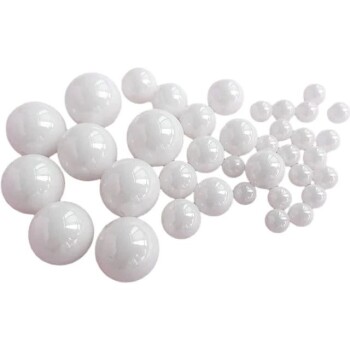
Zirconia grinding media serve a dual purpose in synthesizing Li6PS5Cl: acting as both a high-energy kinetic driver and a strict contamination barrier. They utilize high hardness and density to generate the mechanical force needed to drive solid-phase reactions between precursors like Li2S, P2S5, and LiCl. Simultaneously, the chemical inertness of zirconia prevents the introduction of conductive metallic impurities, which is essential for preserving the electrolyte's ionic conductivity and stability.
The success of Li6PS5Cl synthesis relies on delivering intense mechanical energy without compromising purity. Zirconia is the material of choice because it provides the necessary impact force to fuse precursors while remaining chemically inert, ensuring the final electrolyte retains high ionic conductivity and electrochemical stability.
Driving the Mechanochemical Reaction
Delivering High Kinetic Energy
The synthesis of Li6PS5Cl is a mechanochemical process, meaning chemical reactions are induced by mechanical force rather than heat.
Zirconia balls possess high density and hardness, allowing them to withstand the rigorous conditions of high-energy ball milling.
When these balls impact the precursor powders (Li2S, P2S5, and LiCl), they transfer significant kinetic energy. This energy breaks chemical bonds and forces the materials to react at the atomic level.
Pulverization and Surface Area
Effective solid-state reactions require intimate contact between particles.
The high hardness of zirconia ensures efficient pulverization of the hard precursor materials.
By reducing particle size and increasing surface area, zirconia media facilitate the diffusion of atoms needed to form the Li6PS5Cl crystal structure.
Preserving Electrochemical Performance
preventing Metallic Contamination
A critical challenge in synthesizing sulfide electrolytes is maintaining purity.
Metal grinding media, such as stainless steel, can shed microscopic metallic particles due to wear during high-energy milling.
Zirconia is a ceramic material that is chemically inert. It does not shed conductive metal debris, ensuring the dielectric properties of the electrolyte are maintained.
Ensuring Ionic Conductivity
For a solid-state electrolyte to function, it must conduct ions but block electrons.
Metallic impurities introduced by inferior grinding media can create electronic pathways, leading to short circuits or self-discharge within a battery.
By using zirconia, you ensure the material remains a pure ionic conductor, safeguarding its electrochemical stability.
Understanding the Trade-offs
Zirconia vs. High-Density Alternatives
While materials like Tungsten Carbide (WC) offer even higher density and impact energy, they carry a higher risk of contamination.
Zirconia strikes the optimal balance for sulfide electrolytes. It provides sufficient energy to drive the reaction without the chemical reactivity associated with metals.
Environmental Control
In addition to the media itself, the milling jar plays a containment role.
High-quality zirconia jars are designed to be sealed airtight.
This allows the process to occur under an inert argon atmosphere, preventing the moisture-sensitive sulfide electrolytes from hydrolyzing or oxidizing during the long milling process.
Making the Right Choice for Your Goal
Selecting the correct milling configuration is vital for balancing reaction speed with material performance.
- If your primary focus is maximum electrochemical stability: Prioritize high-purity zirconia media to eliminate the risk of metallic impurities that cause electronic leakage.
- If your primary focus is reaction completeness: Ensure the ball-to-powder ratio is sufficiently high so the zirconia media can deliver the kinetic energy required to fully react the precursors.
By leveraging the inert hardness of zirconia, you ensure the resulting Li6PS5Cl electrolyte achieves the high purity required for high-performance solid-state batteries.
Summary Table:
| Feature | Function in Li6PS5Cl Synthesis | Benefit for Solid-State Electrolytes |
|---|---|---|
| High Density/Hardness | Delivers high kinetic energy & pulverization | Ensures complete solid-phase reaction and fine particle size |
| Chemical Inertness | Prevents metallic debris shedding | Maintains high ionic conductivity and prevents electronic leakage |
| Wear Resistance | Long-duration milling stability | Consistent performance without compromising material purity |
| Hermetic Sealing | Maintains inert argon atmosphere | Protects moisture-sensitive sulfides from oxidation/hydrolysis |
Elevate Your Solid-State Battery Research with KINTEK
Precision in mechanochemical synthesis starts with the right materials. KINTEK specializes in providing high-performance laboratory solutions tailored for advanced energy research. Our premium zirconia grinding jars and balls, along with our extensive range of crushing and milling systems, vacuum furnaces, and glovebox-ready tools, are engineered to deliver the intense energy required for Li6PS5Cl synthesis while ensuring zero metallic contamination.
Whether you are refining sulfide electrolytes or developing next-generation battery architectures, KINTEK offers the expertise and high-purity consumables—including PTFE products, ceramics, and crucibles—to guarantee electrochemical stability and performance.
Ready to optimize your electrolyte purity? Contact our technical experts today to find the perfect milling configuration for your lab!
Related Products
- Laboratory Jar Ball Mill with Alumina Zirconia Grinding Jar and Balls
- Precision Machined Zirconia Ceramic Ball for Engineering Advanced Fine Ceramics
- Laboratory Jar Mill with Agate Grinding Jar and Balls
- Laboratory Ball Mill Jar Mill with Metal Alloy Grinding Jar and Balls
- Nature Agate Mortar and Pestle for Grinding and Mixing
People Also Ask
- What are the primary functions of using a ball mill for BZCY72 powder? Achieve High Purity and Enhanced Sintering
- In what way does a laboratory ball mill affect material properties when modifying PHBV/pulp fiber composites?
- Why is a laboratory ball mill required for ultra-fine fly ash? Unlock Nano-Scale Adsorption Power
- What is the function of a laboratory ball mill in the preparation of AMMCs? Optimize Dispersion & Grain Refinement
- What is the function of a laboratory ball mill in the pretreatment of waste tire char (WTC)? Optimize Material Reactivity