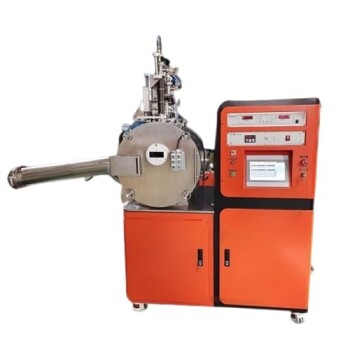
Sputtering is a highly controlled Physical Vapor Deposition (PVD) process utilized to create thin films by ejecting atoms from a source material. The process takes place within a vacuum chamber filled with an inert gas, where the source material is electrically charged to act as a cathode. This charge initiates a chain reaction of particle collisions, dislodging atoms from the source so they can travel across the chamber and coat a substrate.
Core Takeaway: Sputtering functions essentially like "atomic billiards." It uses high-energy plasma ions to physically smash into a target material, knocking atoms loose so they can reassemble as a precision coating on a nearby surface.
The Physics of the Sputtering Process
To understand sputtering, you must follow the transfer of energy from electrical potential to kinetic impact. The process creates a thin film—ranging from fractions of a nanometer to several micrometers—through a distinct sequence of events.
The Vacuum Environment
The process begins by securing the substrate (the object to be coated) inside a vacuum chamber.
This chamber is subsequently filled with a controlled amount of inert gas, commonly Argon. The vacuum ensures a clean environment, while the inert gas provides the medium necessary to generate the physical force required for deposition.
Creating the Plasma
The source material, often referred to as the target, is given a negative electrical charge.
This negative charge transforms the target into a cathode, causing it to emit free electrons into the chamber.
Ionization of the Gas
As these free electrons move, they collide with the atoms of the inert gas.
These collisions knock electrons off the gas atoms, converting the neutral gas into positively charged, high-energy ions. This state of ionized gas is known as plasma.
Bombardment and Ejection
Because the target material is negatively charged, it acts as a magnet for the newly created positive ions.
The positive ions accelerate toward the target with immense velocity. Upon impact, they transfer their momentum to the target material, physically detaching (or "sputtering") atomic-sized particles from its surface.
Deposition on the Substrate
The ejected particles travel freely across the vacuum chamber.
They eventually land on the surface of the substrate, accumulating layer by layer. Over time, these accumulating atoms form a uniform, cohesive thin film.
Understanding the Trade-offs and Context
While sputtering is a powerful technique, it is essential to understand how it differs from other deposition methods to ensure it fits your specific engineering requirements.
Physical vs. Chemical Deposition
Sputtering is a Physical Vapor Deposition (PVD) process. It relies on kinetic energy and physical collision to move material.
This stands in contrast to Chemical Vapor Deposition (CVD). In CVD, reactive gases are introduced to a chamber to undergo chemical reactions (often creating radicals via RF plasma) to form a solid film on a heated substrate.
Energy and Temperature
Because sputtering involves high-energy ion bombardment, it is a "cold" process relative to thermal evaporation, but the kinetic impact generates heat.
This allows for the deposition of materials with very high melting points, which might be difficult to evaporate thermally.
Application Scope
Sputtering is highly versatile. It is used for electronic components, optical coatings, and data storage devices.
It is also critical for creating specialized energy solutions, such as thin-film batteries and photovoltaic cells, due to the precision of the film thickness.
Making the Right Choice for Your Goal
The choice to use sputtering usually depends on the material properties you need and the precision required for the film thickness.
- If your primary focus is material purity and precision: Sputtering is ideal because it physically ejects the source material atom-by-atom in a vacuum, offering high control over film thickness (from nanometers to micrometers).
- If your primary focus is complex chemical synthesis: You may want to investigate Chemical Vapor Deposition (CVD), as it relies on chemical reactions between gases rather than physical momentum transfer.
Sputtering provides a method to disassemble a material at the atomic level and reconstruct it exactly where you need it, creating high-performance coatings for advanced technology.
Summary Table:
| Stage | Action | Description |
|---|---|---|
| Vacuum & Gas | Chamber Preparation | Chamber is evacuated and filled with inert Argon gas. |
| Plasma Creation | Ionization | Free electrons collide with gas atoms to create high-energy positive ions. |
| Bombardment | Kinetic Impact | Positive ions strike the negative target, ejecting source atoms. |
| Deposition | Film Formation | Ejected atoms travel through the vacuum to form a uniform layer on the substrate. |
Elevate Your Material Research with KINTEK
Precision in thin-film deposition is critical for next-generation electronic and optical components. KINTEK specializes in high-performance laboratory equipment, providing the tools you need for advanced PVD and CVD processes. From high-temperature furnaces and vacuum systems to specialized crushing, milling, and hydraulic press solutions, we empower researchers to achieve superior material purity and control.
Ready to optimize your sputtering or laboratory workflow? Contact our experts today to find the perfect equipment for your application
Related Products
- Spark Plasma Sintering Furnace SPS Furnace
- Vacuum Induction Melting Spinning System Arc Melting Furnace
- Chemical Vapor Deposition CVD Equipment System Chamber Slide PECVD Tube Furnace with Liquid Gasifier PECVD Machine
- Customer Made Versatile CVD Tube Furnace Chemical Vapor Deposition Chamber System Equipment
People Also Ask
- What is SPS sintering method? A Guide to High-Speed, High-Performance Material Fabrication
- Why are Spark Plasma Sintering (SPS) furnaces or hot presses utilized in the preparation of Li3PS4 solid electrolytes?
- What is the difference between spark plasma sintering and flash sintering? A Guide to Advanced Sintering Methods
- What technical advantages does a Spark Plasma Sintering (SPS) furnace offer for LZP ceramics? Enhance Ionic Conductivity
- What is the theory of spark plasma sintering? A Guide to Rapid, Low-Temperature Densification