Knowledge What is the inside of a mold called? Understanding the Mold Cavity and Core
Author avatar

Tech Team · Kintek Solution

Updated 1 week ago

What is the inside of a mold called? Understanding the Mold Cavity and Core


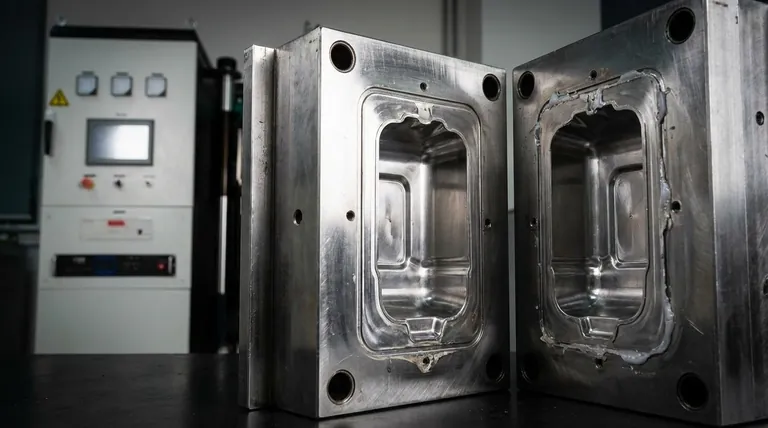
The hollow space inside a mold is called the cavity. This is the void where molten plastic, liquid silicone, or another raw material is injected or forced in order to form the final shape of a part. Essentially, the cavity is the negative space that defines the product's external geometry.

The core principle to understand is that "cavity" can refer to two distinct but related things: the three-dimensional space that forms the part, and the entire half of the mold tool that typically shapes the part's cosmetic exterior.
What is the inside of a mold called? Understanding the Mold Cavity and Core

The Fundamental Role of the Mold Cavity

Defining the Part's Geometry

The primary function of the mold cavity is to give the final product its shape. The walls of the cavity are the inverse of the part's features, and their precision directly determines the quality and accuracy of the molded component.

The Union of Two Halves

In most common processes like injection molding, the cavity is the empty space created when two halves of the mold, the A-side and the B-side, are clamped together. The material fills this void between them.

A Universal Manufacturing Concept

The term cavity is not limited to one process. Whether in transfer molding for rubber or injection molding for plastic, the concept remains the same: the cavity is the chamber that contains and shapes the raw material under pressure.

Understanding Common Terminology Pitfalls

Cavity Space vs. Cavity Half (A-Side)

Herein lies a frequent point of confusion. The term cavity is often used as shorthand for the entire A-side of the mold. This half is also called the "cavity half" because it usually forms the primary cosmetic or exterior surface of the part.

The Role of the Core (B-Side)

The other half of the mold is known as the core, or the B-side. The core typically forms the internal, non-cosmetic features of a part, such as ribs, bosses, or posts. The cavity space is formed between the core and the cavity half.

Why Precision Matters

Distinguishing between "the mold cavity" (the space) and "the cavity half" (the tool) is critical. In technical discussions with designers, engineers, and toolmakers, this precision prevents costly misunderstandings about which part of the mold or product feature is being discussed.

Making the Right Choice for Your Goal

To ensure your intent is perfectly clear, use the term that best fits the context of your discussion.

  • If your primary focus is the final part's shape: Refer to the mold cavity, which is the void where the material solidifies.
  • If your primary focus is the physical tooling: Refer to the cavity half (A-side) and the core half (B-side) to differentiate between the two sides of the mold.
  • If you are ever in doubt: Describe the function to avoid ambiguity, such as "the space that forms the part's exterior" or "the stationary half of the mold tool."

Using this precise language ensures your design intent is perfectly understood from concept to production.

Summary Table:

Term Definition Primary Function
Mold Cavity The hollow space inside a mold where material is injected. Defines the external geometry and shape of the final part.
Cavity Half (A-Side) The half of the mold tool that typically forms the part's exterior surface. Houses the cavity space; often the cosmetic side.
Core Half (B-Side) The opposing half of the mold that forms internal features (ribs, posts). Creates internal part geometry; mates with the cavity half.

Need precision mold components or lab equipment for your production? KINTEK specializes in high-quality lab equipment and consumables, serving laboratories and manufacturing needs with reliable solutions. Let our expertise support your molding projects—contact us today to discuss how we can enhance your process efficiency and part quality!

Visual Guide
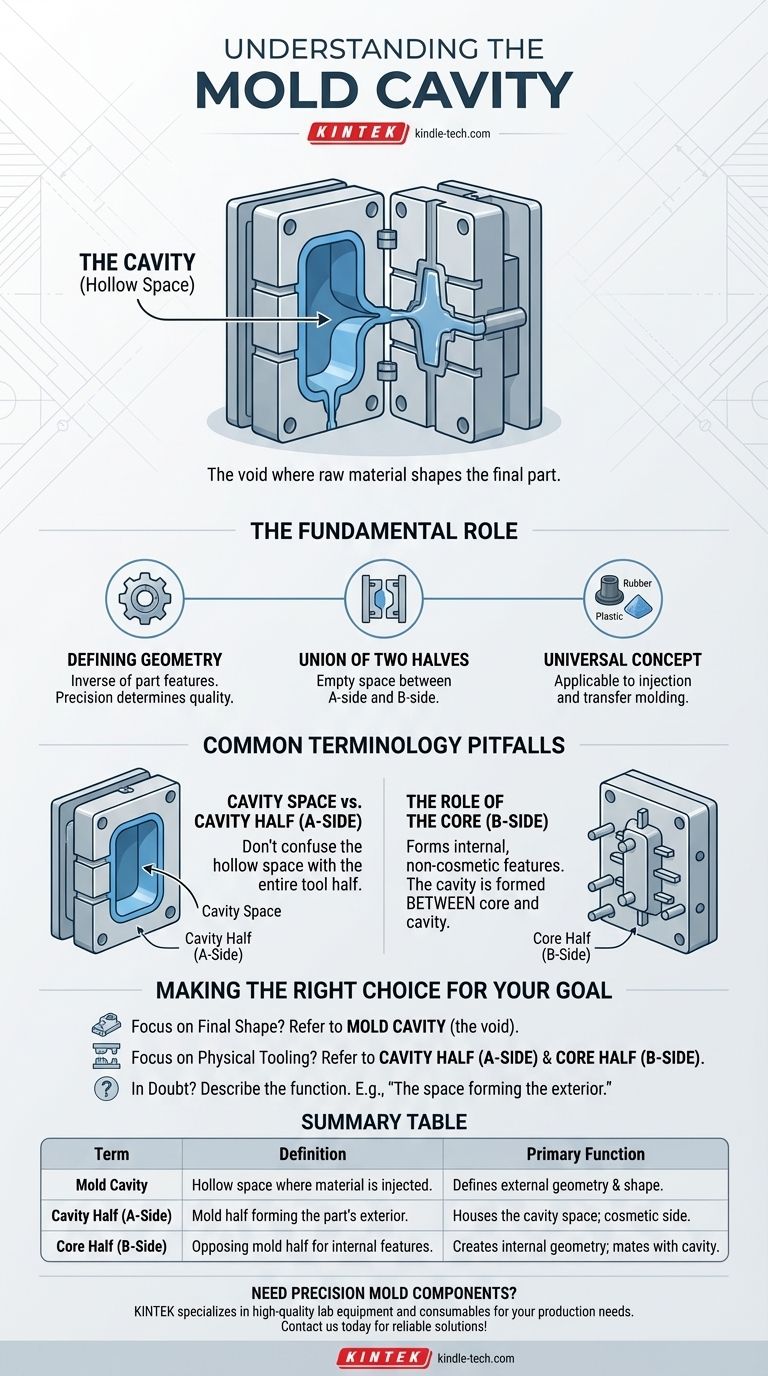
What is the inside of a mold called? Understanding the Mold Cavity and Core Visual Guide

Related Products

People Also Ask

Related Products

Vacuum Heat Treat and Molybdenum Wire Sintering Furnace for Vacuum Sintering

Vacuum Heat Treat and Molybdenum Wire Sintering Furnace for Vacuum Sintering

A vacuum molybdenum wire sintering furnace is a vertical or bedroom structure, which is suitable for withdrawal, brazing, sintering and degassing of metal materials under high vacuum and high temperature conditions. It is also suitable for dehydroxylation treatment of quartz materials.

Three-dimensional electromagnetic sieving instrument

Three-dimensional electromagnetic sieving instrument

KT-VT150 is a desktop sample processing instrument for both sieving and grinding. Grinding and sieving can be used both dry and wet. The vibration amplitude is 5mm and the vibration frequency is 3000-3600 times/min.

Lab Internal Rubber Mixer Rubber Kneader Machine for Mixing and Kneading

Lab Internal Rubber Mixer Rubber Kneader Machine for Mixing and Kneading

Lab internal rubber mixer is suitable for mixing, kneading and dispersing various chemical raw materials such as plastics, rubber, synthetic rubber, hot melt adhesive and various low-viscosity materials.

Hydraulic Diaphragm Lab Filter Press for Laboratory Filtration

Hydraulic Diaphragm Lab Filter Press for Laboratory Filtration

Hydraulic diaphragm lab press filter is one type lab scale filter press, it takes small footprint, and higher pressing power.

1800℃ Muffle Oven Furnace for Laboratory

1800℃ Muffle Oven Furnace for Laboratory

KT-18 muffle furnace with Japan Al2O3 polycrystalline fibe and Silicon Molybdenum heating element, up to 1900℃, PID temperature control and 7" smart touch screen. Compact design, low heat loss, and high energy efficiency. Safety interlock system and versatile functions.

Vacuum Induction Melting Spinning System Arc Melting Furnace

Vacuum Induction Melting Spinning System Arc Melting Furnace

Develop metastable materials with ease using our Vacuum Melt Spinning System. Ideal for research and experimental work with amorphous and microcrystalline materials. Order now for effective results.

CVD Diamond Domes for Industrial and Scientific Applications

CVD Diamond Domes for Industrial and Scientific Applications

Discover CVD diamond domes, the ultimate solution for high-performance loudspeakers. Made with DC Arc Plasma Jet technology, these domes deliver exceptional sound quality, durability, and power handling.

Nature Agate Mortar and Pestle for Grinding and Mixing

Nature Agate Mortar and Pestle for Grinding and Mixing

Get high-quality grinding results with Nature Agate Mortar and Pestle. Available in various sizes with shining polished grinding surfaces.

High Temperature Muffle Oven Furnace for Laboratory Debinding and Pre Sintering

High Temperature Muffle Oven Furnace for Laboratory Debinding and Pre Sintering

KT-MD High temperature debinding and pre-sintering furnace for ceramic materials with various molding processes. Ideal for electronic components such as MLCC and NFC.

Copper Foam

Copper Foam

Copper foam has good thermal conductivity and can be widely used for heat conduction and heat dissipation of motors/electrical appliances and electronic components.

Laboratory CVD Boron Doped Diamond Materials

Laboratory CVD Boron Doped Diamond Materials

CVD boron-doped diamond: A versatile material enabling tailored electrical conductivity, optical transparency, and exceptional thermal properties for applications in electronics, optics, sensing, and quantum technologies.

High Performance Lab Homogenizer for Pharma Cosmetics and Food R&D

High Performance Lab Homogenizer for Pharma Cosmetics and Food R&D

Lab vacuum homogenizing emulsifier for pharmaceuticals, cosmetics & food. High-shear mixing, vacuum deaeration, scalable 1L-10L. Get expert advice now!

Custom PTFE Teflon Parts Manufacturer for PTFE Stirring Bar Recovery Rod

Custom PTFE Teflon Parts Manufacturer for PTFE Stirring Bar Recovery Rod

This product is used for stirrer recovery, and is resistant to high temperature, corrosion, and strong alkali, and is almost insoluble in all solvents. The product has a stainless steel rod inside and a polytetrafluoroethylene sleeve outside.

Single Punch Electric Tablet Press Machine Laboratory Powder Tablet Punching TDP Tablet Press

Single Punch Electric Tablet Press Machine Laboratory Powder Tablet Punching TDP Tablet Press

The single-punch electric tablet press is a laboratory-scale tablet press suitable for corporate laboratories in pharmaceutical, chemical, food, metallurgical and other industries.

High-Purity Titanium Foil and Sheet for Industrial Applications

High-Purity Titanium Foil and Sheet for Industrial Applications

Titanium is chemically stable, with a density of 4.51g/cm3, which is higher than aluminum and lower than steel, copper, and nickel, but its specific strength ranks first among metals.

Custom PTFE Wafer Holders for Lab and Semiconductor Processing

Custom PTFE Wafer Holders for Lab and Semiconductor Processing

This is a high-purity, custom-machined PTFE (Teflon) holder, expertly designed for the secure handling and processing of delicate substrates like conductive glass, wafers, and optical components.


Leave Your Message