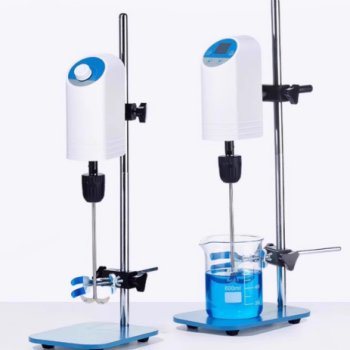
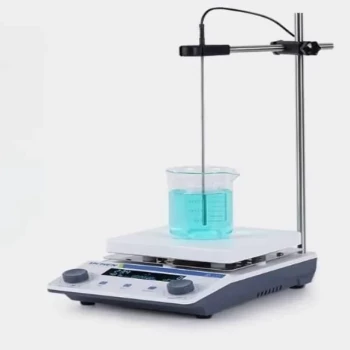
The primary mechanical function of an overhead digital stirrer is to generate controlled agitation within the anode chamber, accelerating the forced convection of the electrolyte solution. This physical motion is the catalyst for maintaining a stable electrochemical environment, ensuring that the dissolution of the molybdenum disk proceeds without interruption.
By driving forced convection, the stirrer eliminates the static boundary layer that naturally forms at the anode surface. This prevents the reaction from stalling due to reactant starvation or the buildup of blocking oxide layers.
The Role of Forced Convection in Electrochemistry
The stirrer does not merely mix fluids; it actively manages the mass transport regime of the electrochemical cell.
Accelerating Mass Transport
In a static solution, chemicals move only by diffusion, which is a slow process.
The overhead stirrer introduces forced convection.
This rapidly transports fluids to and from the electrode surface, far exceeding the rates achievable by natural diffusion alone.
Eliminating Concentration Polarization
As the molybdenum dissolves, reaction products accumulate immediately next to the disk.
Simultaneously, the concentration of reactants decreases in this local zone.
This phenomenon, known as concentration polarization, creates a barrier that slows the reaction. The stirrer creates a flow that constantly flushes this zone, neutralizing the polarization effect.
Replenishing Hydroxide Ions
The electrochemical oxidation of molybdenum requires a constant supply of hydroxide ions.
Without agitation, the local supply at the anode surface is quickly depleted.
The mechanical stirring circulates fresh electrolyte from the bulk solution to the disk surface, ensuring the necessary ions are always available for the reaction.
Preventing System Failure via Passivation
The most critical function of the stirrer is ensuring the longevity of the dissolution process.
Disrupting Oxide Layer Formation
Molybdenum has a natural tendency to form a solid oxide layer on its surface during oxidation.
If allowed to stabilize, this layer acts as an electrical insulator, effectively stopping the current and the dissolution process.
This is known as passivation.
Maintaining Surface Activity
The mechanical agitation effectively scrubs the reaction interface.
By rapidly removing reaction products, the stirrer prevents the chemical conditions that allow the passivation layer to form.
This keeps the anode surface "active" and creates a pathway for continuous electrochemical oxidation.
Operational Dependencies
While the stirrer improves efficiency, its mechanical action introduces specific operational requirements that must be managed.
The Requirement for Continuity
The benefits of the stirrer are instantaneous but transient.
If the mechanical agitation ceases, concentration polarization re-establishes almost immediately.
Therefore, the reliability of the mechanical system is a direct point of failure for the chemical process.
The Importance of Control
The primary reference specifies "controlled mechanical agitation," not random turbulence.
Inconsistent stirring speeds can lead to fluctuating reaction rates.
Precise digital control is necessary to maintain a steady hydrodynamic environment for uniform dissolution.
Optimizing the Dissolution Process
To ensure the successful dissolution of molybdenum disks, you must view the stirrer as a critical process parameter rather than ancillary equipment.
- If your primary focus is reaction speed: Increase the agitation rate to the maximum controlled level to minimize the diffusion layer thickness and maximize ion replenishment.
- If your primary focus is process reliability: Ensure the stirrer is capable of maintaining constant torque to prevent the formation of a passivation layer, which would halt the process entirely.
The overhead digital stirrer serves as the mechanical guarantor of chemical efficiency, transforming a self-limiting reaction into a continuous, stable process.
Summary Table:
| Function | Mechanical Mechanism | Electrochemical Impact |
|---|---|---|
| Mass Transport | Forced Convection | Accelerates ion movement beyond natural diffusion rates. |
| Polarization Control | Fluid Flushing | Eliminates concentration polarization at the anode surface. |
| Surface Activity | Interface Scrubbing | Prevents the formation of insulating oxide passivation layers. |
| Ion Replenishment | Constant Circulation | Ensures a continuous supply of hydroxide ions to the reaction zone. |
| Process Stability | Precise Digital Control | Maintains steady hydrodynamic environments for uniform dissolution. |
Elevate Your Electrochemical Precision with KINTEK
Don't let passivation stall your research. KINTEK specializes in high-performance laboratory equipment designed to handle the most demanding chemical processes. From overhead digital stirrers that ensure precise hydrodynamic control to our advanced electrolytic cells and electrodes, we provide the tools you need for stable and continuous dissolution.
Whether you are working with battery research consumables, high-temperature furnaces, or precision hydraulic presses, KINTEK delivers the reliability your lab deserves. Our experts are ready to help you select the perfect agitation and thermal solutions tailored to your specific application.
Ready to optimize your lab's performance? Contact KINTEK today to discuss your equipment needs!
References
- Izabela Cieszykowska, Grażyna Birnbaum. Studies on electrochemical dissolution of sintered molybdenum discs as a potential method for targets dissolution in 99mTc production. DOI: 10.1007/s10967-021-08155-3
This article is also based on technical information from Kintek Solution Knowledge Base .
Related Products
- High Performance Laboratory Stirrers for Diverse Applications
- Laboratory Small Constant Temperature Heated Magnetic Stirrer Heater and Stirrer
People Also Ask
- How does a laboratory stirrer influence MOF product quality? Master Precision in Non-Solvothermal Synthesis
- What critical role does a Laboratory Stirrer play during leaching? Enhance Titanium-Magnesium Waste Recovery
- What is the primary function of laboratory stirring equipment in the preparation of compost leachate? Optimize Extraction
- What is a laboratory mixer? A Guide to Achieving Perfect Sample Homogeneity
- What is a laboratory mixer used for? Choose the Right Tool for Liquids or Solids