At its core, microwave pyrolysis is a thermal decomposition process that uses microwave energy, rather than conventional external heating, to break down materials in an oxygen-free environment. This advanced method converts organic matter, such as biomass, plastics, or tires, into valuable products like syngas (synthesis gas), bio-oil (a liquid fuel), and bio-char (a solid carbon-rich material).
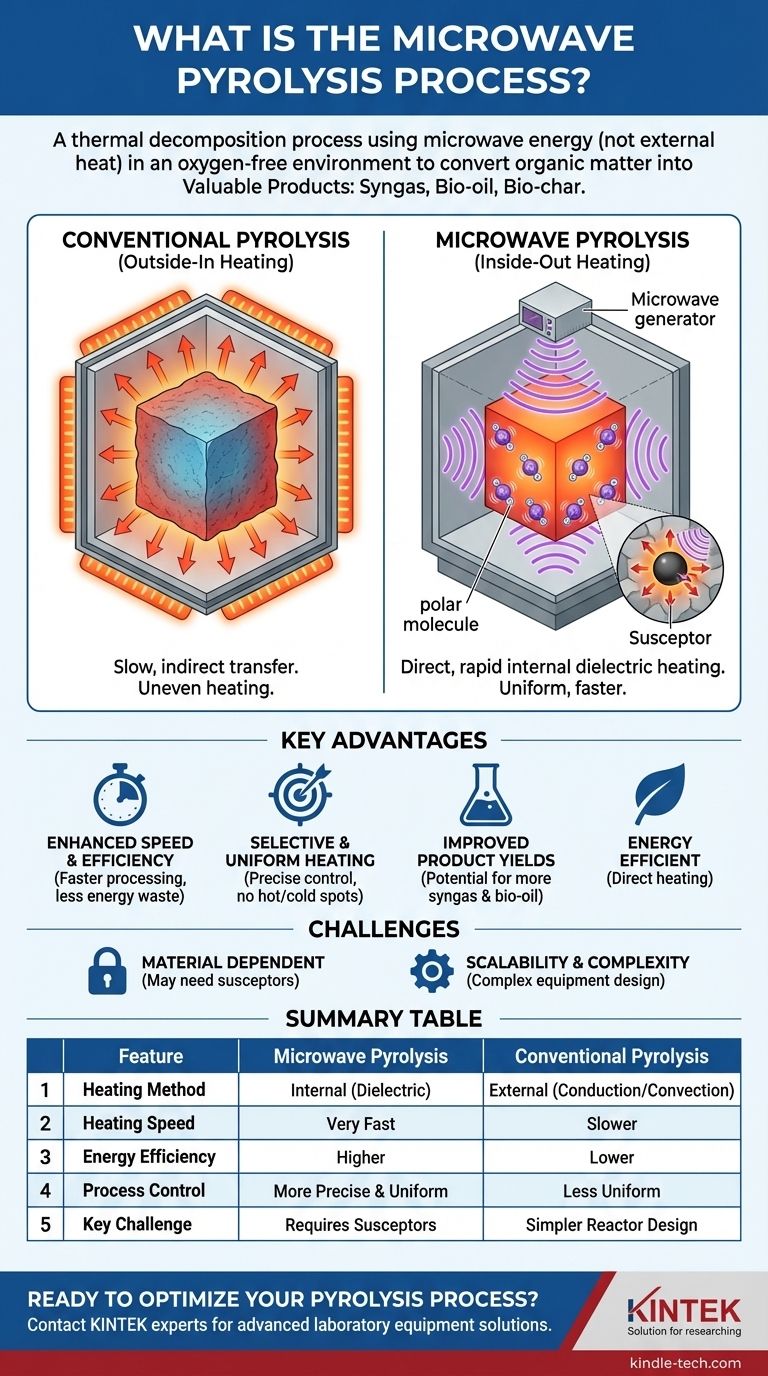
The fundamental difference between microwave and conventional pyrolysis lies in the heating method. Instead of heating a chamber from the outside-in, microwaves directly and rapidly heat the material from the inside-out, leading to faster processing and potentially higher energy efficiency.
How Microwave Heating Changes the Pyrolysis Equation
To understand microwave pyrolysis, you must first understand that it is not just a different power source; it is a fundamentally different heating mechanism that changes the entire process dynamic.
The Principle of Dielectric Heating
Traditional pyrolysis relies on conduction and convection, where external heating elements heat the walls of a furnace, which then slowly transfers that heat to the material inside.
Microwave pyrolysis uses dielectric heating. The microwaves cause polar molecules within the material to rapidly vibrate and rotate, generating friction and thus, heat, directly inside the material itself.
The Role of Microwave Susceptors
Not all materials absorb microwave energy effectively. For substances with low dielectric properties (like many dry plastics), a microwave susceptor is required.
A susceptor is a highly microwave-absorbent material, such as activated carbon or silicon carbide, that is mixed with the primary feedstock. The susceptor absorbs the microwave energy, converts it to intense thermal energy, and transfers that heat directly to the surrounding material.
From Outside-In to Inside-Out Heating
This "inside-out" heating model is the primary advantage of the microwave approach. It avoids the slow thermal transfer of conventional methods, creating a more uniform and rapid temperature rise throughout the entire volume of the material.
Key Advantages of the Microwave Approach
The unique heating mechanism of microwave pyrolysis offers several distinct operational advantages over its conventional counterpart.
Enhanced Speed and Efficiency
Because the material heats itself directly, the process is significantly faster. There is less wasted energy heating the reactor vessel and surrounding environment, leading to higher overall energy efficiency.
Selective and Uniform Heating
Microwaves can be targeted to heat only the feedstock (and susceptor), not the entire chamber. This results in highly responsive and precise temperature control, ensuring the material is heated uniformly and avoiding hot or cold spots that can lower product quality.
Potentially Improved Product Yields
The rapid and uniform heating profile can alter the chemical reaction pathways. For many feedstocks, this leads to a higher yield of valuable outputs, particularly the gas (syngas) and liquid (bio-oil) fractions, compared to the slower heating rates of conventional pyrolysis.
Understanding the Trade-offs and Challenges
Despite its advantages, microwave pyrolysis is not a universal solution. It comes with its own set of engineering challenges and limitations that must be considered.
Material-Dependent Performance
The process is highly dependent on the feedstock's dielectric properties. Materials that do not absorb microwaves well will not heat effectively without the addition of a susceptor, adding a step to the process.
The Need for Susceptors
While effective, adding a susceptor can introduce complications. It can increase operational costs and, if not separated post-pyrolysis, can contaminate the final bio-char product, potentially reducing its value.
Scalability and Equipment Complexity
Designing large-scale industrial microwave pyrolysis systems is complex. It requires specialized microwave generators, waveguides, and applicator cavities to ensure uniform energy distribution. Furthermore, as noted in similar high-temperature microwave applications, cooling the equipment can become a significant engineering hurdle.
Making the Right Choice for Your Application
Choosing between conventional and microwave pyrolysis depends entirely on your specific goals, feedstock, and operational priorities.
- If your primary focus is rapid processing and energy efficiency: Microwave pyrolysis is a compelling option due to its direct and fast internal heating mechanism.
- If your primary focus is simplicity and handling diverse feedstocks without additives: Conventional pyrolysis often offers a more robust and straightforward setup that is less sensitive to material properties.
- If your primary focus is maximizing the yield of high-quality liquid or gas products: The precise, uniform temperature control of microwave pyrolysis may provide superior results and a more valuable product distribution.
Understanding this fundamental difference in heating is the key to selecting the right technology to achieve your waste-to-value objectives.
Summary Table:
| Feature | Microwave Pyrolysis | Conventional Pyrolysis |
|---|---|---|
| Heating Method | Internal (dielectric heating) | External (conduction/convection) |
| Heating Speed | Very Fast | Slower |
| Energy Efficiency | Higher | Lower |
| Process Control | More Precise & Uniform | Less Uniform |
| Key Challenge | Requires susceptors for some materials | Simpler reactor design |
Ready to optimize your pyrolysis process?
At KINTEK, we specialize in advanced laboratory equipment for cutting-edge thermal processes like microwave pyrolysis. Our expertise can help you select the right technology to maximize your yield of syngas, bio-oil, and bio-char from your specific feedstock.
Contact our experts today to discuss how our solutions can enhance your waste-to-energy or chemical production research.
Get in touch via our Contact Form
Visual Guide
Related Products
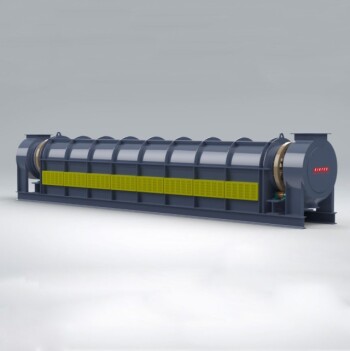
- Electric Rotary Kiln Pyrolysis Furnace Plant Machine Calciner Small Rotary Kiln Rotating Furnace
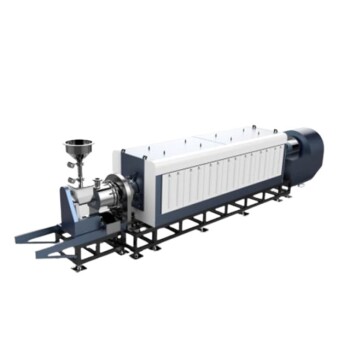
- Electric Rotary Kiln Continuous Working Small Rotary Furnace Heating Pyrolysis Plant
- Electric Rotary Kiln Small Rotary Furnace Biomass Pyrolysis Plant
- Microwave Plasma Chemical Vapor Deposition MPCVD Machine System Reactor for Lab and Diamond Growth
- Custom PTFE Teflon Parts Manufacturer for Microwave Digestion Tank
People Also Ask
- How are rotary kilns heated? Direct vs. Indirect Heating Methods Explained
- How does a rotary kiln operate? Master Continuous High-Temperature Processing
- What is the temperature of a rotating kiln? It Depends on Your Material and Process Goal
- Is rotary kiln a furnace? Discover the Key Differences for Industrial Processing
- What is a rotary kiln electric furnace? Achieve Superior Uniform Heating for Your Materials