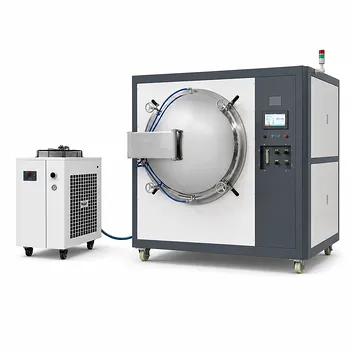
A controlled atmosphere furnace is indispensable for valid research because it performs two critical functions simultaneously: it maintains the high temperatures necessary to melt corrosive salts (such as sulfates and chlorides) and actively regulates the gas composition to mimic industrial flue gases. Without this specific equipment, it is impossible to accurately replicate the complex chemical interactions that lead to the degradation of austenitic heat-resistant steel.
Core Takeaway To understand how austenitic steel fails, you must look beyond thermal stress and examine chemical interactions. A controlled atmosphere furnace is required to simulate the specific interaction between molten media and flue gases (like SO2 and CO2), which is the primary driver of protective film destruction and internal sulfidation.
Simulating the Thermal Environment
Reaching Required Melting Points
The foundational requirement for researching molten salt corrosion is achieving a liquid state for the corrosive media.
Austenitic heat-resistant steels operate in high-temperature environments where deposits like sulfates and chlorides melt. The controlled atmosphere furnace provides the precise thermal regulation needed to keep these salts in a molten state, initiating the corrosion process.
Replicating Industrial Gas Compositions
Regulating Internal Atmosphere
Temperature alone is insufficient for accurate simulation. In real-world applications, these steels are exposed to flue gases containing specific contaminants.
A controlled atmosphere furnace allows researchers to introduce and regulate concentrations of gases such as Sulfur Dioxide (SO2) and Carbon Dioxide (CO2). This capability transforms a simple thermal test into a realistic simulation of an industrial flue gas environment.
Analyzing Corrosion Mechanisms
Investigating Protective Film Destruction
The primary mechanism of failure in these steels is the breakdown of their protective surface layer.
By combining high heat with a specific gas atmosphere, researchers can analyze the exact destruction process of this protective film. The furnace creates the conditions necessary to observe how the gas and molten salt interact to breach the steel's defenses.
Studying Internal Sulfidation
Beyond surface damage, these materials suffer from internal degradation.
The presence of regulated SO2 in the atmosphere allows for the investigation of internal sulfidation phenomena. This is a critical deep-tissue corrosion mechanism that cannot be replicated in a standard air-atmosphere furnace.
Common Pitfalls to Avoid
The Risk of Incomplete Simulation
A common error in corrosion research is isolating the thermal variable from the chemical variable.
Using a standard furnace that only controls temperature (and not atmosphere) will yield incomplete data. It fails to account for the complex chemical reactions driven by the presence of CO2 and SO2, leading to an underestimation of the corrosion rate and a misunderstanding of the failure mechanism.
Making the Right Choice for Your Research
To ensure your experimental setup aligns with your research goals, consider the following distinct requirements:
- If your primary focus is basic material stability: A standard high-temperature furnace is sufficient for testing heat resistance in air, but it will not reveal chemical corrosion risks.
- If your primary focus is corrosion mechanisms: You must use a controlled atmosphere furnace to capture the critical interactions between molten salts and flue gases (SO2/CO2) that cause sulfidation and film breakdown.
Accurate corrosion research relies not just on melting the salt, but on precisely recreating the hostile atmosphere that surrounds it.
Summary Table:
| Feature | Standard Furnace | Controlled Atmosphere Furnace |
|---|---|---|
| Temperature Control | High-precision heating | High-precision heating |
| Gas Regulation | Ambient air only | Precise control of SO2, CO2, etc. |
| Environment Simulation | Basic thermal stress | Complex industrial flue gas mimicry |
| Research Capability | Surface heat resistance | Internal sulfidation & film destruction |
| Data Accuracy | Incomplete (missing chemical data) | Comprehensive & realistic mechanisms |
Elevate Your Material Research with KINTEK Precision
Don't settle for incomplete data when studying critical corrosion mechanisms. KINTEK specializes in advanced laboratory solutions designed for high-stakes research. Our comprehensive range of controlled atmosphere, vacuum, and tube furnaces provides the precise thermal and gaseous regulation necessary to simulate the harshest industrial environments.
Whether you are analyzing austenitic steel degradation or developing next-generation alloys, our portfolio—including crushing systems, hydraulic presses, high-pressure reactors, and specialized ceramics—ensures your lab is equipped for success.
Ready to achieve superior experimental accuracy? Contact KINTEK today to discuss your customized equipment needs and see how our expertise can drive your innovation forward.
References
- Huatian Wang, Jianwen Jia. Precipitation and Properties at Elevated Temperature in Austenitic Heat‐Resistant Steels—A Review. DOI: 10.1002/srin.202000378
This article is also based on technical information from Kintek Solution Knowledge Base .
Related Products
- 1200℃ Controlled Atmosphere Furnace Nitrogen Inert Atmosphere Furnace
- 1700℃ Controlled Atmosphere Furnace Nitrogen Inert Atmosphere Furnace
- 1400℃ Controlled Atmosphere Furnace with Nitrogen and Inert Atmosphere
- Controlled Nitrogen Inert Hydrogen Atmosphere Furnace
- Mesh belt controlled atmosphere furnace
People Also Ask
- What is a controlled atmosphere furnace? Achieve Purity and Precision in High-Temp Processing
- Can you braze copper to brass without flux? Yes, but only under these specific conditions.
- What is the function of a high-precision controlled atmosphere furnace for Alloy 617? Simulate Extreme VHTR Conditions
- What is the role of the furnace atmosphere? Master Precise Metallurgical Control for Your Heat Treatment
- What is controlled atmosphere furnace? Precision Heating Without Oxidation for Superior Materials