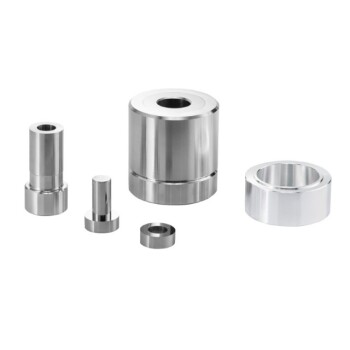
Preparing porous boron nitride (PBN) for contact angle testing requires a laboratory hydraulic press and cylindrical molds to transform loose powders into stable, flat pellets. This process creates a uniform interface that is essential for optical measurement, as the raw powder form cannot support a droplet or provide a consistent surface for assessing hydrophobicity.
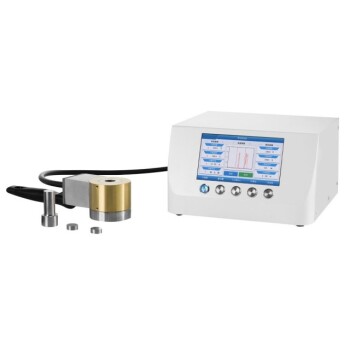
A laboratory hydraulic press and precision mold are necessary to eliminate physical variables like macroscopic roughness and capillary adsorption, ensuring that contact angle data reflects the material's inherent chemical surface energy rather than its physical state.
Transforming Powder into a Measurable Surface
Overcoming the Limitations of Powder Form
Porous boron nitride raw materials typically exist in a powder state, which is incompatible with optical contact angle measurement systems. A droplet placed on loose powder would immediately infiltrate the gaps or fail to form a clear baseline, making it impossible to evaluate surface wettability.
Creating a Stable Optical Interface
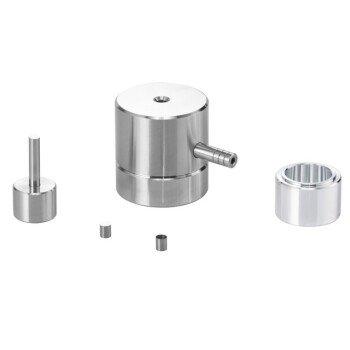
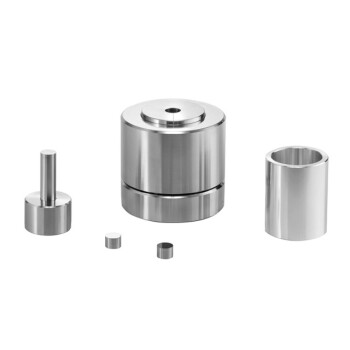
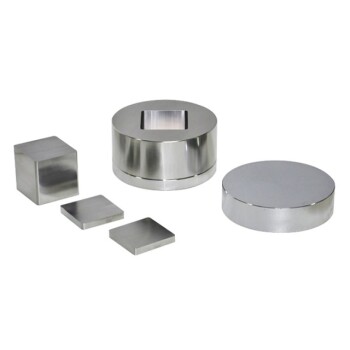
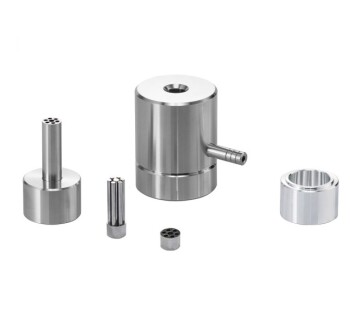
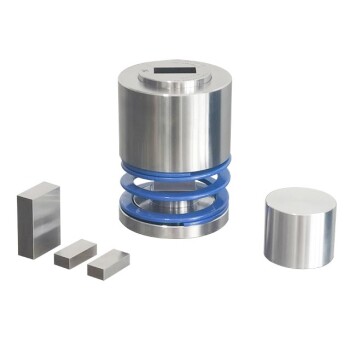
Using a precision cylindrical mold allows the material to be shaped into a solid pellet with a flat, smooth surface. This stable physical plane is a prerequisite for the camera systems used in contact angle meters to accurately define the interface between the liquid, the solid, and the air.
Eliminating Physical Interference
Reducing Macroscopic Surface Roughness
Standardized sample preparation via high pressure (e.g., 60 MPa) minimizes macroscopic roughness that can artificially inflate or deflate contact angle readings. By creating a dense, smooth pellet, the test accurately reflects the qualitative changes in hydrophobicity caused by material modifications rather than surface irregularities.
Preventing Capillary Adsorption
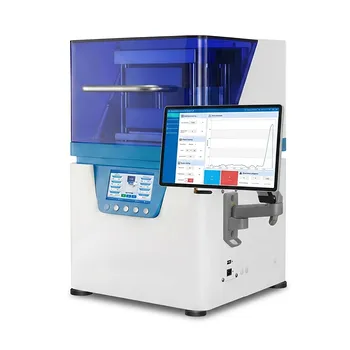
In its loose state, powder exerts strong capillary forces that "wick" the testing liquid into the sample. The high-pressure compression from a hydraulic press eliminates these internal micro-pores, ensuring the droplet remains on the surface for a stable and objective assessment of surface free energy.
Precision Control and Material Integrity
Managing Pressure for Structural Consistency
High-precision pressure regulation, often ranging from 60 MPa to 155 MPa, ensures tight physical contact between particles. Precise control is vital because insufficient pressure results in loose samples that crumble, while excessive pressure (exceeding 310 MPa in some BN structures) can crush the material's internal architecture.
Aligning Material Microstructure
In specialized composites, a heated hydraulic press can induce the orientation and alignment of high-aspect-ratio boron nitride nanosheets. This alignment is critical when the goal is to evaluate how the material's anisotropic properties affect its interaction with liquids.
Understanding the Trade-offs
The Risk of Structural Deformation
While high pressure is necessary for density, it can lead to undesirable anisotropy or the destruction of spherical structures within the boron nitride. If the pressure exceeds the material's structural limit, the resulting data may not represent the "porous" nature the user intended to test.
Potential for Processing Stresses
The pressing process can introduce internal processing stresses or microscopic cracks if the pressure is released too quickly. These defects can lead to inconsistent wetting behavior across different areas of the same pellet, compromising the reproducibility of the results.
How to Apply This to Your Project
Making the Right Choice for Your Goal
To ensure your contact angle testing yields reliable and comparable data, tailor your pressing parameters to your specific material requirements.
- If your primary focus is evaluating chemical modifications: Use standard pressure (e.g., 60–200 bar) to create the smoothest possible surface to isolate chemical wetting effects.
- If your primary focus is thermal conductivity or mechanical performance: Utilize a heated press to ensure full compaction and alignment of nanosheets, removing internal air bubbles.
- If your primary focus is preserving porous structures: Carefully calibrate your hydraulic press to the minimum pressure required for pellet stability to avoid crushing the internal pore network.
Standardizing your sample preparation with a hydraulic press is the only way to transform irregular powders into the high-fidelity specimens required for accurate surface analysis.
Summary Table:
| Feature | Impact on Contact Angle Testing | Primary Benefit |
|---|---|---|
| Surface Planarity | Creates a flat optical baseline | Enables accurate camera measurement |
| Pore Elimination | Prevents capillary liquid wicking | Measures inherent surface energy |
| Pressure Control | Standardizes density (60–155 MPa) | Ensures data reproducibility |
| Sample Stability | Transforms powder into solid pellets | Prevents sample crumbling/collapse |
Precision is paramount in material characterization. KINTEK specializes in high-performance laboratory equipment designed to deliver repeatable results. Whether you require specialized pellet, hot, or isostatic hydraulic presses for perfect sample compaction, or high-temperature furnaces (muffle, vacuum, CVD) for advanced material synthesis, our comprehensive range supports every stage of your research. We also offer precision crushing systems, sieving equipment, and essential consumables like crucibles and ceramics. Contact KINTEK today to discover how our tailored solutions can enhance your laboratory’s efficiency and data accuracy.
References
- Tongtai Ji, Hongli Zhu. High Ion Conductive and Selective Membrane Achieved through Dual Ion Conducting Mechanisms. DOI: 10.1002/smll.202206807
This article is also based on technical information from Kintek Solution Knowledge Base .
Related Products
- Cylindrical Press Mold for Lab Applications
- Cylindrical Press Mold with Scale for Lab
- Cylindrical Lab Electric Heating Press Mold for Laboratory Applications
- Assemble Lab Cylindrical Press Mold
- Assemble Square Lab Press Mold for Laboratory Applications
People Also Ask
- How to use a press mold? Master the Art of Creating Consistent Ceramic Forms
- What is the press mould method? A Guide to Consistent, Detailed Ceramic Forms
- Why are pressure molds with non-conductive resin inner walls required for battery testing? Ensure Data Accuracy
- What is the purpose of specialized pressure devices in sulfide solid-state batteries? Ensure Chemo-Mechanical Stability
- What is the function of press molds during the preparation of SiCf/Ti-43Al-9V composites? Achieve Structural Precision