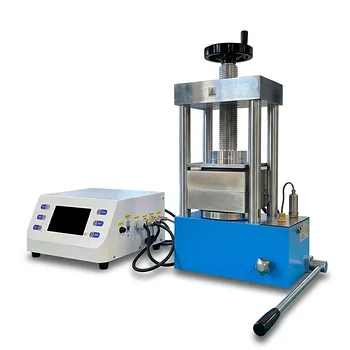
The physical mechanism relies on the application of continuous uniaxial pressure to overcome surface oxidation barriers. By maintaining a constant force, such as 30 MPa, the hydraulic system mechanically ruptures the brittle oxide shells covering the copper-chromium-niobium (Cu-Cr-Nb) particles. This action exposes the underlying fresh metal, allowing direct particle-to-particle bonding that would otherwise be inhibited by the oxide layer.
While heat softens the material, the hydraulic loading system provides the essential mechanical force required to break through stubborn oxide layers on Cu-Cr-Nb powders. This rupturing process is the critical step that transforms loose, oxidized powder into a dense, high-strength solid by enabling clean metal-to-metal contact.
The Role of Pressure in Densification
Providing the Driving Force
The hydraulic system generates the external stress needed to compress the powder mass significantly. This continuous pressure acts as the primary driving force for densification, pushing particles closer together than gravity or vibration alone could achieve.
Overcoming Material Resistance
Cu-Cr-Nb alloys possess inherent strength that resists deformation. The hydraulic load forces the particles to rearrange and physically deform at their contact points, reducing porosity and ensuring maximum packing density.
Breaking the Oxide Barrier
The Challenge of Oxide Shells
Surface-oxidized powders are encased in a thin, brittle ceramic-like layer. This layer acts as a diffusion barrier, preventing the metal atoms from different particles from fusing together to form a strong bond.
Mechanical Rupture at Contact Points
As the hydraulic system applies pressure, stress concentrates intensely at the microscopic points where particles touch. Because the oxide shell is brittle compared to the underlying metal, this localized stress forces the shell to crack and rupture.
Exposing Fresh Metal
Once the oxide shell fractures, clean, unoxidized metal extrudes through the gaps. This exposure allows for immediate neck formation—the initial bridge between particles—which is essential for increasing the overall strength of the sintered material.
Understanding the Trade-offs
Mechanical Disruption vs. Elimination
It is important to note that the hydraulic system disrupts the oxide film but does not chemically remove it. The fractured oxide debris remains trapped within the material matrix, which is distinct from chemical reduction processes that might eliminate oxygen entirely.
Tooling Limitations
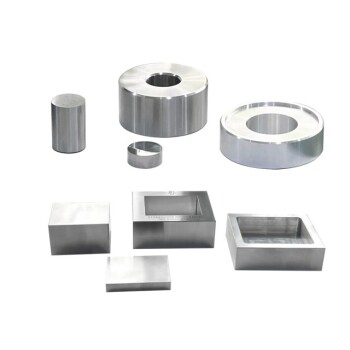
While higher pressures generally facilitate better oxide rupture, there is a practical limit. Excessive hydraulic force can damage the graphite dies typically used in laboratory hot presses, requiring a careful balance between necessary densification force and tool integrity.
Optimizing the Hot Pressing Process
To effectively sinter surface-oxidized Cu-Cr-Nb powders, you must view pressure as a variable equal in importance to temperature.
- If your primary focus is Maximum Density: Maintain continuous peak pressure (e.g., 30 MPa) throughout the high-temperature hold to minimize porosity.
- If your primary focus is Inter-particle Bonding: Ensure the pressure applied is sufficient to mechanically crush the specific thickness of the oxide layer present on your specific powder batch.
The hydraulic system is not merely a compactor; it is the mechanical key that unlocks the bonding potential of oxidized powders.
Summary Table:
| Mechanism Feature | Description | Impact on Sintering |
|---|---|---|
| Uniaxial Pressure | Continuous force (e.g., 30 MPa) applied via hydraulic system | Acts as the primary driving force for powder densification |
| Oxide Rupture | Mechanical fracturing of brittle surface oxide layers | Exposes fresh metal for immediate particle neck formation |
| Deformation | Physical rearrangement and extrusion of alloy particles | Reduces porosity and increases final material density |
| Stress Concentration | Intense localized stress at microscopic contact points | Overcomes material resistance and breaks diffusion barriers |
Elevate Your Material Research with KINTEK Precision
Unlock the full potential of your alloy development with KINTEK’s high-performance laboratory hot presses. Whether you are sintering complex Cu-Cr-Nb powders or advanced ceramics, our hydraulic loading systems provide the precise, continuous pressure needed to rupture oxide barriers and achieve theoretical density.
Why choose KINTEK?
- Comprehensive Range: From hydraulic pellet and isostatic presses to high-temperature vacuum and atmosphere furnaces.
- Specialized Expertise: We provide the tools for critical bonding, including CVD/PECVD systems and high-pressure reactors.
- Total Lab Solutions: Supporting your workflow with crushing systems, cooling solutions, and premium consumables like PTFE and crucibles.
Don't let surface oxidation compromise your material integrity. Contact KINTEK today to find the perfect sintering solution for your lab!
Related Products
- 30T 40T Split Automatic Heated Hydraulic Press Machine with Heated Plates for Laboratory Hot Press
- Automatic Heated Hydraulic Press Machine with Heated Plates for Laboratory Hot Press
- Heated Hydraulic Press Machine with Heated Plates Split Manual Laboratory Hot Press
- Automatic Laboratory Heat Press Machine
- Automatic Heated Hydraulic Press Machine with Heated Plates for Laboratory Hot Press 25T 30T 50T
People Also Ask
- What are the advantages of using a laboratory hydraulic press for hot pressing? Achieve Peak Nano-Composite Density
- What are the core advantages of using a laboratory hot press to produce Bi2Se3? Achieve 93% Density & High Conductivity
- Why is a laboratory hydraulic hot press essential for high-density, additive-free Silicon Carbide? Unlock Pure SiC.
- How does a laboratory hydraulic hot press ensure the quality of PHBV/natural fiber composites? Expert Guide
- What is the function of a laboratory hydraulic hot press in the assembly of solid-state photoelectrochemical cells?