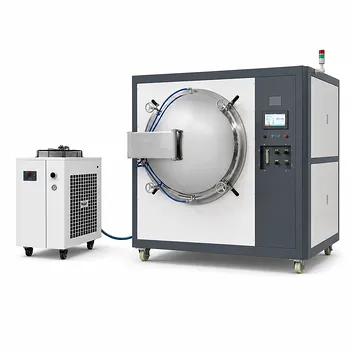
The high-vacuum tube furnace serves as the foundational thermal reactor for the synthesis of antimony-doped bismuth selenide (Sb-doped $Bi_2Se_3$) nanoribbons. Its primary function is to provide a precisely controlled high-temperature environment and a stable thermal gradient that facilitates the simultaneous vaporization of precursor materials and their subsequent transport to downstream substrates for growth.
The tube furnace acts as a precision-controlled environment that manages the transition of solid precursors into a vapor phase. By establishing a specific temperature gradient, it enables the directional transport and organized crystallization of nanostructures on cooler substrates.
Managing Phase Transitions and Vaporization
Precision Heating for Precursor Activation
In the CVD process, the furnace must reach specific temperatures to drive the vaporization of raw materials. For Sb-doped $Bi_2Se_3$, the furnace heats mixed precursor powders at its center while selenium particles are positioned upstream.
The high-temperature environment ensures that these solid materials reach their sublimation or boiling points at a consistent rate. This stability is critical for maintaining a steady supply of vaporized atoms throughout the synthesis duration.
Establishing the Thermal Gradient
A tube furnace is uniquely designed to create a stable thermal gradient along the length of the quartz tube. While the center remains at the highest temperature to vaporize precursors, the temperature drops systematically toward the ends of the furnace.
This gradient is essential because it dictates where the vaporized materials will condense and crystallize. Without a defined temperature drop, the precursors would remain in a gaseous state rather than depositing as solid nanoribbons on the substrate.
Controlling Growth Dynamics and Morphology
Regulating the Evaporation Rate
The furnace’s ability to maintain a constant temperature phase directly influences the yield and quality of the nanoribbons. Fluctuations in heat can lead to irregular evaporation, resulting in inconsistent doping or non-uniform nanostructure dimensions.
By finely tuning the heating rate, researchers can control the supersaturation levels of the vapor near the substrate. This control is the primary factor in determining whether the resulting structures are one-dimensional nanoribbons or bulk crystals.
Atmospheric Control and Sealing Integrity
The "high-vacuum" aspect of the furnace ensures high-purity growth by removing atmospheric contaminants like oxygen or moisture. It also allows the process to operate at reduced pressures, which can lower the required vaporization temperatures for sensitive precursors.
The furnace tube acts as a sealed vessel where carrier gases (like Argon) can move the vaporized precursors toward the substrate. This directional flow, combined with vacuum pressure, ensures that the growth process is both efficient and repeatable.
Understanding the Trade-offs
Temperature Sensitivity and Gradient Fluctuations
While a steep thermal gradient is necessary for deposition, a gradient that is too aggressive can lead to "thermal shock" or poor crystallinity. If the temperature drops too rapidly, the precursors may solidify into an amorphous state rather than forming the desired highly crystalline nanoribbons.
Precursor Positioning and Cross-Contamination
The placement of materials within the furnace is a delicate balance. Positioning the selenium upstream is vital for a selenium-rich environment, but incorrect spacing can lead to the premature deposition of dopants (antimony) before they reach the growth zone, leading to non-uniform doping concentrations.
How to Apply This to Your Project
Maximizing Synthesis Efficiency
To achieve high-quality Sb-doped $Bi_2Se_3$ nanoribbons, focus your furnace configuration on the following goals:
- If your primary focus is high crystallinity: Ensure the furnace maintains a stable, high-precision thermal field to minimize grain boundary defects and promote long-range atomic order.
- If your primary focus is uniform doping: Precisely calibrate the temperature at the center of the furnace to ensure the antimony and bismuth selenide powders vaporize at a synchronized, predictable rate.
- If your primary focus is morphology control: Focus on adjusting the carrier gas flow rate and the specific distance of the substrate from the heating center to find the "sweet spot" of the thermal gradient.
By mastering the furnace's thermal gradient and atmospheric integrity, you can reliably produce nanoribbons with the precise electronic and structural properties required for advanced material research.
Summary Table:
| Function | Role in CVD Synthesis | Key Control Factor |
|---|---|---|
| Phase Transition | Ensures consistent vaporization of precursors (Sb, Bi, Se) | Temperature precision & stability |
| Thermal Gradient | Dictates where vaporized materials condense and crystallize | Substrate positioning & cooling rate |
| Atmosphere Control | Removes contaminants and manages carrier gas flow | Vacuum integrity & Argon flow rates |
| Morphology Control | Regulates supersaturation for nanoribbon formation | Heating rate & evaporation timing |
Elevate Your Nanomaterial Research with KINTEK
Achieving high-crystallinity and uniform doping in Sb-doped $Bi_2Se_3$ nanoribbons requires uncompromising thermal precision. KINTEK specializes in advanced laboratory equipment designed for complex CVD processes. Our high-performance tube furnaces (CVD, PECVD, MPCVD, and vacuum models) provide the stable thermal gradients and high-vacuum integrity essential for high-purity synthesis.
Beyond furnaces, we support your entire workflow with:
- Material Preparation: Crushing and milling systems, hydraulic presses (pellet, hot, isostatic), and high-purity crucibles.
- Reaction Systems: High-temperature high-pressure reactors, autoclaves, and electrolytic cells.
- Lab Essentials: Cooling solutions (ULT freezers), homogenizers, and essential ceramics/PTFE consumables.
Whether you are a researcher or a distributor looking for reliable OEM/ODM support, KINTEK delivers the tools to ensure repeatable, high-quality results.
Contact KINTEK today to find the perfect furnace for your synthesis needs!
References
- Duhyuk Kwon, Myung‐Ho Bae. Quantum interference probed by the thermovoltage in Sb-doped Bi2Se3 nanowires. DOI: 10.1016/j.isci.2022.105691
This article is also based on technical information from Kintek Solution Knowledge Base .
Related Products
- Laboratory High Pressure Vacuum Tube Furnace
- 1700℃ Controlled Atmosphere Furnace Nitrogen Inert Atmosphere Furnace
- 1700℃ Laboratory High Temperature Tube Furnace with Alumina Tube
- Ultra-High Temperature Graphite Vacuum Graphitization Furnace
- 2200 ℃ Tungsten Vacuum Heat Treat and Sintering Furnace
People Also Ask
- What is the role of a high-vacuum tube furnace in preparing Co3S4@NiS2/C composite materials? Expert Synthesis Insights
- What role does a high-vacuum tube furnace play in synthesizing manganese nitride? Achieve Precise Phase & Stoichiometry.
- Role of High-Pressure Tube Furnace in Ru/OMC Synthesis: Achieve Precise Reduction & Nanostructure Control
- What are the primary functions of a high-pressure tube furnace? Expert Guide to MWCNT/Metal Oxide Synthesis
- What is the primary function of a high-pressure tube furnace in the preparation of Laver biochar? Expert Pyrolysis Guide