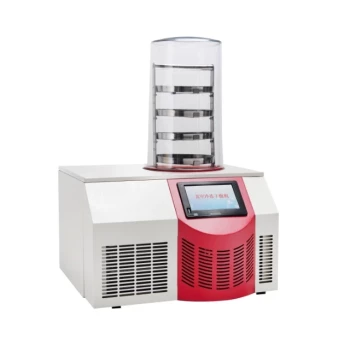
The primary function of a vacuum drying oven in this specific process is to facilitate rapid solvent removal at low temperatures while preserving the structural integrity of the coating. By creating a negative pressure environment, the oven lowers the boiling point of the solvent (typically water) to approximately 80°C, allowing the NH4H2PO4 layer to set uniformly on the NCM811 precursor without the risks associated with high-heat drying.
Core Takeaway The vacuum drying oven acts as a stabilization tool, not just a dryer. It enables a "gentle" evaporation process that protects the precursor from oxidation and agglomeration, ensuring the phosphorus source creates a uniform, effective protective shell around the cathode material.
The Mechanics of Vacuum Drying
Lowering the Boiling Point
The central principle at work is the relationship between pressure and temperature. By reducing the pressure inside the chamber, the vacuum oven significantly lowers the boiling point of the solvent used in the slurry.
Enabling Low-Temperature Evaporation
This thermodynamic shift allows the solvent to evaporate rapidly at relatively low temperatures, such as 80°C, rather than the standard 100°C required at atmospheric pressure. This creates a "gentle" drying environment that removes liquid without subjecting the sensitive chemical components to excessive thermal stress.
Critical Benefits for Coated Precursors
Ensuring Coating Uniformity
For NH4H2PO4-coated NCM811, the uniformity of the coating layer is paramount. Rapid, high-heat drying can cause the coating to crack or distribute unevenly; the controlled vacuum environment ensures the phosphorous source deposits evenly across the surface.
Preventing Material Oxidation
NCM811 is highly sensitive to atmospheric conditions. The vacuum oven isolates the precursor from air during the heating process, effectively preventing unintended oxidation of the nickel-rich material that would occur in a standard convection oven.
Mitigating Agglomeration
When solvents evaporate unevenly or too slowly, particles tend to clump together. The efficient, low-temperature removal of solvents in a vacuum minimizes this particle-to-particle bridging, preventing the agglomeration of the precursor powder.
Understanding the Trade-offs
Batch Processing Limitations
Unlike conveyor-belt style drying, vacuum ovens operate as batch processes. This ensures high quality and atmosphere control, but can become a bottleneck for throughput if large quantities of precursor need to be processed rapidly.
The Risk of "Bumping"
While vacuum lowers the boiling point, applying a vacuum too aggressively to a wet slurry can cause the solvent to flash-boil violently (bumping). This can splatter the coating material, ruining the uniformity you are trying to achieve, requiring careful regulation of the pressure decrease.
Making the Right Choice for Your Goal
To maximize the effectiveness of your vacuum drying process for NCM811 precursors, consider your specific priority:
- If your primary focus is Coating Integrity: Maintain a steady, moderate vacuum level to ensure slow, even solvent evaporation, preventing surface cracking or pinholes.
- If your primary focus is Purity: Ensure the system is flushed with an inert gas prior to pulling a vacuum to guarantee the absolute minimal oxygen exposure for the nickel-rich core.
Ultimately, the vacuum oven is the critical control point that transforms a wet chemical slurry into a stable, high-performance battery cathode precursor.
Summary Table:
| Feature | Impact on NH4H2PO4-coated NCM811 |
|---|---|
| Low-Temp Boiling | Facilitates solvent removal at 80°C, reducing thermal stress on precursors. |
| Vacuum Environment | Prevents unintended oxidation of nickel-rich cathode materials. |
| Controlled Evaporation | Ensures uniform coating thickness and prevents surface cracking or pinholes. |
| Agglomeration Control | Minimizes particle clumping, maintaining the integrity of the precursor powder. |
Elevate Your Battery Research with KINTEK Precision
Precision drying is the foundation of high-performance battery materials. KINTEK specializes in advanced laboratory solutions, offering state-of-the-art vacuum drying ovens and high-temperature furnaces (CVD, PECVD, vacuum) specifically designed for delicate processes like NCM811 precursor preparation.
Beyond drying, our comprehensive portfolio includes battery research tools, high-pressure reactors, and crushing and milling systems to support your entire material synthesis workflow. Don't compromise on coating uniformity or material purity. Contact KINTEK today to discover how our high-performance equipment and specialized consumables can optimize your laboratory's efficiency and results.
Related Products
- 56L Vertical Laboratory Vacuum Drying Oven
- 23L Laboratory Vacuum Drying Oven
- Laboratory Scientific Electric Heating Blast Drying Oven
- Benchtop Laboratory Vacuum Freeze Dryer
- Dental Porcelain Zirconia Sintering Ceramic Vacuum Press Furnace
People Also Ask
- Why is a laboratory vacuum drying oven recommended for rice straw residues? Protect Your Biomass Integrity
- What role does a laboratory vacuum drying oven play in the preparation of modified multi-walled carbon nanotubes?
- What is the importance of using a laboratory vacuum drying oven? Preserving Slow-Release Microcapsule Integrity
- Why is a Laboratory Vacuum Drying Oven recommended for PBAT microspheres? Protect Sensitive Polymer Integrity
- What role does a laboratory vacuum drying oven play in processing nanoparticle powder samples? Protect Sample Integrity