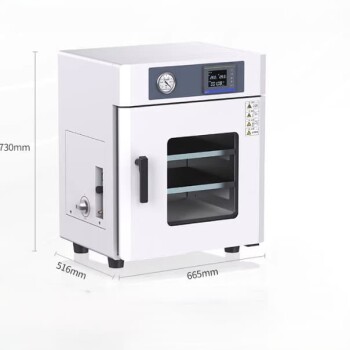
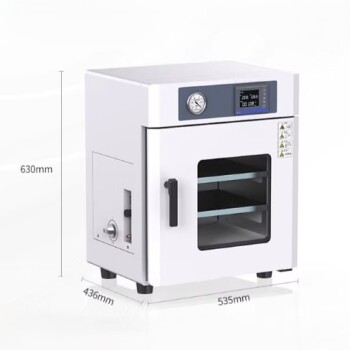
A vacuum oven acts as a critical structural engineering tool during solid electrolyte membrane formation, doing far more than simply removing moisture. Its primary function is to facilitate the controlled evaporation of solvents like acetonitrile from homogenized slurries cast on glass plates. This process actively eliminates internal air bubbles and residual solvents that would otherwise compromise the material's performance.
The vacuum environment transforms a liquid slurry into a high-performance solid by preventing microscopic voids. It ensures the final membrane is dense, defect-free, and uniform—qualities essential for reliable conductivity.
The Mechanics of Membrane Formation
The use of a vacuum oven is not merely about drying; it is about controlling the physical transition from a liquid slurry to a solid state.
Controlled Solvent Evaporation
The primary reference indicates that the vacuum oven facilitates slow and thorough evaporation.
This is distinct from rapid heat drying, which can trap solvents. By lowering the pressure, solvents like acetonitrile can be removed effectively without requiring excessive temperatures that might degrade the electrolyte components.
Eliminating Internal Defects
When the electrolyte slurry is homogenized (mixed), air is often trapped within the viscous liquid.
The vacuum environment creates a pressure differential that draws these internal air bubbles out of the slurry. If these bubbles were not removed, they would remain as voids in the solid membrane, disrupting the pathway for ions.
Achieving Structural Integrity
The ultimate goal of using a vacuum oven is to produce a membrane with specific physical characteristics necessary for battery performance.
Creating a Dense Matrix
A "defect-free" membrane relies on density. By removing both residual solvents and air pockets, the vacuum oven allows the solid particles to pack together tightly.
This results in a dense solid electrolyte membrane, which is crucial for maximizing ionic conductivity and mechanical strength.
Ensuring Uniform Thickness
The drying process directly impacts the physical dimensions of the membrane.
A vacuum ensures that evaporation occurs consistently throughout the material, rather than just on the surface. This consistent removal of volatiles allows the slurry to settle evenly on the glass plate, resulting in uniform thickness across the entire membrane.
Understanding the Trade-offs
While the vacuum is essential, the parameters of its operation must be carefully managed to avoid damaging the membrane.
The Balance of Evaporation Rate
The reference emphasizes "slow" evaporation. If the vacuum pressure is dropped too suddenly, solvents may boil violently rather than evaporating steadily.
This rapid boiling can actually introduce new defects or surface irregularities, countering the goal of creating a smooth, dense film.
Making the Right Choice for Your Goal
To maximize the effectiveness of your vacuum oven process, align your technique with your specific quality metrics.
- If your primary focus is high conductivity: Prioritize the thorough removal of residual solvents and air bubbles to ensure a dense, void-free path for ion transport.
- If your primary focus is mechanical consistency: Ensure the evaporation rate is slow and controlled to achieve uniform thickness and prevent physical warping.
By controlling the vacuum environment, you ensure the transition from slurry to solid yields a high-performance electrolyte component.
Summary Table:
| Process Feature | Physical Impact | Battery Performance Benefit |
|---|---|---|
| Controlled Evaporation | Prevents solvent trapping and degradation | Enhanced material purity and stability |
| Void Elimination | Removes internal air bubbles and microscopic pores | Maximizes ionic conductivity pathways |
| Structural Densification | Enables tight packing of solid particles | Increases mechanical strength and durability |
| Uniform Settling | Ensures consistent thickness across the plate | Reliable electrochemical performance |
Elevate Your Battery Research with KINTEK
Precision is the key to high-performance solid-state batteries. KINTEK provides industry-leading vacuum ovens and battery research tools specifically designed to optimize the structural integrity of your electrolyte membranes. From achieving perfect solvent evaporation to ensuring void-free material density, our equipment empowers you to produce superior results.
Explore our comprehensive range of laboratory solutions, including:
- High-Temperature Vacuum & Atmosphere Furnaces
- Precision Hydraulic Presses (Pellet, Hot, Isostatic)
- Homogenizers & Crushing Systems
- Battery Consumables (Ceramics, Crucibles, and PTFE products)
Ready to enhance your lab's efficiency and material quality? Contact our specialists today!
Related Products
- 56L Vertical Laboratory Vacuum Drying Oven
- 23L Laboratory Vacuum Drying Oven
- Vacuum Heat Treat Sintering Brazing Furnace
- 2200 ℃ Graphite Vacuum Heat Treat Furnace
- Dental Porcelain Zirconia Sintering Ceramic Vacuum Press Furnace
People Also Ask
- Why is a laboratory vacuum drying oven recommended for rice straw residues? Protect Your Biomass Integrity
- What role does a laboratory vacuum drying oven play in the preparation of modified multi-walled carbon nanotubes?
- What is the importance of using a laboratory vacuum drying oven? Preserving Slow-Release Microcapsule Integrity
- Why is a Laboratory Vacuum Drying Oven recommended for PBAT microspheres? Protect Sensitive Polymer Integrity
- What role does a laboratory vacuum drying oven play in processing nanoparticle powder samples? Protect Sample Integrity