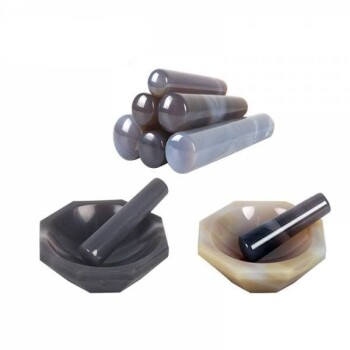
The primary function of an Agate Mortar in this specific context is to mechanically pulverize synthesized Mesoporous Rutile TiO2 samples into a fine, uniform powder. This physical grinding is a mandatory preparatory step performed immediately after synthesis to ready the material for high-sensitivity analytical techniques.
The Agate Mortar is not merely a grinding tool; it is a contamination barrier. Its specific role is to reduce particle size while guaranteeing zero introduction of metallic or impurity contamination, preserving the chemical integrity required for accurate characterization.
The Mechanics of Sample Preparation
Achieving Uniform Particle Size
The synthesis of Mesoporous Rutile TiO2 often yields agglomerated material. The agate mortar is used to break these agglomerates down into discrete, fine particles.
This reduction in size is not aesthetic; it is functional. A fine, homogeneous powder is physically required to mount samples properly for microscopic and spectroscopic analysis.
High-Impact Pulverization
Agate is utilized because of its high hardness. It can effectively grind the TiO2—a hard ceramic material—without degrading the mortar itself.
This durability allows the researcher to apply sufficient mechanical force to pulverize the sample thoroughly. Soft mortars would simply abrade under the pressure required to grind titanium dioxide.
Why Material Choice Matters
Preventing Metallic Contamination
The most critical aspect of using agate is its superior chemical stability. Standard metal mortars can shed microscopic metallic flakes into the sample during vigorous grinding.
For a catalyst like TiO2, trace metal contamination is disastrous. It alters the catalytic properties and generates false data points, rendering the synthesis effort wasted.
Ensuring Analytical Accuracy
The choice of agate directly impacts the validity of subsequent testing. Specifically, techniques like Transmission Electron Microscopy (TEM) require pristine samples to visualize pore structure without artifacts.
Similarly, X-ray Diffraction (XRD) analysis relies on pure crystal patterns. Contaminants introduced during grinding would appear as foreign peaks in the XRD data, leading to incorrect structural conclusions.
Common Pitfalls to Avoid
The Risk of Alternative Materials
A common mistake is substituting agate with porcelain or steel mortars for convenience. Porcelain is often too soft and porous, leading to cross-contamination and sample loss.
Steel, while hard, is chemically reactive in this context. Using a steel mortar introduces iron impurities that are indistinguishable from the catalyst's active sites in many analytical scans.
Manual Inconsistency
Because the agate mortar relies on manual grinding, user variability is a limitation. Inconsistent grinding pressure or duration can lead to batches with varying particle sizes.
This lack of uniformity can affect how the powder packs or disperses during characterization, potentially skewing quantitative results.
Making the Right Choice for Your Goal
To ensure your characterization yields publication-grade data, apply the following guidelines:
- If your primary focus is imaging (TEM): Grind the sample thoroughly in agate to ensure particles are fine enough to be electron-transparent without introducing dense metallic artifacts.
- If your primary focus is structural analysis (XRD): Use the agate mortar to achieve a random orientation of crystals, preventing "preferred orientation" errors while keeping the background signal clean.
The agate mortar provides the essential baseline of purity that allows your advanced instrumentation to report what is actually there, rather than what was added during preparation.
Summary Table:
| Feature | Function in TiO2 Preparation | Benefit to Research |
|---|---|---|
| High Hardness | Effectively pulverizes hard ceramic TiO2 | Prevents mortar abrasion and sample loss |
| Chemical Stability | Zero introduction of metallic impurities | Preserves catalytic integrity and data accuracy |
| Particle Reduction | Breaks down agglomerates into fine powder | Enables proper mounting for microscopic analysis |
| Non-Porous Surface | Minimizes cross-contamination | Ensures pristine samples for high-sensitivity XRD/TEM |
Elevate Your Material Characterization with KINTEK
Precise research starts with pristine sample preparation. At KINTEK, we understand that even trace contamination can compromise your catalyst's performance and analytical data. Our high-quality agate mortars are designed to provide the ultimate contamination-free grinding environment for your Mesoporous Rutile TiO2 and other advanced materials.
Beyond sample preparation, KINTEK offers a comprehensive suite of laboratory solutions, including:
- High-Temperature Furnaces: Muffle, vacuum, and CVD systems for precise synthesis.
- Material Processing: Advanced crushing, milling, and hydraulic pellet presses.
- Specialized Consumables: High-purity ceramics, crucibles, and PTFE products.
Don't let impurities skew your results. Contact our experts today to find the perfect equipment and consumables for your laboratory's needs.
References
- Shiuan‐Shinn Lee, Min-Chang Wu. Study of the structure and characteristics of mesoporous TiO<sub>2</sub> photocatalyst, and evaluation of its factors on gaseous formaldehyde removal by the analysis of ANOVA and S/N ratio. DOI: 10.1039/c8ra03557a
This article is also based on technical information from Kintek Solution Knowledge Base .
Related Products
- Nature Agate Mortar and Pestle for Grinding and Mixing
- Laboratory Jar Mill with Agate Grinding Jar and Balls
People Also Ask
- Why are agate mortars and pestles used for grinding iron oxide? Ensure Sample Purity for XRD Analysis
- What is the function of an agate mortar and pestle? Ensure Purity in Halide Solid-State Electrolyte Synthesis
- What is the primary function of an agate mortar and pestle? Optimize VO2+ CaZn2(PO4)2 Nanopowder Pre-Treatment
- Why is an agate mortar and pestle required for grinding Zr3(Al1-xSix)C2? Ensure Maximum Sample Purity
- Why is an agate mortar and pestle preferred for grinding MAX phase? Ensure Sample Purity & Zero Contamination