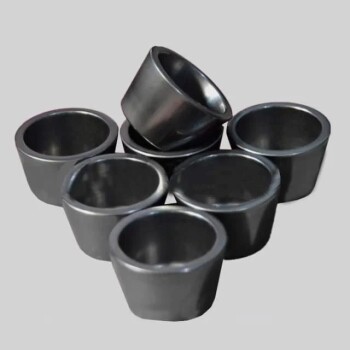
High-carbon graphite reactors serve a dual purpose in the synthesis of titanium-zirconium mixed carbide powders: they act as both a robust thermal vessel and an active chemical participant. Specifically, they provide the thermal resistance necessary to sustain 1600 °C while simultaneously acting as a carbon source to create the required reducing atmosphere.
The reactor is not merely a passive container; it is an integral component of the reaction system. By providing both extreme thermal stability and a source of carbon, it enables the thorough reaction of metal powders and hydrides into pure carbide solid solutions.
The Physical Role: Extreme Thermal Stability
Withstanding High Synthesis Temperatures
The synthesis of (Ti,Zr)C0.85 reinforcement phases requires an environment capable of sustaining extreme heat. The primary physical requirement of the reactor is to maintain stability at 1600 °C.
Maintaining Structural Integrity
High-carbon graphite is selected because it resists degradation at these elevated temperatures. This ensures the synthesis environment remains consistent throughout the duration of the reaction without mechanical failure of the vessel.
The Chemical Role: Active Atmosphere Regulation
Acting as a Carbon Source
Unlike inert vessels used in some chemical processes, the graphite reactor actively participates in the synthesis. It serves as a carbon source within the reaction chamber, directly influencing the chemical stoichiometry of the final product.
Creating a Reducing Atmosphere
The reactor works in tandem with a high-purity argon flow. Together, the graphite (carbon) and argon create a reducing atmosphere that prevents unwanted oxidation.
Ensuring Thorough Reaction
This controlled environment is critical for the reactants—specifically metal powders and hydrides. The active carbon presence ensures these materials react thoroughly to produce high-purity carbide solid solutions.
Understanding the Operational Context
The Reactor as a Reagent
It is vital to recognize that in this specific process, the reactor contributes chemically to the outcome.
Stability vs. Reactivity
While many high-temperature processes require chemically inert vessels to prevent contamination, this synthesis relies on the "contamination" (carbon) provided by the reactor. The reactor essentially functions as a slow-release reagent that supports the formation of the carbide phase.
Making the Right Choice for Your Synthesis
To apply this to your material synthesis or equipment selection:
- If your primary focus is thermal endurance: Ensure your vessel material is rated for sustained operation at 1600 °C to prevent structural failure during the heating cycle.
- If your primary focus is chemical stoichiometry: Account for the reactor walls as an active carbon contributor, ensuring this aligns with your desired carbon balance to promote a reducing atmosphere.
Successfully synthesizing mixed carbides requires viewing the reactor as a chemical partner, not just a physical container.
Summary Table:
| Feature | Physical Role | Chemical Role |
|---|---|---|
| Primary Function | Structural containment & thermal vessel | Active carbon source & reagent |
| Temperature Limit | Sustains constant 1600 °C | Facilitates carbide solid solution formation |
| Atmosphere Control | Resists thermal degradation | Creates reducing atmosphere with Argon |
| Reaction Outcome | Maintains process consistency | Ensures thorough reaction of metal powders |
Elevate Your Material Synthesis with KINTEK Precision
Achieving high-purity carbide solid solutions requires more than just high temperatures—it demands the right chemical environment. KINTEK specializes in advanced laboratory equipment designed for the most rigorous research environments. Whether you need high-temperature furnaces (vacuum, tube, or atmosphere) to reach 1600 °C, high-pressure reactors, or specialized graphite and ceramic consumables, our solutions ensure your chemical stoichiometry remains precise.
From crushing and milling systems for precursor preparation to pellet presses and cooling solutions, KINTEK provides the end-to-end tools necessary for advanced battery research and materials science.
Ready to optimize your synthesis process? Contact our technical experts today to find the perfect reactor or furnace configuration for your laboratory.
References
- Paweł Rutkowski, Paweł Nieroda. Thermal properties of spark plasma sintered Inconel 625 modified by titanium zirconium mixed carbide. DOI: 10.1007/s10973-023-12259-1
This article is also based on technical information from Kintek Solution Knowledge Base .
Related Products
- Carbon Graphite Boat -Laboratory Tube Furnace with Cover
- Large Vertical Graphite Vacuum Graphitization Furnace
- Graphite Vacuum Continuous Graphitization Furnace
- Ultra-High Temperature Graphite Vacuum Graphitization Furnace
- Graphite Vacuum Furnace Bottom Discharge Graphitization Furnace for Carbon Materials
People Also Ask
- What is the use of graphite furnace? Achieve Extreme-Temperature Processing for Advanced Materials
- Why is graphite used in furnaces? For Extreme Heat, Purity, and Efficiency
- What core conditions do high-temperature graphite tube furnaces provide during the pressureless sintering of Boron Carbide (B4C)?
- What is the use of graphite tube? Essential for Extreme Heat & Corrosive Environments
- What is the disadvantage of graphite furnace? Managing Reactivity and Contamination Risks