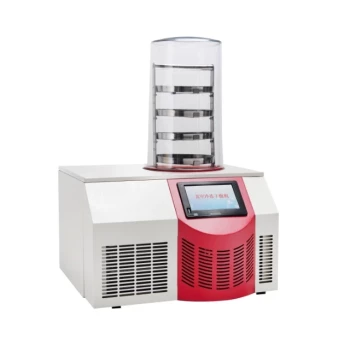
The primary purpose of using a vacuum drying oven in this context is to ensure the absolute chemical purity of the raw materials before synthesis. Specifically, the oven is used to heat treat nickel, titanium, and amorphous boron powders at 150 °C. This process drives off adsorbed moisture and hydroxyl (OH) groups that would otherwise introduce oxidation impurities during the subsequent high-temperature manufacturing phase.
The vacuum drying process serves as a critical purification step, eliminating volatile surface contaminants to prevent the formation of detrimental oxides during Self-Propagating High-Temperature Synthesis (SHS).
The Critical Role of Pretreatment
Targeting Surface Contaminants
Raw metal powders, particularly amorphous boron and titanium, have high surface energies that naturally attract contaminants. During storage and handling, these materials adsorb moisture and form hydroxyl (OH) groups on their surfaces. The vacuum drying oven targets these specific impurities, which are difficult to remove through standard air drying.
The Specifics of Thermal Desorption
The process requires a precise thermal profile, specifically heating the powder mixture to 150 °C. At this temperature, the bond between the powder surface and the adsorbed water or hydroxyl groups is broken. The vacuum environment then lowers the vapor pressure, ensuring these liberated volatiles are immediately evacuated from the chamber.
Impact on the SHS Reaction
Preventing Oxidation Impurities
The Inconel 625/TiB2 composite is created using Self-Propagating High-Temperature Synthesis (SHS). This is a highly exothermic reaction where purity is paramount. If moisture or OH groups remain, the intense heat of SHS will trigger them to react with the metal powders, creating unwanted oxide layers.
Ensuring Compositional Integrity
The presence of oxides weakens the final composite structure and alters its intended chemical properties. By using vacuum drying to ensure the feedstock is "dry" at a molecular level, you preserve the stoichiometry of the reaction. This guarantees that the final synthetic product is pure Inconel 625/TiB2, rather than a degraded oxide-heavy variant.
Understanding the Trade-offs
Process Speed vs. Purity
Vacuum drying is inherently slower than standard convection drying or flash drying methods. It requires sealing the chamber, drawing a vacuum, and maintaining a stable temperature over time to ensure deep desorption. However, this time investment is non-negotiable for high-performance composites where even trace impurities can cause failure.
Equipment Complexity
Unlike simple ovens, vacuum systems require pumps, seals, and pressure gauges that add complexity to the workflow. Operators must monitor vacuum levels to ensure no back-streaming of oil or air leaks occurs. A failure in the vacuum seal at 150 °C could introduce more oxygen than the process removes, ruining the batch.
Making the Right Choice for Your Goal
To maximize the quality of your Inconel 625/TiB2 composite, apply the following principles:
- If your primary focus is Material Purity: strictly adhere to the 150 °C setpoint, as lower temperatures may fail to fully sever the bonds of hydroxyl groups on the boron powder.
- If your primary focus is Process Consistency: implement rigorous vacuum leak checks before every cycle to ensure the atmosphere remains inert and free of external oxygen.
Ultimate material performance begins with the invisible work of removing molecular contaminants before the first spark of synthesis is ever struck.
Summary Table:
| Parameter | Specification | Purpose in Pretreatment |
|---|---|---|
| Target Materials | Ni, Ti, Amorphous Boron | Eliminate adsorbed moisture & hydroxyl (OH) groups |
| Operating Temp | 150 °C | Break chemical bonds of surface contaminants |
| Environment | Vacuum Chamber | Lower vapor pressure to evacuate liberated volatiles |
| Key Outcome | Pure Feedstock | Prevent unwanted oxide formation during SHS reaction |
Elevate Your Material Integrity with KINTEK Precision
High-performance composites like Inconel 625/TiB2 demand absolute purity from the very first step. KINTEK specializes in advanced laboratory solutions designed to eliminate molecular contaminants and ensure reaction consistency. Our comprehensive portfolio includes:
- High-Temperature Vacuum Ovens & Furnaces: Perfect for the precise thermal desorption of sensitive metal powders.
- Processing Excellence: From crushing and milling systems to hydraulic pellet presses for sample preparation.
- Specialized Research Tools: High-pressure reactors, autoclaves, and high-quality ceramics/crucibles for SHS and thermal synthesis.
Don't let surface impurities compromise your synthetic integrity. Partner with KINTEK for reliable equipment that guarantees the chemical purity your research deserves.
Contact our technical experts today to find the perfect drying solution for your lab!
References
- Vladimir Promakhov, Anton Perminov. Inconel 625/TiB2 Metal Matrix Composites by Direct Laser Deposition. DOI: 10.3390/met9020141
This article is also based on technical information from Kintek Solution Knowledge Base .
Related Products
- 56L Vertical Laboratory Vacuum Drying Oven
- 23L Laboratory Vacuum Drying Oven
- Laboratory Scientific Electric Heating Blast Drying Oven
- Benchtop Laboratory Vacuum Freeze Dryer
- Dental Porcelain Zirconia Sintering Ceramic Vacuum Press Furnace
People Also Ask
- Why is a laboratory vacuum drying oven recommended for rice straw residues? Protect Your Biomass Integrity
- What role does a laboratory vacuum drying oven play in the preparation of modified multi-walled carbon nanotubes?
- What is the importance of using a laboratory vacuum drying oven? Preserving Slow-Release Microcapsule Integrity
- Why is a Laboratory Vacuum Drying Oven recommended for PBAT microspheres? Protect Sensitive Polymer Integrity
- What role does a laboratory vacuum drying oven play in processing nanoparticle powder samples? Protect Sample Integrity