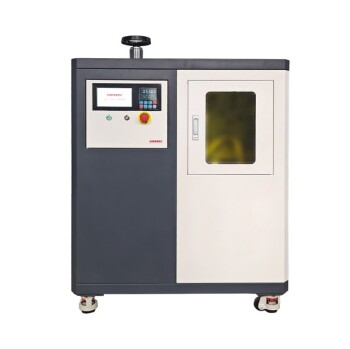
The primary purpose of the Hot Press process is to achieve complete densification and induce specific crystal orientation in purified Thallium Bromide (TlBr). By subjecting the material to a "thermo-mechanical" environment—simultaneously applying heat and axial pressure—this process transforms raw powder into a solid, high-density semiconductor block essential for radiation detection.
The Hot Press process serves as the critical bridge between raw purification and functional device performance. It eliminates internal porosity and aligns the crystal structure, directly resulting in the high gamma-ray attenuation and photon counting efficiency required for detector-grade semiconductors.
The Mechanics of Densification
Eliminating Internal Defects
The most immediate goal of hot pressing is the elimination of internal micro-porosity.
Raw Thallium Bromide often contains microscopic voids that can trap charge carriers and degrade detector performance. The simultaneous application of heat and pressure forces the material to consolidate, removing these voids to create a uniform solid.
Promoting Inter-Granular Bonding
Beyond simple compression, this process acts as a sintering phase.
It promotes tight inter-granular bonding between particles of the high-purity raw material. This consolidation creates a coherent bulk material that is mechanically robust and structurally consistent.
Optimizing Crystal Properties
Controlling Crystal Orientation
For a semiconductor to function correctly as a detector, density is not enough; the arrangement of atoms matters.
Hot pressing allows for the control of the stress field during crystal growth. This suppresses defect formation and guides the material into specific crystal orientations, which is vital for uniform electrical properties across the detector.
Enhancing Detection Capability
The physical changes induced by hot pressing have direct functional benefits.
The resulting high-density crystal exhibits a superior gamma-ray attenuation coefficient. This maximizes the probability that incoming radiation will interact with the crystal, thereby increasing the device's overall detection efficiency.
Critical Process Parameters
Precision Thermo-Mechanical Coupling
Success depends on a precise "recipe" of environmental conditions maintained for a specific duration.
According to standard manufacturing protocols, the process requires a continuous pressure of approximately 30 kN. This must be held stable while the material is heated to a temperature range of 455 to 465 ºC.
Duration and Stability
Time is a distinct factor in achieving structural integrity.
The material is typically held under these conditions for a duration of 2 hours. This holding period ensures that the heat and pressure have sufficient time to thoroughly permeate the mold, ensuring uniform densification throughout the entire volume of the crystal.
Understanding the Trade-offs
The Necessity of Strict Control
While hot pressing yields superior crystals, it is highly sensitive to parameter deviations.
If the pressure (30 kN) or temperature (455-465 ºC) fluctuates, the material may fail to reach full density or develop irregular crystal orientations. Inconsistent pressure can lead to residual porosity, while incorrect temperatures may cause thermal stress defects rather than suppressing them.
Balance of Forces
The process relies on a synergy of forces that must be perfectly balanced.
It is a "coupled" process; heat alone would simply melt or sinter the material without orientation control, while pressure alone would crush it without proper bonding. The specific equipment—a precision hot press—is required to maintain this delicate balance to produce high-resolution energy detectors.
Making the Right Choice for Your Goal
To ensure your TlBr crystal fabrication meets performance requirements, consider these key drivers:
- If your primary focus is Detection Efficiency: Prioritize maximum densification to ensure the highest possible gamma-ray attenuation coefficient and photon counting capability.
- If your primary focus is Energy Resolution: Focus on the precise control of the stress field and crystal orientation to minimize internal defects that cause signal noise.
The Hot Press process is not merely a molding step; it is the definitive method for engineering the internal structure of TlBr to ensure high-performance radiation detection.
Summary Table:
| Feature | Hot Press Specification | Benefit to TlBr Crystals |
|---|---|---|
| Pressure | 30 kN (Axial) | Eliminates micro-porosity & voids |
| Temperature | 455 - 465 ºC | Promotes inter-granular bonding |
| Duration | 2 Hours | Ensures uniform density & structural integrity |
| Primary Goal | Thermo-mechanical coupling | Induces specific crystal orientation |
| Result | High-density solid | Maximized gamma-ray attenuation & resolution |
Elevate Your Semiconductor Research with KINTEK Precision
Are you looking to achieve complete densification and perfect crystal orientation for high-performance radiation detectors? KINTEK specializes in advanced laboratory equipment designed to meet the rigorous demands of material science.
Our comprehensive range of hydraulic presses (pellet, hot, isostatic) and high-temperature furnaces provides the precise thermo-mechanical control needed for Thallium Bromide (TlBr) fabrication. Beyond pressing, we support your entire workflow with:
- Crushing and milling systems for raw material preparation.
- High-purity ceramics and crucibles for contamination-free processing.
- Specialized battery research tools and cooling solutions for advanced material analysis.
Don't settle for inconsistent results. Contact KINTEK today to discover how our high-precision systems can optimize your crystal growth and semiconductor development!
References
- Tatiana Poliakova, Alexandre M. Fedoseev. Structural regularities in double sulphates of trivalent actinides. DOI: 10.21175/rad.abstr.book.2023.38.1
This article is also based on technical information from Kintek Solution Knowledge Base .
Related Products
- Automatic Heated Hydraulic Press Machine with Heated Plates for Laboratory Hot Press 25T 30T 50T
- Manual High Temperature Heated Hydraulic Press Machine with Heated Plates for Lab
- Touchscreen Automatic Vacuum Heat Press
- 30T 40T Split Automatic Heated Hydraulic Press Machine with Heated Plates for Laboratory Hot Press
- Vacuum Hot Press Furnace Machine Heated Vacuum Press
People Also Ask
- Why is the heating function of a laboratory hydraulic press essential for MEA assembly in DEFC? Optimize Cell Bonding
- What technical conditions does a heated hydraulic press provide for PEO batteries? Optimize Solid-State Interfaces
- How is a heated hydraulic press used for Li-LLZO batteries? Optimize Interfacial Bonding with Thermal-Pressure
- What role does a heated hydraulic press play in Cold Sintering (CSP)? Enhancing LATP-Halide Densification
- What are heated hydraulic presses used for? Molding Composites, Vulcanizing Rubber, and More