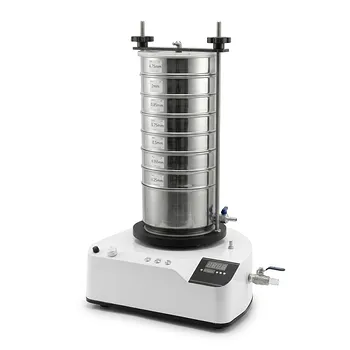
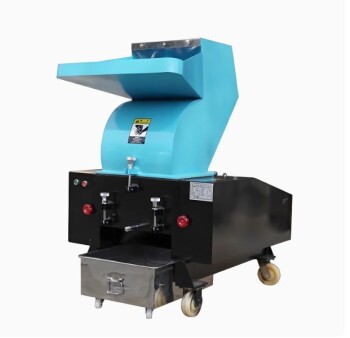
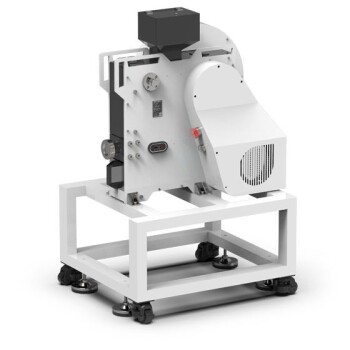
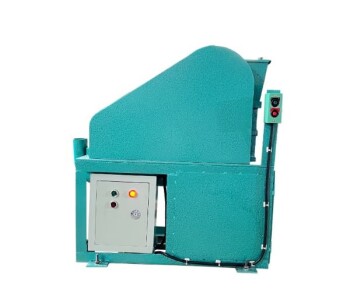
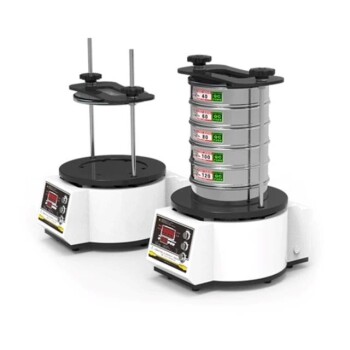
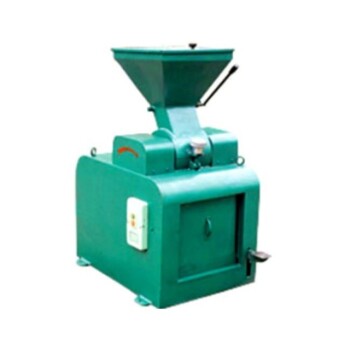
The primary purpose of utilizing crushing and sieving systems during the pre-treatment phase of bioleaching is to process electrode materials into extremely fine powders, typically smaller than 75 micrometers. This mechanical size reduction is critical to maximizing the solid surface area, which serves as the physical foundation for the entire bioleaching reaction.
The ultimate goal of this pre-treatment is not just size reduction, but the enhancement of reaction kinetics. By maximizing surface area, you ensure optimal solid-liquid contact between metal oxides and microbial metabolites, significantly accelerating the rate and efficiency of metal extraction.
The Mechanics of Particle Size Reduction
Achieving Micro-Scale Dimensions
The crushing and sieving process is engineered to reduce complex battery components into a uniform powder. In the context of bioleaching, the target specification is precise, often requiring particle sizes smaller than 75 micrometers.
Maximizing Specific Surface Area
As particle size decreases, the specific surface area (surface area per unit of mass) increases exponentially. This exposes more of the valuable electrode material to the surrounding environment, removing physical barriers that would otherwise impede the chemical process.
Enhancing Bioleaching Kinetics
Facilitating Solid-Liquid Contact
Bioleaching relies on the interaction between a solid phase (the battery material) and a liquid phase (the microbial culture). High-precision sieving ensures that the material is fine enough to suspend effectively in the liquid, creating a homogeneous mixture where reagents can contact the solid surfaces freely.
Accelerating Metabolic Reactions
The efficiency of bioleaching is driven by the reaction between microorganisms, their metabolites (such as organic acids or iron ions), and the metal oxides. By increasing the available surface area, you provide more active sites for these metabolites to attach and react.
Increasing Leaching Efficiency
The direct result of improved contact and accelerated reaction rates is a significant boost in leaching efficiency. The system can extract a higher percentage of target metals in a shorter timeframe because the microorganisms are not limited by surface accessibility.
Operational Considerations and Trade-offs
Balancing Energy and Output
While finer particles generally lead to faster leaching, achieving extremely small particle sizes (e.g., significantly below 75 micrometers) requires exponentially more energy during the mechanical crushing phase. Operators must balance the cost of energy input against the marginal gains in leaching speed.
Separation vs. Reaction
It is important to distinguish between size reduction for reaction kinetics and sieving for material separation. While the primary goal in bioleaching is surface area, sieving systems can also be used earlier in the workflow to separate active graphite from copper and aluminum current collectors, preventing inert materials from taking up volume in the bioleaching reactor.
Optimizing Pre-Treatment for Your Goals
To determine the optimal crushing and sieving parameters for your project, consider your specific end-goals:
- If your primary focus is maximizing reaction speed: Prioritize grinding systems that consistently yield particle sizes below 75 micrometers to ensure the highest possible surface area for microbial attack.
- If your primary focus is material purity: Utilize multi-stage sieving (e.g., 300 to 600 mesh) to physically separate graphite from metallic foils before the fine grinding stage, ensuring high-quality raw material input.
By strictly controlling particle size through crushing and sieving, you transform spent batteries from a waste product into a highly reactive feedstock optimized for biological recovery.
Summary Table:
| Feature | Specification/Requirement | Impact on Bioleaching |
|---|---|---|
| Target Particle Size | < 75 micrometers (μm) | Maximizes specific surface area for microbial attack |
| Primary Mechanism | Mechanical size reduction | Enhances solid-liquid contact between material and metabolites |
| Kinetic Goal | Increased surface area per mass | Accelerates metal extraction rate and leaching efficiency |
| Material Separation | Multi-stage sieving (300-600 mesh) | Separates active graphite from Al/Cu current collectors |
| Operational Balance | Energy input vs. particle size | Optimizes cost-effectiveness of the crushing process |
Optimize Your Battery Recovery Process with KINTEK
Unlock maximum efficiency in your bioleaching workflow with KINTEK’s industry-leading precision equipment. Whether you are refining pre-treatment stages for spent lithium-ion batteries or conducting advanced material research, our comprehensive range of crushing and milling systems, high-precision sieving equipment, and hydraulic presses are engineered to deliver the exact particle sizes required for optimal reaction kinetics.
At KINTEK, we specialize in empowering laboratory and industrial professionals with high-performance tools—from high-temperature furnaces and vacuum reactors to PTFE consumables and cooling solutions. Let our experts help you select the right configuration to enhance your metal extraction rates and material purity.
Ready to elevate your lab's performance? Contact us today to find your perfect equipment solution!
References
- Xu Zhang, Tingyue Gu. Advances in bioleaching of waste lithium batteries under metal ion stress. DOI: 10.1186/s40643-023-00636-5
This article is also based on technical information from Kintek Solution Knowledge Base .
Related Products
- Laboratory Test Sieves and Sieving Machines
- Three-dimensional electromagnetic sieving instrument
- Laboratory Vibratory Sieve Shaker Machine for Dry and Wet Three-Dimensional Sieving
- Powerful Plastic Crusher Machine
- Laboratory Jaw Crusher
People Also Ask
- What are laboratory test sieves used for? A Guide to Particle Size Analysis
- How do you calculate the sieve test? Master Particle Size Distribution for Quality Control
- How does a lab test sieve contribute to biomass charcoal powder preparation? Achieve Uniform Particle Size
- What are the specifications for test sieves? A Guide to ASTM & ISO Standards for Accurate Particle Analysis
- What materials are required for sieving? Achieve Accurate Particle Size Analysis