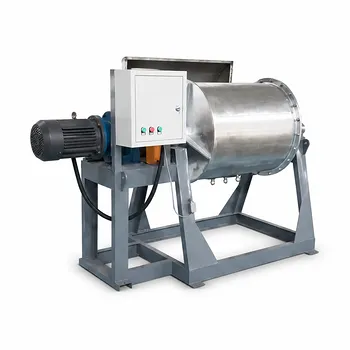
The primary role of a high-energy ball mill in top-down synthesis is to physically pulverize bulk raw materials through the application of high-frequency mechanical impact and strong shear forces. By forcefully reducing materials from the micrometer scale down to the nanometer scale, this process creates active materials with the high specific surface areas necessary for effective soil and groundwater remediation.
Core Takeaway High-energy ball milling acts as a mechanical intensifier that converts inert bulk powders into highly reactive nanoparticles. By maximizing the surface-to-volume ratio, it exposes the critical active sites required to chemically break down environmental contaminants.
The Mechanics of Top-Down Synthesis
Utilizing High-Frequency Impact
The fundamental operation of a high-energy ball mill involves generating intense kinetic energy. As the milling chamber rotates, grinding balls collide with the raw material at high frequencies. This continuous bombardment fractures the material structure, initiating the breakdown process.
Applying Shear Forces
Beyond simple impact, the system applies strong shear forces to the material. These forces are generated by the friction and movement between the grinding media and the chamber walls. This shearing action helps tear apart the material structure, ensuring a uniform reduction in particle size.
From Micro to Nano
The ultimate goal of these physical forces is drastic size reduction. The process takes "macro-scale" or micrometer-sized bulk powders and refines them into nanometer-scale particles. This transformation is the defining characteristic of the top-down synthesis approach.
Enhancing Material Reactivity
Maximizing Specific Surface Area
The reduction in particle size leads to a geometric explosion in specific surface area. For remediation purposes, this is critical because chemical reactions occur on the surface of the particle. The primary reference highlights that this increased surface area is the key factor enabling the material to treat soil and groundwater effectively.
Exposing Active Sites
As bulk materials are refined, the process exposes new active sites that were previously locked inside the bulk structure. In applications like heterogeneous Fenton catalysts, this physical refinement enhances the exposure of catalytic points on surfaces like magnetite.
Improving Adsorption Efficiency
Higher surface area directly translates to better interaction with contaminants. For example, refined nanoparticles demonstrate significantly improved efficiency in adsorbing and degrading complex pollutants, such as antibiotics in wastewater treatment.
Understanding the Process Requirements
Energy Intensity
This process is inherently energy-intensive. It relies on "high-energy" inputs to generate the necessary stress fields. The mechanical forces must be powerful enough to not just break the material, but to refine it to the nanometer level.
Time-Dependent Transformation
Achieving the desired nanostructure is not instantaneous. As processing time increases, the mechanical stress fields evolve, eventually promoting fragmentation along grain boundaries. In some advanced applications, sufficient time allows for strain-induced mass transfer, enabling solid-state reactions to occur alongside physical grinding.
Making the Right Choice for Your Goal
When employing high-energy ball milling for remediation materials, consider your specific objectives:
- If your primary focus is Physical Refinement: Prioritize high impact and shear forces to rapidly reduce bulk powders to the nanoscale for maximum surface area.
- If your primary focus is Chemical Activation: Utilize the extended processing time and mechanical stress fields to induce solid-state reactions or amorphization for specialized catalysts.
High-energy ball milling provides the essential mechanical force required to transform distinct raw materials into potent, high-surface-area agents for environmental cleanup.
Summary Table:
| Feature | Mechanical Action | Impact on Remediation |
|---|---|---|
| Particle Size | Micrometer to Nanometer reduction | Increases reaction sites and penetration depth |
| Surface Area | Geometric explosion of specific surface area | Maximizes adsorption and chemical degradation rates |
| Active Sites | Exposure of internal structural points | Enhances catalytic efficiency (e.g., Fenton catalysts) |
| Material State | High-frequency impact & shear | Converts inert bulk powders into high-energy reagents |
Elevate Your Environmental Remediation with KINTEK Precision
Ready to transform bulk materials into high-performance remediation agents? KINTEK specializes in advanced crushing and milling systems, including high-energy ball mills designed to achieve the extreme surface areas required for effective soil and groundwater treatment.
Our comprehensive laboratory portfolio also includes:
- High-Temperature Furnaces & Reactors: For specialized catalyst synthesis and solid-state reactions.
- High-Pressure Autoclaves: For complex hydrothermal treatments.
- Milling & Sieving Equipment: To ensure perfectly uniform particle distribution.
Whether you are developing heterogeneous catalysts or advanced adsorption media, KINTEK provides the high-performance tools and essential consumables (PTFE, ceramics, and crucibles) your research demands.
Unlock the power of nano-synthesis today. Contact our laboratory specialists now to find the perfect equipment solution for your remediation goals.
References
- Zhengqing Cai, Zhang Lin. Remediation of soil and groundwater contaminated with organic chemicals using stabilized nanoparticles: Lessons from the past two decades. DOI: 10.1007/s11783-020-1263-8
This article is also based on technical information from Kintek Solution Knowledge Base .
Related Products
- High Energy Planetary Ball Mill Milling Machine for Laboratory
- High Energy Planetary Ball Mill for Laboratory Horizontal Tank Type Milling Machine
- High-Energy Omnidirectional Planetary Ball Mill Milling Machine for Laboratory
- High Energy Planetary Ball Mill Milling Machine for Laboratory
- High Energy Planetary Ball Mill Machine for Laboratory Horizontal Tank Type
People Also Ask
- How does a planetary ball mill provide mechanical activation for scandium recovery? Maximize Your Leaching Efficiency
- What role do planetary ball mills and zirconia media play in LLZT preparation? Optimize Your Solid Electrolyte Research
- What is the function of a planetary ball mill in the preparation of high-entropy rare earth silicate multi-phase ceramics?
- What is the purpose of using a planetary ball mill for cathode material regeneration? Achieve Atomic-Level Mixing
- What is the primary function of a planetary ball mill? Mastering SiC/Al Composite Mixing for Homogeneity