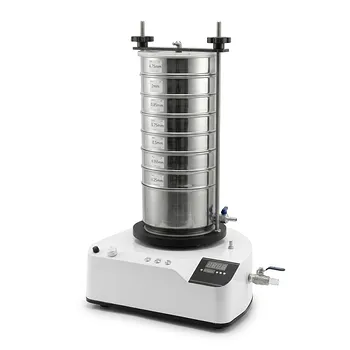
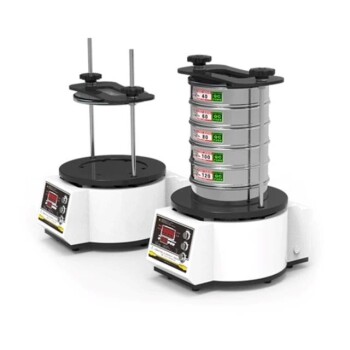
The primary function of standard sieving equipment in the post-processing of tungsten-treated diamonds is the physical segregation of materials. Immediately following diffusion annealing, this equipment is used to separate the treated diamond particles from the excess, unreacted loose tungsten powder that remains in the batch.
Core Takeaway Sieving acts as a critical purification step, ensuring that only pure, pre-coated diamond particles are extracted while preventing redundant tungsten powder from contaminating downstream processes.
The Mechanics of Material Recovery
Post-Annealing Separation
The diffusion annealing process often utilizes an excess of tungsten to ensure adequate coating. Once the heating cycle is complete, the resulting batch consists of the desired product (coated diamonds) and the byproduct (loose tungsten powder).
Physical Isolation
Sieving equipment utilizes mesh differentiation to isolate the two distinct materials. Because the unreacted tungsten powder differs in physical size or flow characteristics compared to the diamond particles, the sieve effectively filters the loose powder away from the structural diamond core.
Why Separation is Critical
Protecting Downstream Processes
The most significant reason for this sieving step is the protection of subsequent manufacturing stages. The primary reference highlights that this process is essential for preparing the diamonds for electroless copper plating.
Preventing Chemical Interference
If loose tungsten powder is not removed, it acts as a contaminant. Redundant tungsten can interfere with the chemical reactions required for plating, leading to poor adhesion or inconsistent coating layers on the diamond surface.
Common Pitfalls to Avoid
Incomplete Separation
The main trade-off in this stage involves the efficiency of the sieving process. If the sieving is incomplete or the mesh size is incorrectly selected, unreacted tungsten will remain mixed with the diamonds.
Impact on Quality
This residual contamination is not merely cosmetic; it fundamentally alters the surface chemistry available for the next processing step. Failing to achieve a clean separation invariably leads to defects during the copper plating phase, compromising the final product's integrity.
Making the Right Choice for Your Goal
To maximize the effectiveness of your post-processing workflow, consider the following based on your specific objectives:
- If your primary focus is process efficiency: Ensure your sieving parameters are tuned to quickly maximize the yield of loose tungsten removal without prolonging the cycle time.
- If your primary focus is final product quality: Prioritize the thoroughness of the sieving stage to guarantee zero interference during the subsequent electroless copper plating application.
Effective sieving converts a raw, mixed batch into a purified substrate ready for advanced chemical bonding.
Summary Table:
| Process Phase | Function of Sieving | Key Benefit |
|---|---|---|
| Post-Annealing | Separation of coated diamonds from loose tungsten | Recovers excess raw materials for reuse |
| Purification | Removal of physical contaminants and byproducts | Prevents chemical interference in plating |
| Quality Control | Mesh-based isolation of particle sizes | Ensures consistent surface chemistry for copper adhesion |
Optimize Your Advanced Material Processing with KINTEK
Precision in post-processing is the difference between a failed batch and a premium product. KINTEK specializes in high-performance laboratory equipment designed for the most demanding applications in diamond research and material science. Whether you need reliable standard sieving equipment for material recovery or advanced high-temperature vacuum furnaces for diffusion annealing, our solutions ensure purity and consistency.
From crushing and milling systems to electrolytic cells and high-pressure reactors, KINTEK provides the tools global researchers trust for battery research, metallurgy, and chemical plating.
Don't let contamination compromise your results. Contact KINTEK today to find the perfect sieving and furnace solutions for your lab!
Related Products
- Three-dimensional electromagnetic sieving instrument
- Laboratory Vibratory Sieve Shaker Machine for Dry and Wet Three-Dimensional Sieving
- Laboratory Test Sieves and Sieving Machines
- Laboratory Wet Three-Dimensional Vibratory Sieve Shaker Machine
- Laboratory Test Sieves and Vibratory Sieve Shaker Machine
People Also Ask
- Why is sieving equipment essential for the classification of processed bio-activated carbon? Optimize Performance
- What are the limitations of sieving? Understanding the Constraints of Particle Size Analysis
- What are advantages and disadvantages of sieving method? A Guide to Reliable & Cost-Effective Particle Sizing
- How is sieving important? The Critical Role of Particle Size Analysis in Quality Control
- What is sieving and how does it work? A Guide to Accurate Particle Size Analysis