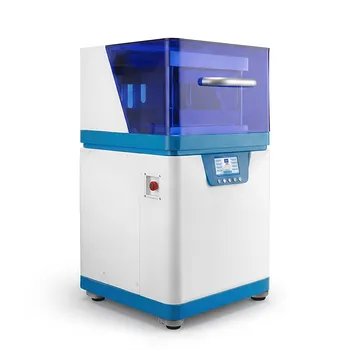
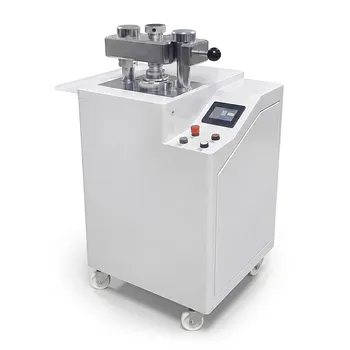
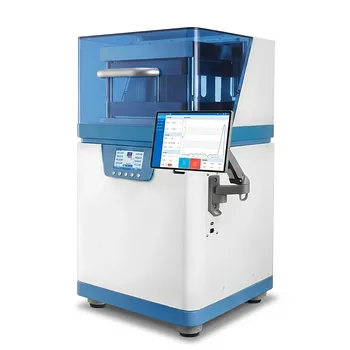
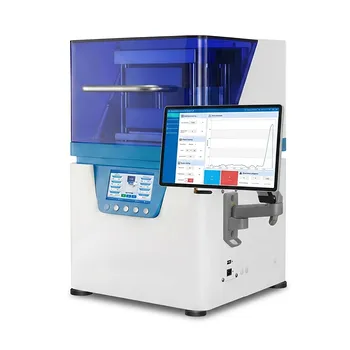
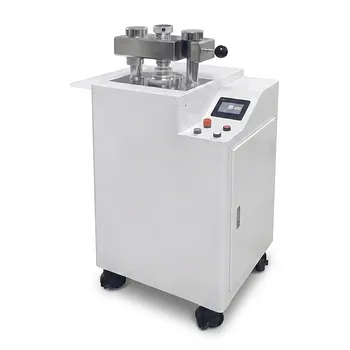
The laboratory manual hydraulic press is the critical tool for transforming loose powders and slurries into functional, high-performance supercapacitor electrodes. By applying high mechanical pressure—often ranging from 10 to 80 MPa—the press compacts active materials, binders, and conductive agents onto current collectors. This process minimizes internal contact resistance and ensures the electrode remains structurally sound during rigorous electrochemical cycling.
The primary purpose of a hydraulic press in supercapacitor fabrication is to establish intimate mechanical and electrical contact between active materials and current collectors. This dual-action compression reduces ohmic resistance while simultaneously providing the structural durability required for stable long-term performance.
Maximizing Electrical Performance
Minimizing Interfacial Contact Resistance
A hydraulic press forces the active material particles, such as microporous carbon, into direct contact with the current collector (e.g., nickel mesh or stainless steel). This physical compression eliminates microscopic air gaps and voids that would otherwise act as insulators. By reducing interfacial resistance, the press ensures that electrons can flow efficiently between the active substance and the external circuit.
Facilitating Rapid Charge Transfer
High-pressure compaction optimizes the internal pathways within the electrode layer itself. By causing powder particles to rearrange and bond tightly, the press enhances the "ohmic contact" between the conductive agents and the active materials. This is vital for achieving high rate performance, allowing the supercapacitor to charge and discharge rapidly under high current densities.
Ensuring Structural Robustness
Mechanical Bonding and Material Integrity
The application of high pressure (e.g., 80 MPa) triggers the mechanical bonding of binders like PTFE or PVDF with the active materials. This compression ensures the mixed powder or slurry adheres firmly to the current collector substrate. Without this force, the active material would likely flake off or delaminate during the handling of the electrode.
Stability During Electrochemical Cycling
During operation, electrodes are submerged in electrolytes and subjected to repeated ion insertion and removal. The hydraulic press provides the mechanical strength necessary to withstand the physical stresses of electrolyte flushing and volume expansion. This structural integrity is the foundation of a supercapacitor’s long-term cycling stability.
Precise Control of Electrode Dimensions
Laboratory presses allow researchers to achieve highly specific and repeatable electrode thicknesses, such as 30 μm. Consistent thickness is necessary for calculating accurate volumetric capacitance and ensuring that test results are comparable across different samples. Precise pressure control ensures that the density of the electrode is uniform across its entire surface.
Understanding the Trade-offs and Pitfalls
The Risk of Excessive Compaction
While high pressure reduces resistance, over-pressing can be detrimental to the electrode's performance. Excessive compaction can crush the porous structure of the active carbon, significantly reducing the available surface area for ion adsorption. If the pores are closed off, the electrolyte cannot penetrate the material, leading to a dramatic drop in total capacitance.
The Danger of Insufficient Pressure
Conversely, applying too little pressure results in a "loose" electrode with high internal impedance. Inadequate pressure prevents the binder from effectively anchoring the active materials to the nickel foam or foil. This often leads to material shedding during testing, which causes premature failure and inconsistent data.
Applying Compaction Logic to Your Project
Recommendations Based on Research Goals
- If your primary focus is maximum power density: Use higher pressures (within the material's limits) to minimize resistance and facilitate the fastest possible electron transfer.
- If your primary focus is maximum energy storage: Aim for a moderate pressure that balances electrical contact with the preservation of the material’s internal porosity and surface area.
- If your primary focus is long-term durability: Prioritize a consistent holding time (dwell time) during the pressing process to ensure the binder fully integrates with the current collector.
The laboratory manual hydraulic press is the bridge between raw chemical components and a viable electrochemical device, dictating both the initial efficiency and the ultimate lifespan of the supercapacitor.
Summary Table:
| Function | Performance Impact | Key Benefit |
|---|---|---|
| Material Compaction | Reduces interfacial resistance | Enhances rapid charge/discharge rates |
| Mechanical Bonding | Ensures structural integrity | Prevents delamination during cycling |
| Dimensional Control | Uniform thickness (e.g., 30 μm) | Provides accurate volumetric capacitance data |
| Porosity Management | Balances surface area & contact | Optimizes energy storage and power density |
Elevate Your Material Research with KINTEK Precision
Achieving the perfect electrode density is critical for high-performance supercapacitor development. KINTEK specializes in high-precision laboratory equipment designed to meet the rigorous demands of battery and energy storage research. From our robust manual and automated hydraulic presses (pellet, hot, and isostatic) to advanced high-temperature furnaces (CVD, vacuum, and muffle), we provide the tools necessary to ensure uniform compaction and superior electrical contact.
Beyond pressing, KINTEK offers a comprehensive ecosystem for your lab, including crushing and milling systems, electrolytic cells, and high-temperature high-pressure reactors. Partner with us to benefit from equipment that guarantees repeatability, durability, and expert technical support.
Ready to optimize your electrode fabrication process? Contact KINTEK today for a tailored solution that drives your research forward!
References
- Li Gui, Alexandr V. Talyzin. Activated carbons with extremely high surface area produced from cones, bark and wood using the same procedure. DOI: 10.1039/d3ra00820g
This article is also based on technical information from Kintek Solution Knowledge Base .
Related Products
- Manual Heated Hydraulic Press Machine with Heated Plates for Laboratory Hot Press
- Laboratory Manual Hydraulic Pellet Press for Lab Use
- Manual High Temperature Heated Hydraulic Press Machine with Heated Plates for Lab
- Laboratory Manual Hydraulic Pellet Press for Lab Use
- Heated Hydraulic Press Machine with Integrated Manual Heated Plates for Lab Use
People Also Ask
- Why use laboratory manual hydraulic presses for semiconductor pellets? Optimize Annealing & Crystalline Quality
- What is manual hydraulic press? A Guide to Simple, High-Force Compression
- How is a laboratory manual hydraulic press used in solid-state battery testing? Optimize Electrode Performance
- Why is a laboratory hydraulic hot press essential for high-density, additive-free Silicon Carbide? Unlock Pure SiC.
- How does a laboratory hydraulic hot press ensure the quality of PHBV/natural fiber composites? Expert Guide