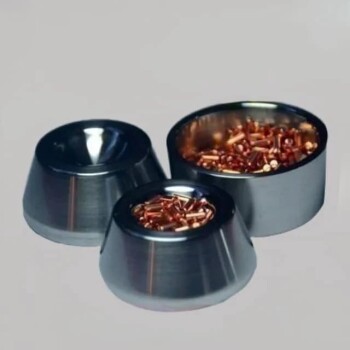
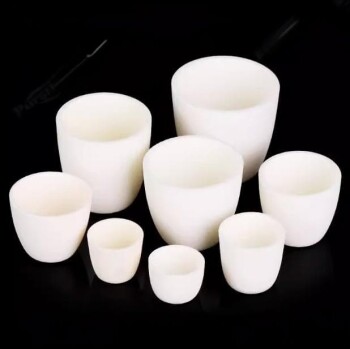
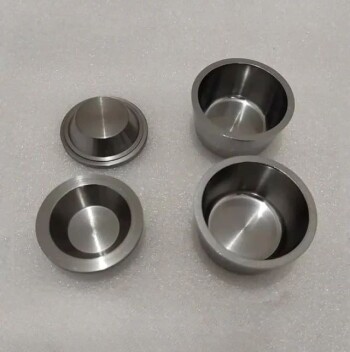
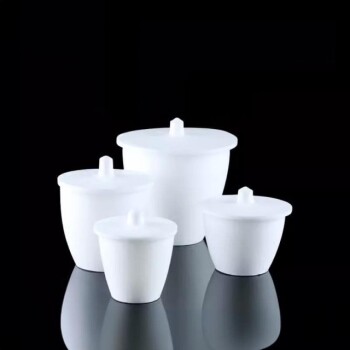
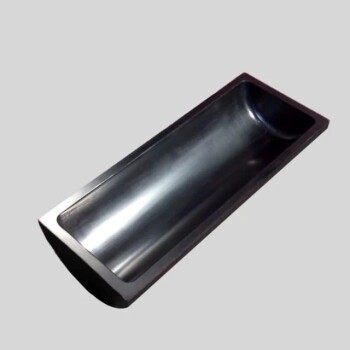
The primary purpose of using a platinum crucible during the LAGP solid-state reaction stage is to provide a container that is both chemically inert and thermally stable enough to withstand temperatures up to 1350°C. Unlike standard ceramic vessels, a platinum crucible holds the raw materials during the aggressive melt-quenching process without reacting with the melt, thereby preventing contamination that would degrade the electrolyte’s performance.
Core Takeaway Successful LAGP synthesis relies on maintaining absolute chemical purity while heating materials to a molten state. Platinum is uniquely essential because it survives the critical 1350°C threshold required for melt-quenching without leaching impurities into the mixture, ensuring the final crystal phase achieves the necessary high ionic conductivity.
Ensuring Chemical Purity
Preventing Material Leaching
The precursor materials used for LAGP (Lithium Aluminum Germanium Phosphate) become highly reactive when they transition into a molten state.
If a standard alumina or silica crucible were used, the molten mixture would likely attack the container walls. Platinum provides a non-reactive barrier, ensuring that foreign atoms from the crucible do not leach into the electrolyte and alter its stoichiometry.
Safeguarding Ionic Conductivity
The ultimate goal of synthesizing LAGP is to create a solid electrolyte with high ionic conductivity.
Any contamination introduced during the melting stage acts as a defect in the final crystal structure. By using platinum to guarantee the purity of the melt, you ensure the final phase has the unobstructed pathways necessary for efficient lithium-ion transport.
Managing Extreme Thermal Requirements
Surviving the 1350°C Threshold
The synthesis process involves a melt-quenching reaction that specifically requires a temperature environment of 1350°C.
Many standard laboratory crucibles begin to soften, degrade, or become porous at these temperatures. Platinum maintains its structural integrity under this intense heat, preventing catastrophic container failure inside the muffle furnace.
Differentiating the Melt from Sintering
It is important to distinguish the melt stage from the subsequent sintering stage.
While the platinum crucible is critical for the initial high-temperature reaction (1350°C), the material is later processed into green pellets and sintered at a lower temperature of 960°C. This secondary step focuses on particle diffusion and bonding to build mechanical strength, but the foundational purity is established during the initial melt in the platinum vessel.
Understanding the Trade-offs
High Operational Cost
The most significant drawback of using platinum crucibles is the extreme cost compared to ceramic alternatives.
This makes the initial setup for LAGP synthesis expensive and requires strict inventory control. It forces laboratories to treat the crucibles as high-value assets rather than consumables.
Mechanical Vulnerability
Despite its thermal resistance, platinum is a relatively soft metal at high temperatures.
It can easily deform if handled roughly with tongs while hot. Furthermore, while it resists the LAGP melt, platinum can be poisoned by certain other metallic oxides or reducing atmospheres, requiring the user to ensure the furnace environment is strictly controlled.
Making the Right Choice for Your Goal
- If your primary focus is Electrochemical Performance: Prioritize the use of platinum during the melt-quenching stage (1350°C) to eliminate impurities that lower ionic conductivity.
- If your primary focus is Mechanical Stability of the Final Pellet: Focus on the subsequent sintering stage (960°C), where particle diffusion bonds the material to support air electrodes, assuming the raw powder was first synthesized purely.
- If your primary focus is Cost Management: You generally cannot compromise on platinum for the melt stage, but you may use high-grade alumina for the lower-temperature sintering steps (post-reaction) to reduce wear on your platinum ware.
Using the correct vessel is not just a procedural detail; it is the foundational step that determines whether your LAGP electrolyte will function at all.
Summary Table:
| Feature | Platinum Crucible (Melt Stage) | Ceramic/Alumina (Sintering Stage) |
|---|---|---|
| Temperature Limit | Up to 1700°C (Stable at 1350°C) | Typically <1200°C for standard use |
| Chemical Reactivity | Highly Inert; No leaching into melt | Potential reaction with molten precursors |
| Primary Function | Melt-quenching & high purity | Particle diffusion & mechanical bonding |
| Typical Temperature | 1350°C | ~960°C |
| Operational Cost | High (Valuable Asset) | Low (Consumable) |
Elevate Your Material Research with KINTEK Precision
Achieving the absolute purity required for high-performance electrolytes like LAGP demands laboratory equipment that can withstand the most aggressive thermal environments. KINTEK specializes in high-quality laboratory solutions, from high-temperature muffle and vacuum furnaces to the specialized platinum crucibles and ceramic labware essential for your solid-state reactions.
Whether you are performing complex melt-quenching at 1350°C or perfecting the mechanical strength of pellets with our hydraulic presses and sintering systems, we provide the tools to ensure your research is never compromised by impurities or equipment failure.
Ready to optimize your synthesis process? Contact our technical experts today to find the perfect furnace and crucible combination for your laboratory's needs.
Related Products
- Electron Beam Evaporation Coating Gold Plating Tungsten Molybdenum Crucible for Evaporation
- High Purity Pure Graphite Crucible for Electron Beam Evaporation
- High Purity Pure Graphite Crucible for Evaporation
- Arc-Shaped Alumina Ceramic Crucible High Temperature Resistant for Engineering Advanced Fine Ceramics
- Alumina Al2O3 Ceramic Crucible Semicircle Boat with Lid for Engineering Advanced Fine Ceramics
People Also Ask
- What is the container that holds the metal source material called in e-beam evaporation? Ensure Purity and Quality in Your Thin-Film Deposition
- What materials are used in electron beam evaporation? Master High-Purity Thin Film Deposition
- What is the process of e-beam coating? Achieve High-Purity, Precise Thin Films for Your Lab
- What is e-beam evaporation? Achieve High-Purity Thin Film Deposition for Your Lab
- What is the voltage of e-beam evaporation? Achieve Precise Thin-Film Deposition