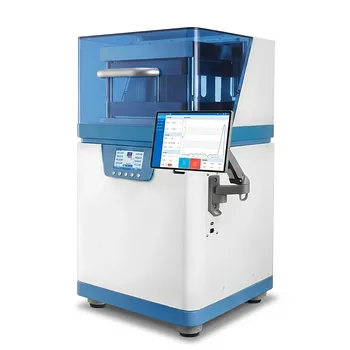
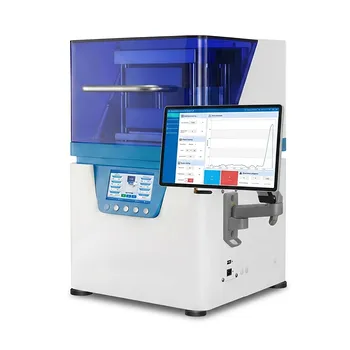
The primary purpose of an industrial-grade high-pressure hydraulic press in Zn-1X binary alloy fabrication is to transform loose, mechanically alloyed powders into a dense, cohesive "green" compact. By applying uniaxial pressure—often reaching 600 MPa—the press forces particles to undergo plastic deformation and dense packing within a precision mold. This process eliminates internal voids and establishes mechanical interlocking, ensuring the compact has the structural integrity required for handling and subsequent sintering.
The hydraulic press serves as the critical mechanical bridge between loose powder and a solid alloy, utilizing extreme pressure to maximize particle contact and eliminate porosity. This structural foundation is essential for effective atomic diffusion during sintering and the prevention of structural defects in the final material.
Facilitating Plastic Deformation and Consolidation
Overcoming Elastic Resistance
Loose alloy powders naturally resist compaction due to their morphology and inherent elasticity. The high-pressure hydraulic press applies sufficient force to overcome this elastic resistance, forcing the particles to rearrange and fill internal pores.
Inducing Plastic Flow
At pressures like 600 MPa, the metallic particles in the Zn-1X mixture undergo plastic deformation. This causes the powder particles to flatten and shape themselves around one another, creating a dense, cylindrical body.
Enhancing Mechanical Interlocking
As particles deform under pressure, they physically hook into one another through mechanical interlocking. This creates a "green strength" that allows the compact to maintain its shape and withstand handling without the need for additional chemical binders.
Creating the Foundation for Sintering
Maximizing Particle Contact Area
The primary goal of high-pressure cold pressing is to maximize the contact interface between individual alloy particles. This intimate contact is the physical foundation required for effective atomic diffusion during the subsequent sintering or heat treatment phases.
Eliminating Macroscopic Voids
By forcing particles into a dense packing arrangement, the hydraulic press effectively eliminates macroscopic voids. Reducing these gaps is fundamental to preventing cracks and ensuring the final composite reaches its theoretical maximum hardness.
Shaping the Geometric Precursor
The press utilizes steel dies to convert powders into specific geometric shapes, such as dense pellets or cylinders. This ensures the material has the correct dimensions and surface-to-volume ratio for specialized processes like vacuum arc melting or Hot Isostatic Pressing (HIP).
Understanding the Trade-offs and Pitfalls
The Risk of Lamination and Cracking
Applying excessive pressure can lead to elastic recovery or "springback" once the load is released. If the internal stresses exceed the green strength of the compact, it may result in delamination or micro-cracks that compromise the final product.
Density Gradients and Friction
Friction between the powder particles and the mold walls can cause density gradients. This means the center of the green compact may be less dense than the ends, potentially leading to uneven shrinkage or warping during the sintering process.
Equipment and Die Wear
Operating at pressures near 600 MPa or higher places significant stress on the steel dies. Continuous industrial use requires high-grade materials and regular maintenance to prevent dimensional inaccuracies caused by tool wear.
Applying This to Your Fabrication Process
Recommendations for Implementation
- If your primary focus is maximizing final material density: Use higher pressures (near 600 MPa) to ensure total void elimination and provide the tightest possible interface for atomic diffusion.
- If your primary focus is preventing structural cracks: Monitor the rate of pressure release (decompression) to minimize the effects of elastic recovery and internal stress.
- If your primary focus is eliminating chemical contaminants: Rely on high-pressure mechanical interlocking to achieve green strength, which removes the need for organic binders that must be burned off later.
By precisely controlling uniaxial pressure, the hydraulic press ensures that Zn-1X alloys possess the necessary density and structural integrity to transition from raw powder to a high-performance industrial material.
Summary Table:
| Key Function | Impact on Zn-1X Alloy Fabrication | Technical Result |
|---|---|---|
| Plastic Deformation | Flattens metallic particles at high pressure (600 MPa) | Dense, cohesive cylindrical body |
| Void Elimination | Removes macroscopic pores and internal air pockets | Maximized theoretical hardness |
| Mechanical Interlocking | Physically hooks particles together without binders | High green strength for handling |
| Particle Contact | Maximizes the interface between alloy particles | Ideal foundation for atomic diffusion |
Elevate Your Alloy Fabrication Precision with KINTEK
Achieving the perfect green compact requires more than just force—it requires precision and reliability. KINTEK specializes in high-performance laboratory equipment, offering a robust range of hydraulic presses, including pellet, hot, and isostatic models, designed to handle the extreme pressures (600 MPa+) necessary for Zn-1X binary alloy consolidation.
Our solutions eliminate the need for chemical binders, ensuring your materials remain pure while achieving maximum density and structural integrity. Beyond presses, KINTEK supports your entire workflow with high-temperature furnaces, crushing systems, and specialized consumables like PTFE products and crucibles.
Ready to optimize your material density and sintering results? Contact our experts at KINTEK today to find the ideal pressing solution for your research or production needs.
References
- Kamil Kowalski, M. Jurczyk. Micro Arc Oxidation of Mechanically Alloyed Binary Zn-1X (X = Mg or Sr) Alloys. DOI: 10.3390/cryst13101503
This article is also based on technical information from Kintek Solution Knowledge Base .
Related Products
- Automatic Laboratory Hot Press 400x400 mm with Programmable High Temperature and Hydraulic Force Control
- Automatic High Temperature Heated Hydraulic Press Machine with Heated Plates for Lab
- Manual High Temperature Heated Hydraulic Press Machine with Heated Plates for Lab
- Automatic Hydraulic Hot Press with 500x500mm Heating Plates and Multi Stage PLC Control for Material Sintering
- Ball Press Mold for Lab
People Also Ask
- What is the primary function of a laboratory hot press in MEA assembly? Optimize Fuel Cell Bonding & Performance
- What specific conditions does a laboratory hot press provide for the assembly of fuel cell MEA? Expert Bond Tips.
- How do a laboratory hydraulic hot press and standardized steel molds ensure the quality of WPC test specimens?
- What are the core advantages of using a laboratory hot press to produce Bi2Se3? Achieve 93% Density & High Conductivity
- How does a laboratory heating hydraulic press contribute to the preparation of recycled graphite green bodies? - Optimize Density.