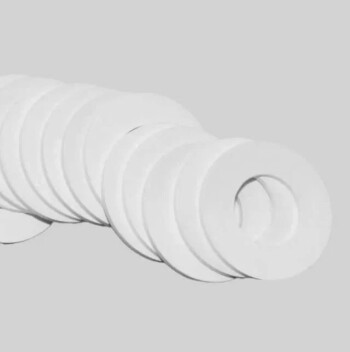
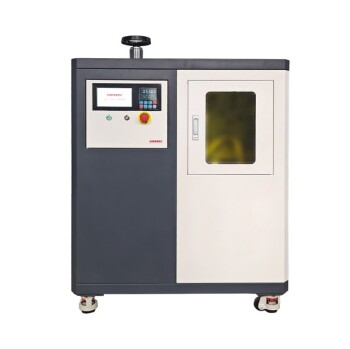
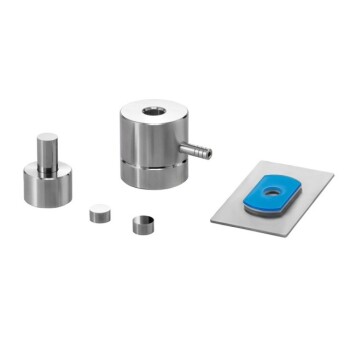
The primary purpose of using precision limiting molds or spacers is to strictly dictate the final physical dimensions of a solid-state electrolyte membrane during the hot pressing process. By acting as a mechanical stop, these tools ensure the membrane achieves a specific, uniform thickness and absolute flatness, regardless of the pressure applied by the machine.
Core Takeaway Precision spacers transform the hot pressing process from a simple densification step into a calibrated manufacturing procedure. By enforcing exact thickness, they ensure a consistent lithium-ion transport path, enabling accurate scientific calculations and preventing dangerous irregularities in current distribution.
The Critical Role of Dimensional Control
Defining the Lithium-Ion Transport Path
The fundamental goal of a solid-state electrolyte is to facilitate the movement of ions between electrodes.
Uniform thickness ensures that the distance lithium ions must travel is consistent across the entire surface area of the membrane. Without spacers, the membrane might be wedge-shaped or uneven, creating variable resistance paths that degrade performance.
Enabling Accurate Data Analysis
For researchers and engineers, calculating ionic conductivity is a key performance metric.
The mathematical formula for conductivity relies heavily on the thickness of the sample. If the membrane thickness varies or is unknown, the calculated conductivity values will be erroneous. Spacers provide a known, fixed value (e.g., 25 µm), making these calculations precise and reproducible.
Enhancing Electrochemical Performance
Ensuring Uniform Current Distribution
Flatness is not just an aesthetic quality; it is an electrochemical necessity.
A membrane with uneven thickness causes current localization, where electricity prefers the path of least resistance (the thinnest sections). This can lead to "hot spots," dendrite formation, and premature failure of the battery. Precision molds ensure the current is distributed evenly across the entire active area.
Controlled Densification
Hot pressing is used to eliminate internal pores and embed ceramic particles into the polymer matrix.
While high pressure (often around 20 MPa) and temperature are required to densify the material, applying this force without a spacer could crush the membrane too thin or distort it. Spacers allow the operator to apply the necessary force to eliminate defects and pores while mechanically preventing the material from being over-compressed.
Understanding the Trade-offs
The Risk of Inadequate Contact
While spacers protect the membrane thickness, they can occasionally prevent full pressure application if the starting material is insufficient.
If the volume of the loose coating or powder is too low, the press may hit the spacers before the material is fully densified. This results in a membrane that meets the thickness requirement but retains internal porosity, significantly lowering ionic conductivity.
Material Flow Constraints
Precision molds confine the material laterally.
If the polymer composite has poor flow characteristics at the chosen temperature (e.g., 70°C), the material may not spread to fill the mold corners completely. This creates membranes with inconsistent edges, necessitating that the sample be trimmed down to the center area for actual use.
Making the Right Choice for Your Goal
To ensure you are getting the most out of your hot pressing process, consider your specific end-goal:
- If your primary focus is Research and Characterization: Use precision spacers to guarantee a specific thickness, allowing for the precise calculation of ionic conductivity metrics.
- If your primary focus is Battery Assembly and Safety: Prioritize flatness to ensure uniform contact with the electrodes, which minimizes resistance and prevents current hotspots.
Ultimately, the use of precision spacers is the difference between creating a rough experimental sample and engineering a reliable, high-performance electrolyte component.
Summary Table:
| Feature | Purpose in Hot Pressing | Impact on Electrolyte Performance |
|---|---|---|
| Dimensional Control | Dictates final thickness and flatness | Ensures consistent lithium-ion transport path |
| Pressure Regulation | Acts as a mechanical stop | Prevents over-compression while allowing densification |
| Data Accuracy | Provides a fixed, known sample value | Enables precise calculation of ionic conductivity |
| Surface Uniformity | Eliminates current localization | Prevents "hot spots" and dendrite formation |
Elevate Your Battery Research with KINTEK Precision Solutions
Achieve uncompromising accuracy in your solid-state electrolyte development. KINTEK specializes in advanced laboratory equipment designed for the most demanding energy storage research. Whether you need high-performance hydraulic pellet presses, precision-engineered molds, or temperature-controlled hot presses, our tools ensure your membranes meet exact scientific standards.
From high-temperature furnaces and vacuum systems to specialized battery research consumables, KINTEK provides the comprehensive support your lab deserves. Don't let dimensional inconsistencies compromise your data—partner with the experts in material processing.
Ready to optimize your electrolyte manufacturing? Contact KINTEK today for a custom consultation!
Related Products
- Hexagonal Boron Nitride HBN Spacer Cam Profile and Various Spacer Types
- Automatic High Temperature Heated Hydraulic Press Machine with Heated Plates for Lab
- Manual High Temperature Heated Hydraulic Press Machine with Heated Plates for Lab
- Ball Press Mold for Lab
- Heated Hydraulic Press Machine with Integrated Manual Heated Plates for Lab Use
People Also Ask
- Why is a hexagonal Boron Nitride (h-BN) layer required for LATP? Protect Your Samples from Carbon Contamination
- What are the different types of nanocarbons? A Guide to Fullerenes, Nanotubes, and Graphene
- Why is argon used instead of nitrogen? Ensuring Absolute Inertness for High-Stakes Applications
- What are the characterization of single-walled carbon nanotubes? Essential Techniques for SWCNT Analysis
- Why are Boron Nitride Tubes selected as reaction vessels for Na3SbS4? Ensure Purity in High-Temp Synthesis