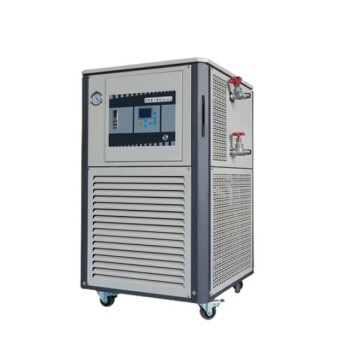
In the synthesis of SiO2 nanospheres using the Stöber method, the constant temperature water bath and magnetic stirrer serve as the fundamental controls for reaction stability and homogeneity. The water bath ensures a fixed thermal environment, typically maintaining the reaction at 30 °C, while the magnetic stirrer drives the mechanics of the chemical reaction, ensuring tetraethyl orthosilicate (TEOS) undergoes complete hydrolysis and polycondensation.
By synchronizing precise thermal regulation with continuous mechanical agitation, these two tools transform a volatile chemical mixture into a controlled system, directly enabling the production of silica cores with high sphericity and uniform particle size.
The Function of Thermal Regulation
Establishing a Stable Environment
The primary role of the constant temperature water bath is to isolate the reaction mixture from external thermal fluctuations. By locking the temperature at a specific set point, such as 30 °C, the bath dictates the energy available to the system.
Controlling Reaction Kinetics
Temperature is the main variable governing the speed of chemical reactions. A stable temperature ensures that the hydrolysis and condensation rates of TEOS remain constant throughout the entire synthesis duration. This stability prevents rapid bursts of nucleation or growth that would result in uneven particle sizes.
The Function of Mechanical Agitation
Facilitating Uniform Hydrolysis
The magnetic stirrer creates a homogeneous mixture of the reactants: ethanol, water, and ammonia. This agitation is critical because it ensures that TEOS molecules are evenly dispersed and fully exposed to the water and catalyst (ammonia) required for hydrolysis.
Ensuring Complete Polycondensation
Beyond initial mixing, the stirrer maintains the motion necessary for polycondensation, the process where the silica network actually forms. Without this mechanical assistance, the reaction might be incomplete in certain areas of the vessel, leading to defects or irregular structures.
The Result: Particle Quality
Achieving Monodispersity
The combined effect of fixed temperature and uniform stirring results in a narrow particle size distribution, often referred to as monodispersity. Because every part of the solution experiences the same conditions, every nanoparticle grows at the same rate.
Promoting High Sphericity
These controls are also essential for the geometric integrity of the particles. The consistent environment allows the SiO2 cores to form into perfect or near-perfect spheres, rather than irregular or oblong shapes.
Understanding the Trade-offs
Sensitivity to Equipment Failure
The reliance on these tools means that even minor mechanical failures can ruin a batch. A slight drift in the water bath temperature can significantly alter the final diameter of the nanospheres.
The Risk of Mixing gradients
While the magnetic stirrer ensures uniformity, the speed must be optimized. If stirring is too vigorous or too slow, it may disrupt the flow dynamics, potentially affecting the final sphericity or causing aggregation.
Making the Right Choice for Your Goal
To maximize the quality of your SiO2 nanospheres, consider these focus areas:
- If your primary focus is Monodispersity (Uniform Size): Prioritize the precision of your water bath; thermal fluctuations are the leading cause of size variation.
- If your primary focus is High Sphericity (Roundness): Ensure your magnetic stirring keeps the TEOS fully suspended and reacting evenly without creating excessive shear force.
Mastering these two variables is the difference between a random precipitate and high-quality optical-grade nanomaterials.
Summary Table:
| Equipment | Primary Function | Impact on SiO2 Nanospheres |
|---|---|---|
| Water Bath | Maintains stable thermal environment (e.g., 30°C) | Controls reaction kinetics for uniform particle size |
| Magnetic Stirrer | Ensures homogeneous mixing of reactants | Facilitates complete hydrolysis and polycondensation |
| Combined Effect | Synchronized thermal and mechanical control | Achieves high sphericity and narrow size distribution |
Elevate Your Nanomaterial Synthesis with KINTEK Precision
Achieving the perfect balance of monodispersity and sphericity in SiO2 nanospheres requires equipment that offers uncompromising stability. KINTEK specializes in high-performance laboratory solutions designed for rigorous chemical synthesis. From precision constant temperature water baths and high-torque magnetic stirrers to our specialized high-temperature reactors and homogenizers, we provide the tools necessary to master reaction kinetics.
Whether you are conducting battery research, developing optical-grade materials, or scaling up chemical production, KINTEK's comprehensive range of laboratory equipment and consumables—including PTFE products, ceramics, and crucibles—ensures your lab operates at peak efficiency.
Ready to optimize your synthesis results? Contact us today to find the perfect equipment for your laboratory.
References
- Dazheng Ci, Qunling Fang. SiO<sub>2</sub>@AuAg/PDA hybrid nanospheres with photo-thermally enhanced synergistic antibacterial and catalytic activity. DOI: 10.1039/d3ra07607e
This article is also based on technical information from Kintek Solution Knowledge Base .
Related Products
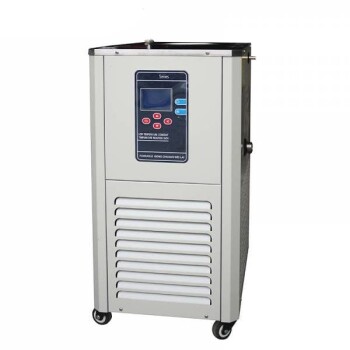
- High Temperature Constant Temperature Heating Circulator Water Bath Chiller Circulator for Reaction Bath
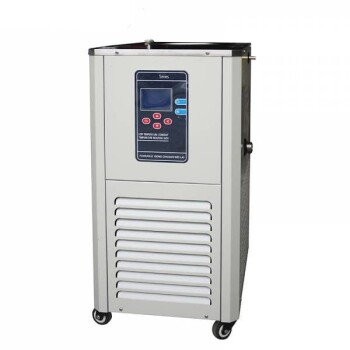
- 50L Chiller Water Bath Cooling Circulator Low Temperature Constant Temperature Reaction Bath
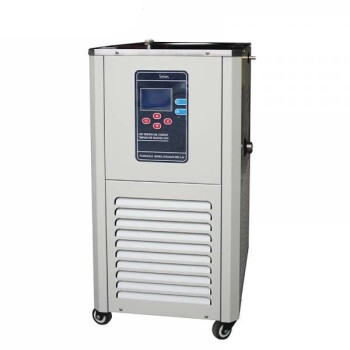
- 10L Chilling Circulator Cooling Water Bath Low Temperature Constant Temperature Reaction Bath
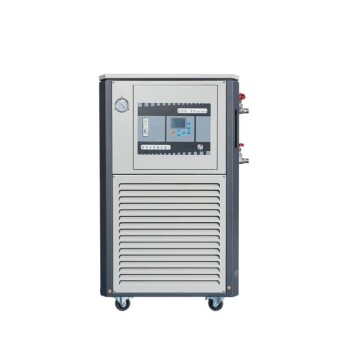
- 30L Chiller Water Bath Cooling Circulator Low Temperature Constant Temperature Reaction Bath
- 40L Chiller Water Bath Cooling Circulator Low Temperature Constant Temperature Reaction Bath
People Also Ask
- What is the necessity of a circulating water bath in chlorate production? Optimize Yield & Purity with Precision
- How do constant temperature circulators impact weight-loss immersion tests? Ensure Precision in Corrosion Analysis
- How does a constant temperature circulator support the leaching reaction of gold scrap? Optimize Gold Recovery Results
- Why is a constant temperature water bath used for precursor storage in CVD? Achieve Stable Nanocrystalline SiC Deposition
- Why is a high-precision constant temperature water bath necessary for anaerobic digestion? Ensure Success at 37±0.02°C