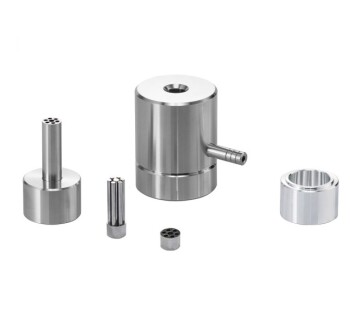
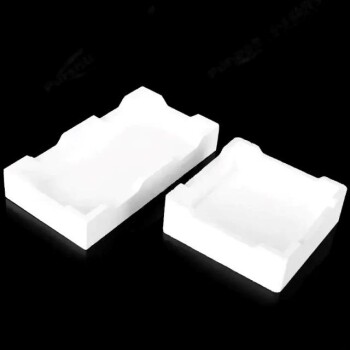
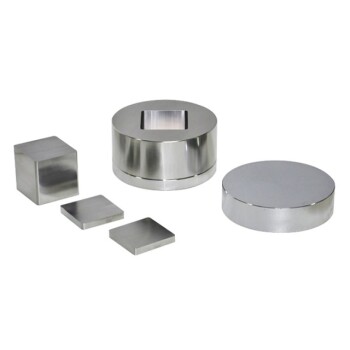
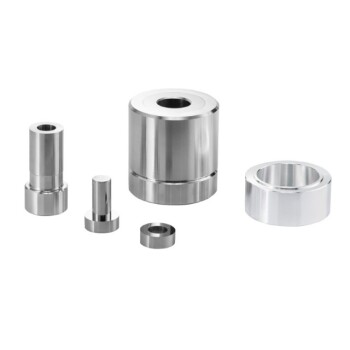
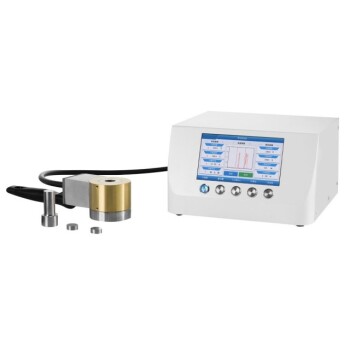
The primary role of a graphite mold in vacuum hot press sintering is to serve as a high-strength containment vessel that simultaneously functions as a mechanical transmission medium. By withstanding temperatures exceeding 1500°C without deformation, it allows for the precise application of uniaxial pressure to the Al2O3/ZrO2 ceramic powder, driving the densification process.
Core Insight: The graphite mold is not merely a passive container; it is an active component of the sintering mechanics. Its unique ability to maintain structural integrity under extreme heat allows it to transfer massive hydraulic pressure (up to 30 MPa) directly to the ceramic powder, forcing particle rearrangement and plastic flow that would be impossible with temperature alone.
The Mechanics of Densification
Acting as a Pressure Transmitter
In vacuum hot pressing, heat alone is often insufficient to fully densify ceramics like Al2O3/ZrO2.
The graphite mold acts as a piston-like interface. It transfers external force—typically generated by a hydraulic system—directly to the ceramic powder.
This uniaxial pressure (often ranging from 10 to 30 MPa) forces the powder particles into closer contact, significantly reducing porosity.
Facilitating Plastic Flow
The pressure applied through the mold serves a specific physical function: it promotes plastic flow.
At elevated temperatures, the ceramic materials soften slightly. The mold ensures the applied force directs this softened material to fill microscopic voids.
This process accelerates the rearrangement of particles, leading to a denser final product than pressureless sintering could achieve.
Thermal and Structural Stability
Withstanding Extreme Temperatures
Alumina (Al2O3) and Zirconia (ZrO2) require high temperatures to sinter effectively.
Graphite is chosen because it maintains excellent thermal stability at temperatures exceeding 1500°C.
Unlike metals that might melt or warp, graphite retains its shape and strength, ensuring the final ceramic component meets precise dimensional specifications.
Ensuring Uniform Heating
Graphite possesses high thermal conductivity.
The mold absorbs heat from the furnace elements and distributes it evenly into the ceramic powder.
This uniformity is critical; it prevents thermal gradients that could cause cracking or uneven densification within the Al2O3/ZrO2 composite.
Understanding the Trade-offs
The Consumable Nature of the Mold
It is vital to recognize that the graphite mold is defined as a "core consumable."
Despite its strength, graphite degrades over time due to the harsh thermal cycling and mechanical stress.
It is not a permanent fixture; it will eventually wear down or react, requiring replacement to maintain precision.
Environmental Influence
While primarily mechanical, the graphite material also impacts the sintering atmosphere.
Graphite can contribute to a reducing atmosphere within the vacuum chamber.
While generally beneficial for preventing oxidation, this chemical interaction must be monitored to ensure it does not negatively alter the stoichiometry of the oxide ceramics (Al2O3/ZrO2).
Making the Right Choice for Your Goal
To optimize your sintering process, consider how the mold influences your specific objectives:
- If your primary focus is Maximum Density: Prioritize a mold design with thick walls to withstand higher pressures (approaching 30-35 MPa) without lateral expansion.
- If your primary focus is Geometric Precision: Ensure the graphite grade used has the highest possible thermal stability to prevent even micro-deformations at 1500°C.
- If your primary focus is Process Efficiency: Leverage the natural lubricity of graphite to design molds that allow for easy sample removal (demolding) without damaging the sintered ceramic.
The graphite mold is the critical link that translates raw energy—both thermal and mechanical—into the physical properties of your final ceramic component.
Summary Table:
| Feature | Role in Hot Press Sintering | Benefit for Al2O3/ZrO2 Ceramics |
|---|---|---|
| Pressure Transmission | Transfers uniaxial force (10-30 MPa) | Reduces porosity and drives particle rearrangement |
| Thermal Stability | Withstands temperatures >1500°C | Maintains precise dimensional integrity of parts |
| Thermal Conductivity | Distributes heat uniformly | Prevents cracking by eliminating thermal gradients |
| Plastic Flow | Directs force on softened material | Accelerates densification compared to pressureless methods |
| Reducing Atmosphere | Naturally lowers oxygen levels | Prevents oxidation during the high-temp vacuum cycle |
Elevate Your Ceramic Research with KINTEK Precision
Maximize the density and precision of your advanced materials with KINTEK’s high-performance laboratory solutions. Whether you are working with Al2O3/ZrO2 composites or specialized alloys, our comprehensive range of vacuum hot presses, muffle furnaces, and high-temperature rotary furnaces provides the thermal and mechanical control your project demands.
From high-strength graphite molds and crucibles to precision hydraulic pellet presses and crushing systems, KINTEK specializes in the tools that bridge the gap between raw powder and high-performance components.
Ready to optimize your sintering workflow? Contact KINTEK today to discuss how our laboratory equipment and specialized consumables can enhance your lab's efficiency and material quality.
Related Products
- Ultra-High Temperature Graphite Vacuum Graphitization Furnace
- 2200 ℃ Graphite Vacuum Heat Treat Furnace
- 600T Vacuum Induction Hot Press Furnace for Heat Treat and Sintering
- Vacuum Heat Treat and Pressure Sintering Furnace for High Temperature Applications
- Vacuum Heat Treat and Molybdenum Wire Sintering Furnace for Vacuum Sintering
People Also Ask
- What is the disadvantage of graphite furnace? Managing Reactivity and Contamination Risks
- Is a graphite melting point high or low? Discover Its Extreme Thermal Resilience
- What are the advantages and disadvantages of graphite furnace? Unlock Extreme Heat Performance
- What is the temperature of a graphite furnace? Achieve Extreme Heat Up to 3000°C
- What are the disadvantages of graphite furnace? Key Limitations and Operational Costs