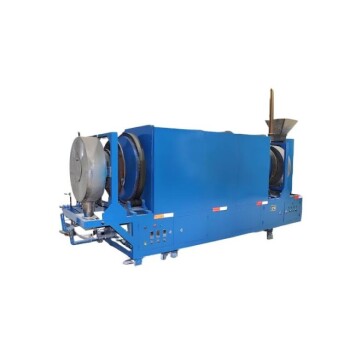
The primary role of a high-pressure rolling system is to transform raw clay into sheets of precise, uniform thickness during the fabrication of ceramic Microbial Fuel Cells (MFCs). typically utilizing a mechanical double-roller machine, this process standardizes the material structure before it is shaped and sintered. This step is the defining factor in establishing the physical and electrochemical reliability of the chassis.
The high-pressure rolling system eliminates variability in the raw material. This consistency is the prerequisite for achieving stable mechanical strength, uniform porosity, and efficient ion conduction in the final sintered product.
The Mechanics of Preparation
To understand the importance of the rolling system, one must look at how it physically alters the raw material.
Processing Raw Clay
The system takes raw, unprocessed clay and subjects it to significant mechanical pressure.
Creating Uniform Sheets
Using a double-roller mechanism, the machine compresses the clay into sheets.
The goal is to achieve a completely consistent wall thickness across the entire surface area of the material.
Why Uniform Thickness Dictates Performance
The thickness of the ceramic wall is not just a physical dimension; it is a variable that controls the cell's efficiency. The high-pressure rolling system ensures three critical outcomes.
Ensuring Mechanical Integrity
A ceramic chassis must withstand physical stress without cracking.
By ensuring the clay sheet is uniform, the rolling system guarantees stable mechanical strength in the final sintered cylinder.
Regulating Porosity
The porous nature of the ceramic allows it to function as a separator in the fuel cell.
Uniform compression leads to consistent porosity, preventing dense spots that block flow or loose spots that leak.
Optimizing Ion Conduction
For an MFC to generate electricity, ions must pass through the ceramic wall.
The rolling system ensures the path for these ions is uniform, stabilizing the electrochemical properties of the cell.
The Risks of Inconsistent Processing
Understanding what happens without this precision helps highlight the value of the rolling system.
Structural Weakness
If the clay is not rolled to a uniform thickness, the resulting chassis will have weak points.
These inconsistencies often lead to structural failure or cracking during the high-heat sintering process.
Unpredictable Performance
Variations in wall thickness result in uneven ion conduction.
This leads to fluctuating power generation and makes it impossible to standardize the performance of the MFC.
Enhancing MFC Reliability
To maximize the efficiency of your ceramic Microbial Fuel Cell, precise preparation of the substrate is non-negotiable.
- If your primary focus is Durability: Ensure high-pressure rolling is used to create a chassis with stable mechanical strength that resists cracking.
- If your primary focus is Electrical Output: Rely on the uniform thickness provided by the roller to guarantee consistent porosity and optimal ion conduction.
Precision in the preparation phase is the single greatest predictor of performance in the operational phase.
Summary Table:
| Feature | Impact on Ceramic MFC Chassis | Benefit of Rolling System |
|---|---|---|
| Wall Thickness | Controls ion diffusion and weight | Ensures absolute precision and uniformity |
| Mechanical Strength | Prevents cracking during sintering | Eliminates weak points through even compression |
| Material Porosity | Regulates flow and separator efficiency | Maintains consistent pore distribution |
| Structural Integrity | Determines durability under stress | Provides a stable, standardized material structure |
Elevate Your MFC Research with KINTEK Precision
Achieving consistent results in Microbial Fuel Cell (MFC) fabrication requires high-performance equipment that guarantees material uniformity. KINTEK specializes in advanced laboratory solutions, providing the crushing and milling systems, hydraulic presses, and high-temperature furnaces necessary for superior ceramic chassis production.
From precise material preparation to the final sintering phase, our portfolio supports every stage of your workflow with:
- Advanced Milling & Sieving: For perfectly homogenized raw clay powders.
- Precision Pressing: Including isostatic and pellet presses for structural density.
- Thermal Excellence: High-temperature furnaces (muffle, tube, and vacuum) for flawless sintering.
Ready to standardize your MFC performance? Contact our laboratory equipment experts today to find the perfect system for your research needs.
References
- Iwona Gajda, Ioannis Ieropoulos. A new method for urine electrofiltration and long term power enhancement using surface modified anodes with activated carbon in ceramic microbial fuel cells. DOI: 10.1016/j.electacta.2020.136388
This article is also based on technical information from Kintek Solution Knowledge Base .
Related Products
- Round Bidirectional Press Mold for Lab
- Vacuum Heat Treat and Sintering Furnace with 9MPa Air Pressure
- Cylindrical Press Mold with Scale for Lab
- Manual High Temperature Heated Hydraulic Press Machine with Heated Plates for Lab
- Automatic High Temperature Heated Hydraulic Press Machine with Heated Plates for Lab
People Also Ask
- How to use a press mold? Master the Art of Creating Consistent Ceramic Forms
- What is the press mould method? A Guide to Consistent, Detailed Ceramic Forms
- What is the function of press molds during the preparation of SiCf/Ti-43Al-9V composites? Achieve Structural Precision
- What is a press mold used for? Achieve Repeatable Precision and Efficiency
- What is the purpose of specialized pressure devices in sulfide solid-state batteries? Ensure Chemo-Mechanical Stability