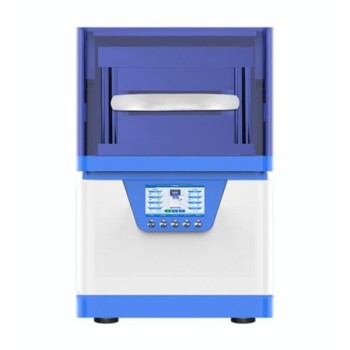
The laboratory hot press furnace serves as the critical enabler for joining beryllium and copper by simultaneously applying precise high heat and axial pressure. This dual-action environment is the only way to drive the atomic diffusion necessary to create a unified composite from these two distinct metals.
Core Insight: The furnace does not merely hold the materials together; it actively forces the mutual migration of atoms across the interface. By overcoming surface energy barriers, the hot press transforms a physical meeting point into a solid, metallurgical bonding layer.
The Mechanics of Diffusion Bonding
Overcoming Surface Energy Barriers
Beryllium and copper possess natural energy barriers at their surfaces that resist bonding. The furnace overcomes this by generating a controlled high-temperature environment. This thermal energy excites the atoms, making them mobile enough to bridge the gap between the materials.
The Role of Axial Pressure
Heat alone is often insufficient for dissimilar metals; physical force is required. The furnace applies axial pressure along the vertical axis of the sample. This pressure ensures intimate contact at the microscopic level, reducing voids that could impede the movement of atoms.
Facilitating Atomic Migration
The combination of heat and pressure triggers the mutual diffusion of atoms. Copper atoms migrate into the beryllium structure, and beryllium atoms migrate into the copper. This migration is the fundamental mechanism that creates the actual bond.
Creating the Metallurgical Interface
Formation of the Bonding Layer
The result of this process is not a simple adhesion, but the creation of a metallurgical bonding layer. This layer consists of an alloyed region where the two materials have chemically interacted. The structural integrity of the final composite depends entirely on the quality of this new layer.
Precision and Control
The laboratory hot press furnace allows for the precise regulation of the bonding layer's thickness. By adjusting the temperature and pressure duration, operators can control how deep the diffusion extends. This control is essential for tailoring the mechanical properties of the final beryllium-copper composite.
Understanding the Trade-offs
Environment Control vs. Oxidation
While the primary goal is diffusion, the "controlled environment" mentioned in technical literature often implies the need to manage oxidation. If the furnace atmosphere is not strictly controlled (often requiring vacuum or inert gas), oxides can form at the interface. Oxide layers act as a barrier, halting atomic diffusion and resulting in a weak or failed bond.
Pressure Limitations
Applying pressure is a balancing act. Insufficient pressure fails to close microscopic gaps, preventing atom-to-atom contact. However, excessive pressure at high temperatures can cause unwanted macroscopic deformation of the copper or beryllium components, distorting the final shape of the part.
Making the Right Choice for Your Goal
When configuring a laboratory hot press furnace for beryllium-copper composites, your parameter settings dictate the outcome.
- If your primary focus is Maximum Bond Strength: Prioritize higher temperatures to maximize atomic mobility and ensure deep diffusion, but ensure the environment is strictly controlled to prevent oxidation.
- If your primary focus is Dimensional Accuracy: Limit the axial pressure to the minimum required for contact to prevent plastic deformation of the softer metal components.
- If your primary focus is Interface Uniformity: Extend the hold time at a moderate temperature rather than increasing heat, allowing diffusion to occur gradually and evenly.
The success of beryllium-copper diffusion bonding relies ultimately on the precise synchronization of thermal energy and mechanical force to engineered specifications.
Summary Table:
| Parameter | Role in Diffusion Bonding | Impact on Beryllium-Copper Composites |
|---|---|---|
| High Temperature | Excites atomic mobility | Overcomes surface energy barriers to trigger mutual migration |
| Axial Pressure | Ensures intimate contact | Closes microscopic voids and reduces the diffusion path distance |
| Environment | Vacuum or Inert gas | Prevents oxidation layers that act as barriers to bonding |
| Hold Time | Regulates diffusion depth | Controls the thickness and uniformity of the metallurgical interface |
| Control Precision | Balances force and heat | Prevents macroscopic deformation while maximizing bond strength |
Elevate Your Material Science with KINTEK Precision
Achieving the perfect metallurgical bond requires more than just heat; it requires the absolute precision of KINTEK laboratory hot press furnaces. Whether you are working on advanced beryllium-copper composites or complex ceramic-metal joins, our equipment provides the exact synchronization of axial pressure and thermal control needed for superior diffusion bonding.
Beyond our industry-leading hot press and isostatic systems, KINTEK specializes in a comprehensive range of laboratory solutions, including:
- High-Temperature Furnaces: Muffle, tube, vacuum, and atmosphere-controlled options.
- Sample Preparation: Crushing, milling, sieving, and high-performance hydraulic pellet presses.
- Specialized Reactors: High-temperature high-pressure reactors and autoclaves for demanding chemistry.
- Advanced Research Tools: Electrolytic cells, battery research consumables, and precision cooling solutions like ULT freezers.
Ready to optimize your bonding parameters? Contact KINTEK today to discover how our high-precision furnaces and consumables can enhance your lab's research efficiency and material integrity.
References
- B. V. Syrnev, O. V. Semilutskaya. Establishing theoretical foundations for predicting the structural and morphological characteristics of diffusion-welded joints of the beryllium–copper composite. DOI: 10.17073/1997-308x-2024-2-14-22
This article is also based on technical information from Kintek Solution Knowledge Base .
Related Products
- Heated Hydraulic Press Machine with Heated Plates Split Manual Laboratory Hot Press
- 30T 40T Split Automatic Heated Hydraulic Press Machine with Heated Plates for Laboratory Hot Press
- Automatic Heated Hydraulic Press Machine with Heated Plates for Laboratory Hot Press
- 24T 30T 60T Heated Hydraulic Press Machine with Heated Plates for Laboratory Hot Press
- Automatic Heated Hydraulic Press Machine with Heated Plates for Laboratory Hot Press 25T 30T 50T
People Also Ask
- How does a laboratory hot press contribute to LATP/polymer composite electrolytes? Achieving Dense, High-Conductivity Films
- Why is a laboratory hot press necessary for all-solid-state battery assembly? Reduce Impedance and Enhance Performance
- What is the physical mechanism for sintering Cu-Cr-Nb powders? Overcoming Oxide Barriers with Hydraulic Loading
- How does a laboratory hot press improve alloy performance? Optimize Liquid Phase Sintering for High-Strength Materials
- What is the purpose of a laboratory hot press in the encapsulation stage of solar cell assembly? Ensure Hermetic Seals