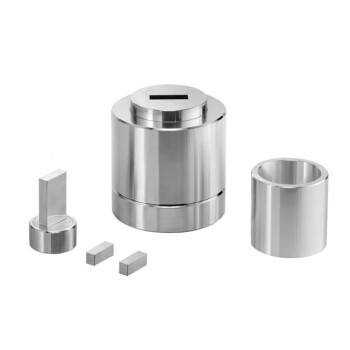
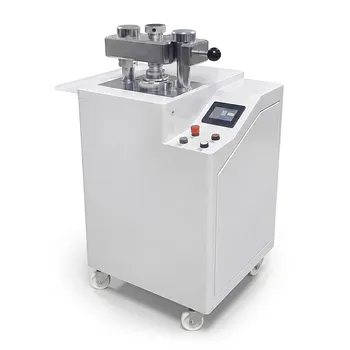
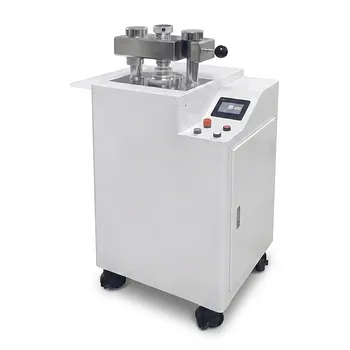
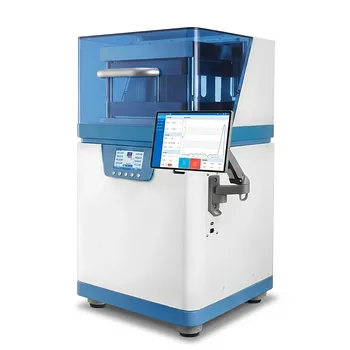
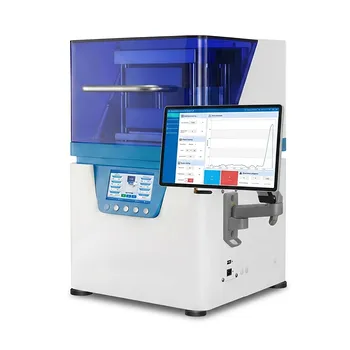
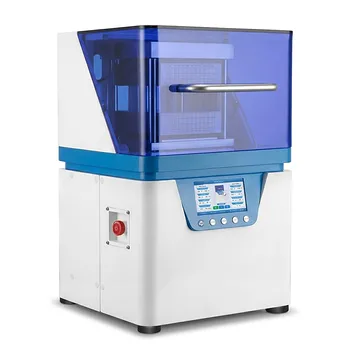
A critical tool for molecular clarity, the laboratory hydraulic press and KBr pellet die are used to transform opaque biochar into a transparent, thin disk suitable for infrared spectroscopy. By compressing a minute amount of biochar with spectroscopic-grade potassium bromide, these tools create a uniform medium that allows an infrared beam to penetrate the sample, enabling the precise identification of chemical functional groups and bonding mechanisms.
The core role of the hydraulic press and KBr die is to eliminate light scattering and ensure sample transparency, which is a fundamental requirement for obtaining high-resolution FTIR spectra of carbonaceous materials like biochar.
The Necessity of Transparency in FTIR
Overcoming Biochar Opacity
Biochar is a naturally dark, carbon-rich material that strongly absorbs infrared radiation. If analyzed in its raw, loose form, the infrared beam cannot penetrate the particles, resulting in a "blackout" where no usable data is recovered.
Creating a Uniform Optical Path
The hydraulic press compresses the sample into an extremely thin disk, often around 0.5mm thick. This uniformity is essential for the standardized calculation of the Area Under the Curve (AUC) and peak heights, allowing for quantitative comparisons between different biochar samples.
KBr as a Spectroscopic Carrier
Potassium Bromide (KBr) is used because it is optically transparent in the infrared range. When combined with biochar under high pressure, KBr acts as a window, holding the trace sample particles in a fixed position while allowing the IR beam to pass through and reach the detector.
The Mechanics of Pellet Formation
High-Pressure Densification
The hydraulic press typically applies approximately 20 MPa (or roughly 6 tons) of pressure to the mixture. This force is necessary to physically fuse the KBr powder and biochar into a solid, semi-transparent pellet that mimics a single optical crystal.
Eliminating Internal Light Scattering
A primary goal of the pressing process is to remove air pockets between the powder grains. By eliminating these voids, the press minimizes light scattering, which ensures that the infrared radiation can pass directly through the sample to capture subtle molecular vibration signals.
Precision Timing and Pressure
Standardized protocols often require applying pressure for a specific duration, such as 5 minutes, to ensure physical stability. This consistency ensures that the resulting pellet is robust enough to be handled and placed in the spectrometer without fracturing.
Analytical Outcomes for Biochar Research
Identifying Functional Groups
This preparation method allows researchers to clearly detect oxygen-containing functional groups, such as C=O (carbonyl) and -OH (hydroxyl). These groups are primary indicators of how the biochar will behave in environmental applications.
Mapping Chemical Modifications
By producing high-quality pellets, scientists can observe how chemical bonds change after the biochar undergoes modification or adsorption processes. This is critical for identifying signals related to Mg-O, Mg-OH, and phosphate groups in specialized biochar variants.
Understanding Adsorption Mechanisms
FTIR analysis of these pellets reveals the "fingerprint" of the biochar surface before and after it interacts with pollutants. This allows for a clear understanding of the adsorption mechanisms, such as ion exchange or surface complexation, that occur during water or soil treatment.
Common Pitfalls to Avoid
Moisture Interference
KBr is hygroscopic, meaning it rapidly absorbs moisture from the air. If the pellet-making process is not performed in a controlled environment, water peaks can appear in the spectrum, potentially masking the -OH groups inherent to the biochar itself.
Sample-to-Bromide Ratio
Using too much biochar will make the pellet too dark, preventing light transmission, while using too little may result in a weak signal-to-noise ratio. Achieving a consistent dilution (typically 1% sample to 99% KBr) is vital for reproducible results.
Incomplete Grinding
If the biochar and KBr are not thoroughly ground into a fine, homogeneous powder before pressing, the resulting pellet will be "speckled." This lack of homogeneity leads to non-linear light absorption and can distort the resulting spectral peaks.
Making the Right Choice for Your Goal
How to Apply This to Your Project
- If your primary focus is quantitative analysis: Ensure you use a calibrated hydraulic press to maintain identical pressure and thickness across all samples for accurate peak height comparisons.
- If your primary focus is identifying trace surface groups: Use high-purity, spectroscopic-grade KBr and perform the pressing in a low-humidity environment to prevent moisture contamination.
- If your primary focus is studying adsorption mechanisms: Prepare pellets of both the raw and spent biochar using the exact same KBr-to-sample ratio to clearly visualize the shift in chemical bond vibrations.
By mastering the use of the hydraulic press and KBr die, you ensure that your FTIR data is a true reflection of the biochar’s chemical architecture rather than an artifact of poor sample preparation.
Summary Table:
| Component | Role in FTIR Analysis | Key Benefit |
|---|---|---|
| Hydraulic Press | Applies ~20 MPa pressure to densify powder | Minimizes light scattering by removing air pockets |
| KBr Pellet Die | Compresses mixture into a 0.5mm thin disk | Ensures a uniform optical path for quantitative AUC |
| KBr Matrix | Acts as an optically transparent carrier | Allows IR beam penetration through opaque biochar |
| Sample Dilution | Mixes trace biochar (1%) with KBr (99%) | Prevents signal "blackout" and enables signal detection |
Achieve Superior Molecular Clarity with KINTEK
Precise FTIR analysis of biochar requires more than just a spectrometer—it demands flawless sample preparation. KINTEK specializes in high-performance laboratory equipment designed to help researchers achieve the highest signal-to-noise ratios. From our precision laboratory hydraulic presses (pellet, hot, and isostatic) and KBr pellet dies to our specialized crushing and milling systems, we provide the tools necessary to transform opaque samples into transparent optical disks.
Why partner with KINTEK?
- Precision Engineering: Ensure repeatable pressure and thickness for accurate quantitative comparisons.
- Comprehensive Solutions: Our portfolio includes high-temperature furnaces (CVD, PECVD, vacuum), high-pressure reactors, electrolytic cells, and essential consumables like PTFE and ceramics.
- Research Focused: We support battery research, environmental science, and material engineering with reliable, durable equipment.
Don't let poor sample preparation compromise your data. Contact us today to find the perfect pellet-pressing solution for your lab!
References
- Xiaomei Wu, Rilong Yang. Adsorption characteristics and mechanism of ammonia nitrogen and phosphate from biogas slurry by Ca2+-modified soybean straw biochar. DOI: 10.1371/journal.pone.0290714
This article is also based on technical information from Kintek Solution Knowledge Base .
Related Products
- Automatic Laboratory Hydraulic Press for XRF & KBR Pellet Press
- Laboratory Hydraulic Pellet Press for XRF KBR FTIR Lab Applications
- kbr pellet press 2t
- Laboratory Hydraulic Press Split Electric Lab Pellet Press
- Laboratory Hydraulic Press Lab Pellet Press Machine for Glove Box
People Also Ask
- What is the significance of applying 200 MPa of pressure with a laboratory hydraulic pellet press for composite ceramics?
- What is the role of a laboratory hydraulic pellet press and stainless steel molds in the fabrication of RuO2/NbC anodes?
- How does a laboratory hydraulic pellet press contribute to SiCw/2024 aluminum composite preforms? Optimize Densification
- What is the necessity of using a laboratory hydraulic pellet press in the preparation of biomass fuel pellets? Guide
- What is the function of a laboratory hydraulic pellet press in supercapacitor electrode fabrication? Optimize 3D VNCN.